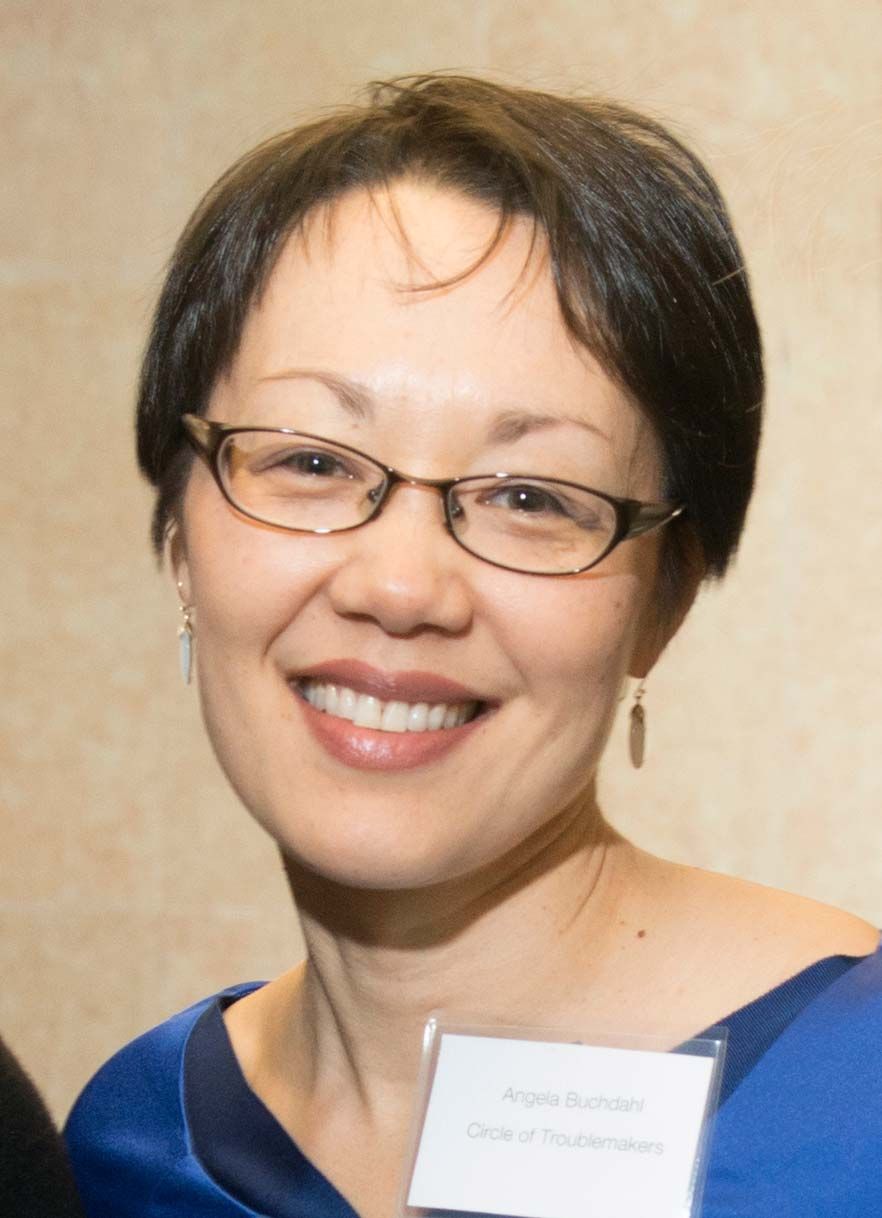
Angela Buchdahl
Rabbi
13
APPEARANCES
9
PODCASTS
Sep 9, 2026


Andrés SpokoinyHOST
But before me glossing over it, why don't you tell us something If you had to describe the main thrust of your book, how would you describe it?

Angela BuchdahlGUEST
I was born in South Korea, but I was born a biracial child of a Jewish father and a Korean Buddhist mother.
Angela BuchdahlGUEST
So I wasn't a citizen of the country I was born in, even with a Korean mother.
Angela BuchdahlGUEST
And I was aware of the fact that I was different than other Korean children.
10 MINS LATER
16:45

But just your take on these two stories and the fact they land for us on Rosh Hashanah, why, what it means, what we should take from them.
Angela BuchdahlGUEST
So I often, especially for people who are not Jewish, I think a big question could be, why do you read the same exact passages every year? Why don't
Angela BuchdahlGUEST
And I always appreciate that the same exact story something else comes out every year that's different.
14 MINS LATER

Yonit LeviHOST
Could you tell us a little bit about, you know, what happened, how you as a community reacted to this? How are you, I assume, still reeling from that attack?

Stephen DubnerHOST
Because it feels like it might be better left unsaid, but I'm curious how you manage that.
Angela BuchdahlGUEST
You know, I, um- It's difficult, but I, a- and I never have pursued fame for its sake.
Angela BuchdahlGUEST
Um, I have a message that I wanna share, and I've always felt like I wanna get this out to a wide as audience as possible.
Angela BuchdahlGUEST
I actually would like to be more anonymous, um, when I'm walking in the street.
8 MINS LATER
Stephen DubnerHOST
So what's your best pitch?


Angela BuchdahlGUEST
I think that when Jews feel under threat and behave out of a place of fear, we often react in ways that build bigger walls.
Angela BuchdahlGUEST
So that switch that happens from patrilineal descent to matrilineal descent, it's not a coincidence that it happens kind of around the time of Ezra when Jews are coming back, but they're, only the remnant is really coming back.
Angela BuchdahlGUEST
You were allowed to come back, um, you know, in the time of the Second Temple, and Ezra basically says, "We see all these intermarried Jews." And he feels that's so threatening at a time when he thinks Judaism is disappearing-
Angela BuchdahlGUEST
And I think that, um, what I've really come to appreciate is Judaism was built for crisis.
Angela BuchdahlGUEST
So much of our liturgy of the holidays that we just celebrated together, um, were born out of times when Jews were martyred, uh, like the martyrology or Unetaneh Tokef or Kol Nidre, which was about when people had to make vows that they didn't, they couldn't keep 'cause they were done under duress.


Angela BuchdahlGUEST
Now, you can also become a Jew through conversion, um, which is a process that, of learning and then of also having a group of three rabbis and having a thing.
Angela BuchdahlGUEST
Anyway, now, um- I would like to just add a, like a little historical footnote that in the time of the Bible, if you read the Bible, there the identity was actually patrilineal- Huh ... meaning like it was about your father.
Angela BuchdahlGUEST
I say this just to say that like I don't know exactly- It's maternal ... why this has been the, you know- Yeah ... why do we now make this all about ma- m- maternal.
15 MINS LATER


Stephen DubnerHOST
'Cause it feels like it might be better left unsaid, but I'm curious how you manage that.
Angela BuchdahlGUEST
Um, I have a message that I wanna share, and I've always felt like I wanna get this out to a wide as audience as possible.
8 MINS LATER

Dave DeStenoHOST
So what are the guardrails on doubt and inquiry that lead it to become constructive rather than destructive?
Angela BuchdahlGUEST
So I think when you are doubting and debating, there are a few guardrails that Judaism brings in.
Angela BuchdahlGUEST
The first is when you are learning and studying and doubting, you aren't doing it by yourself.
Angela BuchdahlGUEST
So to begin with, you are already kind of assigned a dialogic sparring partner for coming up with your thoughts.
11 MINS LATER
Angela BuchdahlGUEST
Well, in the most traditional way it is the Sabbath and the, the, the Jewish protocols around Sabbath is if you wanna make this a, a holy day, a sacred day, you have to set it apart.
Angela BuchdahlGUEST
And one of the ways, um, sort of more traditional ways is, of course, you have a meal, you can go to services at it, at...
Angela BuchdahlGUEST
But even people who don't go to services, they generally have large family and friends over for, um, a Friday night meal and a Saturday lunch over the Sabbath which begins sundown Friday to sundown Saturday.

Dana PerinoHOST
What would you tell people about that concern, maybe e- from people in your own synagogue or in your community, and do we have a chance to make it better?

Angela BuchdahlGUEST
Um, well, just a little background because I think that any, any, um, one who is a Christian, Muslim, or Jew who descends from the, you know, the children of Abraham, we all share an origin story.
Angela BuchdahlGUEST
The origin story in the Bible is that when Abraham is called to begin the Hebrew peoples, he's actually called by God, "Leave your birth place, your home and, and go to this place that I will show you and you will be a blessing." And, and when he crosses over, the word in Hebrew for crossing over, Ya'avor, is where the word Ivri comes from.
Angela BuchdahlGUEST
And there's a sense that God doesn't allow Abraham to become or create Judaism from a place of comfort and home, that he has to actually know what it's like to feel like a stranger.
6 MINS LATER
Angela BuchdahlGUEST
Yes, well, in the most traditional way, it is the Sabbath and the, the, the Jewish protocols around Sabbath is if you wanna make this a, a holy day, a sacred day, you have to set it apart.
Angela BuchdahlGUEST
And one of the ways, um, sort of more traditional ways is, of course you have a meal, you can go to services, at a, at...
Angela BuchdahlGUEST
But even people who don't go to services, they generally have large family and friends over for, um, a Friday night meal and a Saturday lunch over the Sabbath which begins sundown Friday to sundown Saturday.
Angela BuchdahlGUEST
No phones, no TV, um, which, boy, is that, the electronic Sabbath is such a key right now-
Dana PerinoHOST
What would you tell people about-... that concern maybe e- from people in your own synagogue or your near community? And do we have a chance to make it better?


Angela BuchdahlGUEST
I couldn't think of something that would feel more meaningful, challenging, interesting.
Angela BuchdahlGUEST
Like, I wanted to be immersed in the questions that rabbis get to think and talk about.
Angela BuchdahlGUEST
I was like, "I can't believe there's a job in which that's what you get to do.
Angela BuchdahlGUEST
Immerse yourself in these texts, be with people, and think about big questions of life." Like, that, I couldn't believe that's something you get to do.
11 MINS LATER

45:21
I'm just interested to know, partly because you've got such a large community, so there must be a real, by just numbers, there has to be a range of views there, h- what are you doing to keep people together even as you have these yourself, your own very, you know, deeply held strong views on this subject?
Angela BuchdahlGUEST
Um, I have an incredibly diverse congregation and it's demographically, geographically diverse, even religiously diverse, 'cause I have a number of non-Jews, you know, connected to Jews in the community that are part here- part of it, racially diverse.
Angela BuchdahlGUEST
Also ideologically, politically diverse, which by the way, in America, is rarer than you would think.
Angela BuchdahlGUEST
Um, we have basically lost the spaces where people who had ideological and political differences would gather together.
Angela BuchdahlGUEST
Uh, you know, churches have been disintegrating, synagogues as well, the- the- the kind of social clubs that would bring people across difference together have, have, have started to disappear.
Angela BuchdahlGUEST
People are siloing into their bubbles, as you know, um, so I actually think that this is a sacred obligation to keep this ideologically diverse community as one, and I think it's important for, uh, our democracy here in America that people do this for our Jewish souls, um, and I know that having people who are pushing at me from, from different ends of this spectrum, uh, helps keep me more intellectually honest, honestly, because I am constantly thinking from the perspective of where they're coming from.
Angela BuchdahlGUEST
(music jingle) I'm constantly thinking, "How do I, um, articulate the view I don't agree with, uh, in the most respectful, strongest way possible?" Because by the way, that's Jewish (laughs) to do it that way.
6 MINS LATER
53:22
So, I thought if you could, you could tell us about the gloss you put on this phrase, (...), which has become famous as a song, and then, because traditions must be observed, if you would then sing this rather beautiful song for us.
Angela BuchdahlGUEST
This question of do we celebrate, how do we celebrate, I guess it's not a new question.
Angela BuchdahlGUEST
In many ways, this is the question we've been asking ourselves since October 7th.
Angela BuchdahlGUEST
He was taken into captivity and they had their youngest son's bar mitzvah the next week.
Angela BuchdahlGUEST
They had one son, he was shot, and another one in captivity, and he had a wedding.
6 MINS LATER