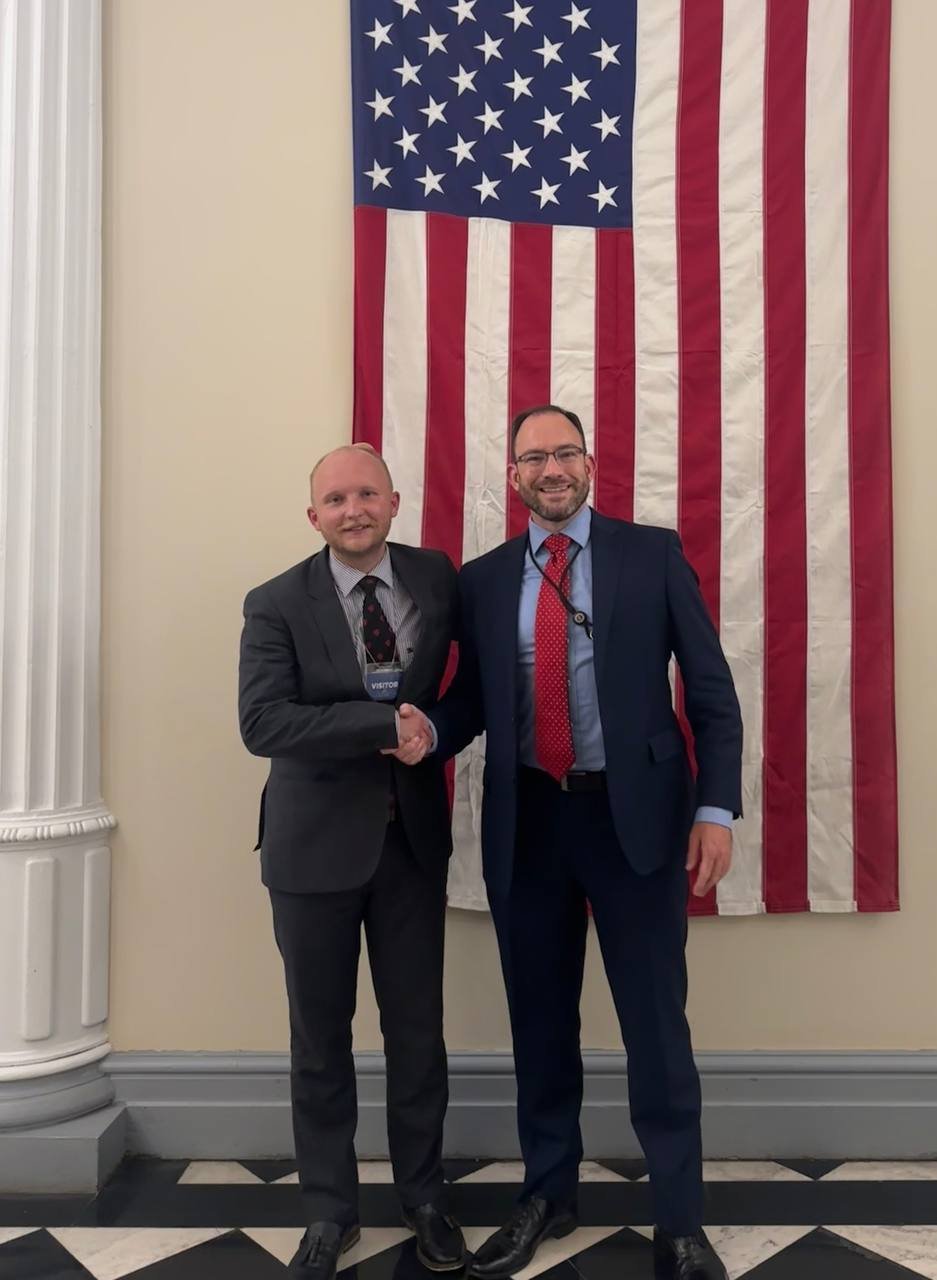
Andy Baker
Deputy National Security Advisor of the United States
9
APPEARANCES
9
PODCASTS
Aug 25, 2026


Andy BakerGUEST
We-- I spoke at a transport tech conference, um, a couple of months ago, and I'd sort of did a little bit of work on this.
Andy BakerGUEST
We actually are operating and piloting some very, very, uh, unique and, and good, um, um, technology, things like AI.
Andy BakerGUEST
Um, we've got an AI pilot, um, which is all about it looks at an, um, at a, at an intersection in real time and then runs through thousands of different scenarios in terms of how the, the lights might phase, uh, in, um, as to what the real-time issue is.
Andy BakerGUEST
And the, at the pilot sites, we've had about a nine percent improvement in travel time.

speaker_0NARRATOR
For more content like this, please visit PTP 365.
Andy BakerGUEST
Well, ladies and gentlemen, on a personal note, this is my very first assigned topic that I've ever had to speak at at Polishing the Pulpit, and I'm going to resist the urge to lead a song.
Andy BakerGUEST
As we begin, the title of the sermon for those maybe listening online is 21st Century Challenges for Every Christian, Building Community in a Crowd of Followers.
Andy BakerGUEST
And my children looked at me when I told them that, and they said, what does that mean? And I said, that's a great question.
Andy BakerGUEST
You look at the subtitle or the tag on it, and it says, thousands of connections cannot replace one real friend in Christ.
Andy BakerGUEST
The way that I read the lesson and what I'm going to be talking about this hour is simply this, 21st Century Challenges for Every Christian, How to Be a Friend and How to Make Friends 101.

Andy BakerGUEST
you?You know, I've had a lot of moments in my life where my music- musical perspective changes, but I think the catalyst for me was my parents both love music.
Andy BakerGUEST
They love different types of music, but my dad was always playing classic rock, and, uh, you know, he got me a little MP3 player, and on that had, like, every Led Zeppelin song, and I just wanted to be John Bonham, like, ever since I was a little kid, and I would, like, learn all the songs.
12 MINS LATER
Jeremiah HigginsHOST
Uh, so my next question, um, as a percussionist, in one word, can you describe the musical chemistry that you share with Spencer and his, and his rhythm on the guitar? You guys have gotta probably be in sync there, right?
Andy BakerGUEST
Like, when we do our live shows, we really love to kinda open sections up, and we really have to listen to each other a lot and lock in.
Andy BakerGUEST
But, like, you know, the gauge for telling if we're locked in is just, like, looking at the audience, and if somebody's not, like, bobbing their head or, like, tapping their foot, that means we gotta lock in.


Tom RogersHOST
What, what you would do if, you know, when I go back to my school, and I'm teaching a class of 30, and I ask a child to do something, and they're rude to me, and they answer back in front of the class, what do you want me to do?
Andy BakerGUEST
F- completely fair question, Tom, and the one thing I'd sort of say on the situation, the initial part was not a judgment of the teacher.
Andy BakerGUEST
I completely agree, and I think this is where when we're talking about the, the preventative, uh, th- that Maria, uh, keeps referring to that, it isn't just about like will teachers need to bear policy.
Andy BakerGUEST
It's also like, well, if teachers' nervous systems are dysregulated, like how are they being supported? What better...
Andy BakerGUEST
You know, how are they able to cope with these very, very difficult situations? And therefore, because I, I often refer to when we're looking at behavior that we find challenging, if we make a list, sometimes if I spend a whole le- you know, a whole training session on delivering training, clicking a pen, quite a few people will find that challenging, even if I'm doing it as a way of regulating my, my emotions, for instance.
Andy BakerGUEST
It's still challenging, and it's the little things that sometimes add up over a period of time that then meaning, mean the bigger behaviors aren't handled as ideally as we would like them to.
8 MINS LATER
Tom RogersHOST
in your ideal world, and I'll ask everybody this, in your ideal world, what would that look like and how would that bit work?


Andy BakerGUEST
So for me personally, I will l- I will gain back about an hour in my day, um, from, uh, from just being able to travel to a closer train station and then get off closer to my work, um, in town.
Andy BakerGUEST
Um, but also, you know, the, each station, the, the capacity for car parking in the park and ride overall is 1,500 car parks spread across the three, um, the three stations in time.
Andy BakerGUEST
So the, the two, um, stations that open on the weekend have got an initial parking allotment of 350 car parks each.
Andy BakerGUEST
Um, and so, you know, accessibility, um, for those who aren't on public transport networks and who want to use the trains to get in and out of town, um, will be, uh, hugely enhanced.


Andy BakerGUEST
Um, most people would potentially claim that they're not prejudiced, for instance, but then you can do loads of subconscious tests and see actually you're prejudiced all over the place.
Andy BakerGUEST
We have to recognize that 95% of our thinking is completely subconscious or non-conscious.
25 MINS LATER


Andy BakerGUEST
mean? Yeah, I think there's both challenges and opportunities and lots of it ties into what we've already talked about in terms of those...
Andy BakerGUEST
broadcast spikes won't be as big, right? With some exceptions around England games and other home nation games.
Andy BakerGUEST
But, you know, the sort of classic kind of passive broadcast experience of, you know, the game's on in the office or I'm watching it whilst working from home.
Andy BakerGUEST
etc that isn't there i've personally been struggling to stay awake for those 11 o'clock kickoffs so so what that means is that as you as we were talking about is that this sort of catch-up moment in the morning is is super important and there's so many layers to that right in terms of whether it's straight highlights or it's your creator hot takes or it's a daily podcast or it's whatever right and that is i think a real opportunity for brands right in that there is a kind of more of a proliferation of where that kind of iconic moment will be lots of people will have you know you found out about Messi's hat trick at, you know, seven o'clock this morning, not when it happened, right? So the moments are still there, but it's like they've shifted and they've spread in terms of how people consume them.
Andy BakerGUEST
And obviously there's the kind of, you know, WhatsApp conversations and Snapchat messages, et cetera, alongside all of the curated media.
5 MINS LATER


Andy BakerGUEST
like putting somebody in a stock and flowing things at them used to stop people from stealing.
16 MINS LATER


Andy BakerGUEST
So the adaptive caregiver model came out of, so my other book is Targeting the Positive, and I wrote that nearly, that's been out for a few years now, a couple of years.
Andy BakerGUEST
And there is a premise under there about high levels of empathy and high levels of focusing on what people can do rather than what people can't do.
Andy BakerGUEST
Focusing on the behavior you want rather than focusing on the behavior you can't.
Andy BakerGUEST
And it's a complete shift or it's a shift in mindset for most people regarding understanding behavior or looking to a change or improve relationships or the quality of outcomes for individuals we're supporting or caring for.
Andy BakerGUEST
What I noticed in the dementia field, I've been working in the dementia field a significant period of time.
28 MINS LATER
33:26
But from your perspective, what's one of the most important things that you think that individuals new to care need to know?