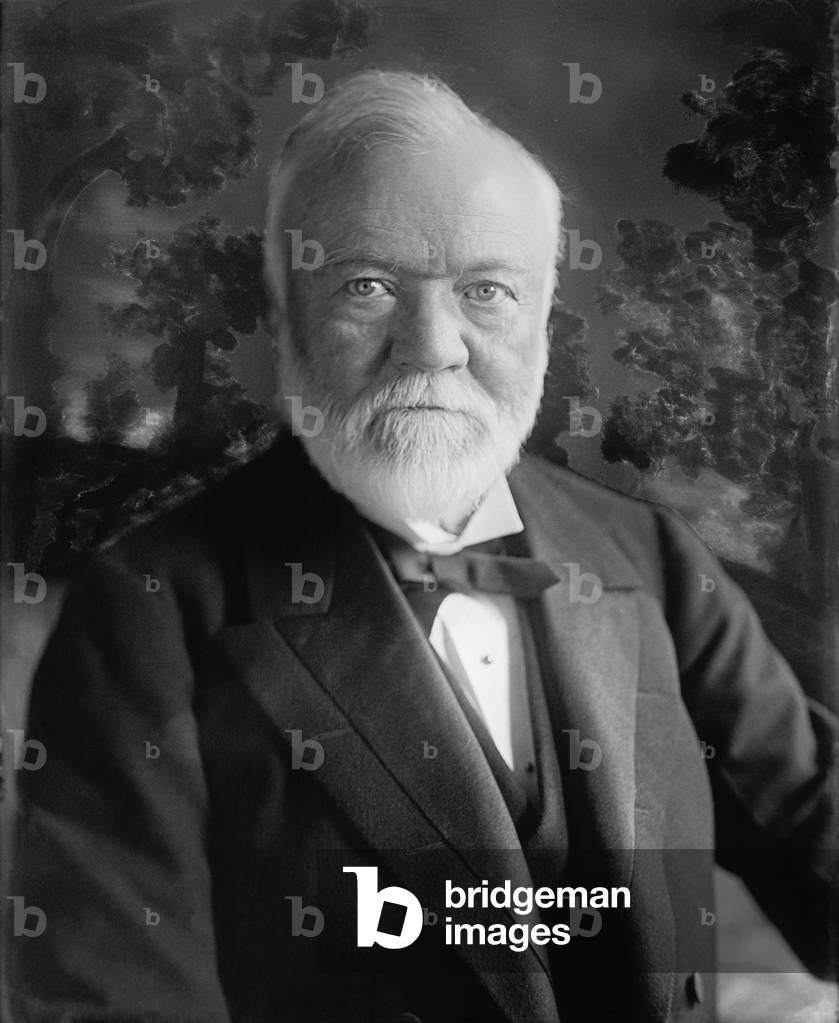
Andrew Carnegie
Scottish-American industrialist and philanthropistWikipedia
489
MENTIONS
193
EPISODES
172
PODCASTS
Search complete. 489 mentions across 193 episodes found for "Andrew Carnegie".
Oct 29, 2026

Mark SierensGUEST
Some people complain about that later.
Mark SierensGUEST
But it was actually built by Andrew Carnegie for his mom.
Mark SierensGUEST
And then she passed.
Mark SierensGUEST
Uh, he donated the entire site to the state of Pennsylvania for a dollar, um, conditions that have become a sanatorium.

David StrassmanHOST
We know exactly where.
David StrassmanHOST
He's at the Carnegie Museum of Natural History.
David StrassmanHOST
Do you want to just introduce him? And then we'll go straight to the interview that you walked through the vaults of the famous Carnegie Museum with Matt LaManna in the halls, in the back rooms.
David StrassmanHOST
We'll go straight to Matt LaManna.
Ray TrollHOST
Yeah, Matt LaManna, vertebrate paleontologist.
Ray TrollHOST
He has spent most of his career at the Carnegie Museum of Natural History in Pittsburgh, Pennsylvania, where I was on June 12th.
Ray TrollHOST
And I wandered through the halls with him.
Ray TrollHOST
And then we went into the back rooms.

Brian ParkHOST
I didn't know that.
Brian ParkHOST
Yeah, Andrew Carnegie.
Dan RosenHOST
They did some great shit.
Dan RosenHOST
Who really cares about how they broke strikes and were cruel and titans of industry and had monopolies? I mean, it's really where we're at now because Zuckerberg's just buying

William TomkoNARRATOR
He still remains, in a sense, an enigma, for it seems possible that the smiling face he has lately turned to the world conceals the real man more effectively than the frowning countenance he wore in former years.
William TomkoNARRATOR
As the dramatist saves his finest effect for the fall of the curtain, so we have saved for the last the most remarkable giver in history, Andrew Carnegie, whose total benefactions amount to at least 100 millions of dollars.
William TomkoNARRATOR
A sum so stupendous would bankrupt many a nation.
William TomkoNARRATOR
Yet Mr. Carnegie is so far from bankrupt that his gifts show no sign of diminution.
William TomkoNARRATOR
The story of how, starting out as a poor boy on the lowest round of the ladder, he acquired this immense fortune is a striking one.
William TomkoNARRATOR
Andrew Carnegie was born in Scotland in 1835.
William TomkoNARRATOR
His father was a weaver, at one time fairly well-to-do, for he owned four hand looms.
William TomkoNARRATOR
But the introduction of steam ruined hand loom weaving, and after a long struggle ending in hardship and poverty, the looms were sold at a sacrifice and the family set sail for America.

Russell BrunsonHOST
In 1908, the richest man in the world, Andrew Carnegie, offered a broke young reporter a 20-year mission with zero pay while secretly timing his answer with a stopwatch.
Russell BrunsonHOST
Longer than 60 seconds, the offer was gone.
Russell BrunsonHOST
Napoleon Hill said yes in just 29.
Russell BrunsonHOST
He worked for a guy named Bob Taylor.
Russell BrunsonHOST
And Bob Taylor had a magazine.
Russell BrunsonHOST
And as the story goes, Napoleon got a commission to go and actually interview the richest man in the world, Andrew Carnegie.
Russell BrunsonHOST
The interview was scheduled for just three hours, but because him and Carnegie kind of hit it off, the interview actually lasted for three full days.
Russell BrunsonHOST
And at the end of these three days, Carnegie and Hill were sitting down at their desk, and Andrew Carnegie, he offered Napoleon Hill an opportunity.

Jay DyerHOST
I want to if I recall this, didn't the CDC say something like we are basically just following the the guidelines of the Rockefeller Foundation? What? Remember that? Why? Why are we following a global influence think tank operation for medical advice? It made no sense.
Jay DyerHOST
That'd be like saying, how do you get your health advice? Oh, I just asked Andrew Carnegie.
Jay DyerHOST
What? Andrew, why would you? Well, because he runs Giant Foundation, so clearly he knows how to be healthy.
Jay DyerHOST
How is the audio janky? It should be fine.

Joni EdelmanGUEST
Midwives were attending births, and that was how birth was.
Joni EdelmanGUEST
And then J.D. Rockefeller, Andrew Carnegie, right, they founded the first medical schools.
Joni EdelmanGUEST
They wanted to – They were founding that, so they were creating the education.
Maddie MilesHOST
And

Kingsley AikinsGUEST
and made a fortune.
Kingsley AikinsGUEST
But he was a disciple of Andrew Carnegie, who was the great Scottish philanthropist.
Kingsley AikinsGUEST
All our libraries in Ireland are built by Carnegie.
Kingsley AikinsGUEST
And Carnegie had this notion of, you know, he had a great line, he said, to die rich is to die disgraced.

Chris MarkowskiHOST
They did, okay? You know, let me ask you a question, Robert.
Chris MarkowskiHOST
How many Robert Reich libraries are at colleges and universities that you paid for? How many libraries and buildings did Andrew Carnegie donate with his hard-earned dollars all over the country? So stop.
Chris MarkowskiHOST
Already, okay? Enough.
Chris MarkowskiHOST
And Musk, he says, represents the power of oligarchy in America over democracy.

Don SpielisHOST
I'm talking about the Gilded Age, the late 19th century when industrial fortunes were growing at an astonishing rate.
Don SpielisHOST
Railroads, steel, oil, banking, men like John D. Rockefeller and Andrew Carnegie and JP Morgan, These guys accumulated wealth on a scale that was difficult for ordinary Americans to comprehend.
Don SpielisHOST
And with that wealth came political influence.
Don SpielisHOST
Railroad companies, for example, had enormous interests in government decisions involving land, regulation, taxation, and transportation.
183 more episodes mention Andrew Carnegie.
Create an account to see the whole feed, search across every transcript, and follow the entities you care about.