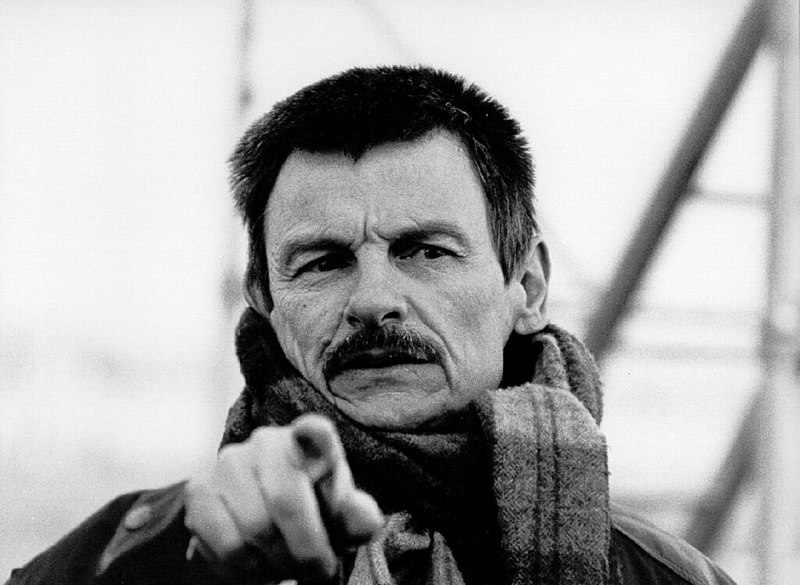
Andrei Tarkovsky
Soviet film director and screenwriterWikipedia
111
MENTIONS
69
EPISODES
63
PODCASTS
Search complete. 111 mentions across 69 episodes found for "Andrei Tarkovsky".
Nov 10, 2026

Jeffrey CranorHOST
mad because not only is that way cheaper which means more movies can be funded but there are certain scenes you just can't do practical lighting for like let's say a car chase or a car just driving through a city digital post really helps here but like any tool digital effects can start to feel like too much of a cheat i mean 95 of what netflix produces look so very, very plain and cheaply made.
Jeffrey CranorHOST
But they're not out here trying to develop the next Tarkovsky or Fellini.
Jeffrey CranorHOST
They're just trying to get crime dramas and rom-coms up en masse.
Jeffrey CranorHOST
The most cheaply slapped together shows and films these days feel like they're shot on a green screen in a WeWork break room and then dolled up later in Final Cut.

Angus TruskettHOST
Which one's stalker?
Geordie GrayGUEST
Tarkovsky.
Angus TruskettHOST
Oh yeah.
Angus TruskettHOST
Yeah.

Aaron GrossmanHOST
I was just going to really say then, sorry, just really quick.
Aaron GrossmanHOST
I think it reminds me a lot actually of Ivan's Childhood, which was Tarkovsky's debut, which was a war film.
Aaron GrossmanHOST
Similarly impressive at times and like Just watching it, you're like, oh, this director sort of has it.
Aaron GrossmanHOST
You know what I mean? I don't know.

Beth MartinHOST
1961 no
Andy YoungHOST
apparently the Tarkovsky book or the Tarkovsky movie is quite different to this film apparently they're both kind of drawing different elements from the book the other one is more about the original movie that is more about like religion and conforming to you know religious standards and things like that and that kind of pull between like religious belief and I suppose science and things like that um
Beth MartinHOST
I think, well, we can get into it, but I do feel like they're...
Beth MartinHOST
I definitely clocked some religious undertones.

QuinnPANELIST
I guess if you're talking to Beria, it's too late.
QuinnPANELIST
But it was like a Soviet pulp novel that Tarkovsky adapted into a movie that did not have aliens.
QuinnPANELIST
did kind of have the zone and uh the wish granter but the wish granter in the book is maybe not real that might just be psychosis uh it's the artifacts that are provably real which are in all probability just trash left by the aliens that people don't really understand um but you know dwarf our technology so immensely that they're still valuable um Tarkovsky made a movie about faith and like doubt that was very interesting and was not that took a couple of things from the books and ran with them.
QuinnPANELIST
The stalker games pull aesthetics from the tarkovsky film but for the most part like the the the whole anomalies and artifacts and um a kind of extracting out stuff through this like complicated mess is more from the the book than um than the the taroski film
StefanHOST
I think stalker is kind of a very distant adaption in the sense of answering the question of like, if there was a magic wish granter in Chernobyl in the collapsing Soviet Union and then like Ukraine in the 90s, what would people do and what would happen? And obviously the answer is people would kill each other over it.
QuinnPANELIST
nope skips a generation
StefanHOST
you'll pass on to your hypothetical children
QuinnPANELIST
sure nice no but this eventually culminates in Escape from Tarkov which is named after Tarkovsky pulls gameplay elements from the Stalker games.

Jani SarajärviHOST
When we think about cinema, cinema has been really, or some directors have been really skillful in this idea.
Jani SarajärviHOST
Andrei Tarkovsky wrote a book called Sculpting in Time.
Jani SarajärviHOST
His argument about what cinema actually is turns out to meet Bergson and Gibson quite nicely.
Jani SarajärviHOST
Tarkovsky said that cinema's unique art is not montage, it's not image, it is not story even.

DanHOST
Well, now I just changed my answer because this was inevitably going to find me at some point.
DanHOST
Um, Andre Tarkovsky is a cinema prayer.
DanHOST
I was due to watch that for a long time.
DanHOST
So I am a wildland firefighter.
DanHOST
So now, uh, I can have like, he reared his beautiful spiritual head.
JaredHOST
Now you're working for free.
DanHOST
But, uh, Andre Tarkovsky at cinema and prayer is sort of a documentary about his life and his work.
DanHOST
It was, uh, it was put together.

Gio PennacchiettiGUEST
Like we mentioned Bukinski, I would be remiss to not mention, um, the relationship to like late Soviet, uh, works of art and cinema as it pertains to the slow cracks that allowed for the metaphysical to come back.
Gio PennacchiettiGUEST
I mean, obviously Andre Tarkovsky, one of the best examples of that, you know, and, uh, but yeah, life as a global, uh, beach cafe, uh, That was the dream of us millennials that 9-11 had robbed us from, you know, because after that point, it was kind of all over.
Gio PennacchiettiGUEST
And now we have like, you know, global war on terror and, you know, the soldier eating, you know, eating first strike bars and drinking rippets and, you know, Islamic terrorism.
Gio PennacchiettiGUEST
Like it's, Yeah, the world fundamentally transformed.

Felix McNamaraGUEST
Because you've had an interest in Chernobyl since your first book.
Felix McNamaraGUEST
And I remember with the Tarkovsky movie Stalker from 1979, which is a... uh loose uh adaption of the strugatsky brothers novel roadside picnic from earlier in the 70s but the stalker in particular i think both of those but stalker in particular is often um seen as being a kind of a precursor, like almost having a weird psychic, uh, being about Chernobyl before the Chernobyl disaster happened, because it is a kind of post-apocalyptic, uh, wasteland Trek sort of, uh, film.
Felix McNamaraGUEST
But then I think the interesting thing with, uh, Well, another like interesting thing is in audience capture dealing with Tasmania and the fact that, you know, in some senses, Australia and Russia are very, very different.
Felix McNamaraGUEST
But at the same time, I mean, politically, culturally, et cetera, they are kind of completely different in a lot of ways.

IanHOST
Instead of rushing toward a climax, slow cinema asks audiences to inhabit a particular place and experience the passage of time alongside its characters.
IanHOST
Originating in the Italian neorealist movement, slow cinema has predominantly been the signature of international filmmakers like Italy's Michelangelo Antonini and Roberto Rossellini, Russia's Andrei Tarkovsky, Japan's Yasuhiro Uso, Belgium's Chantal Ackermann, or Hungary's Bella Tarr.
IanHOST
A modern stateside example might be Terrence Malick's best picture-nominated The Tree of Life, which also falls into a similar structure.
IanHOST
Although Ephus is considerably more conversational and comedic than many examples in its genre, it shares their interest in everyday rituals and the emotional significance of seemingly uneventful moments.
59 more episodes mention Andrei Tarkovsky.
Create an account to see the whole feed, search across every transcript, and follow the entities you care about.