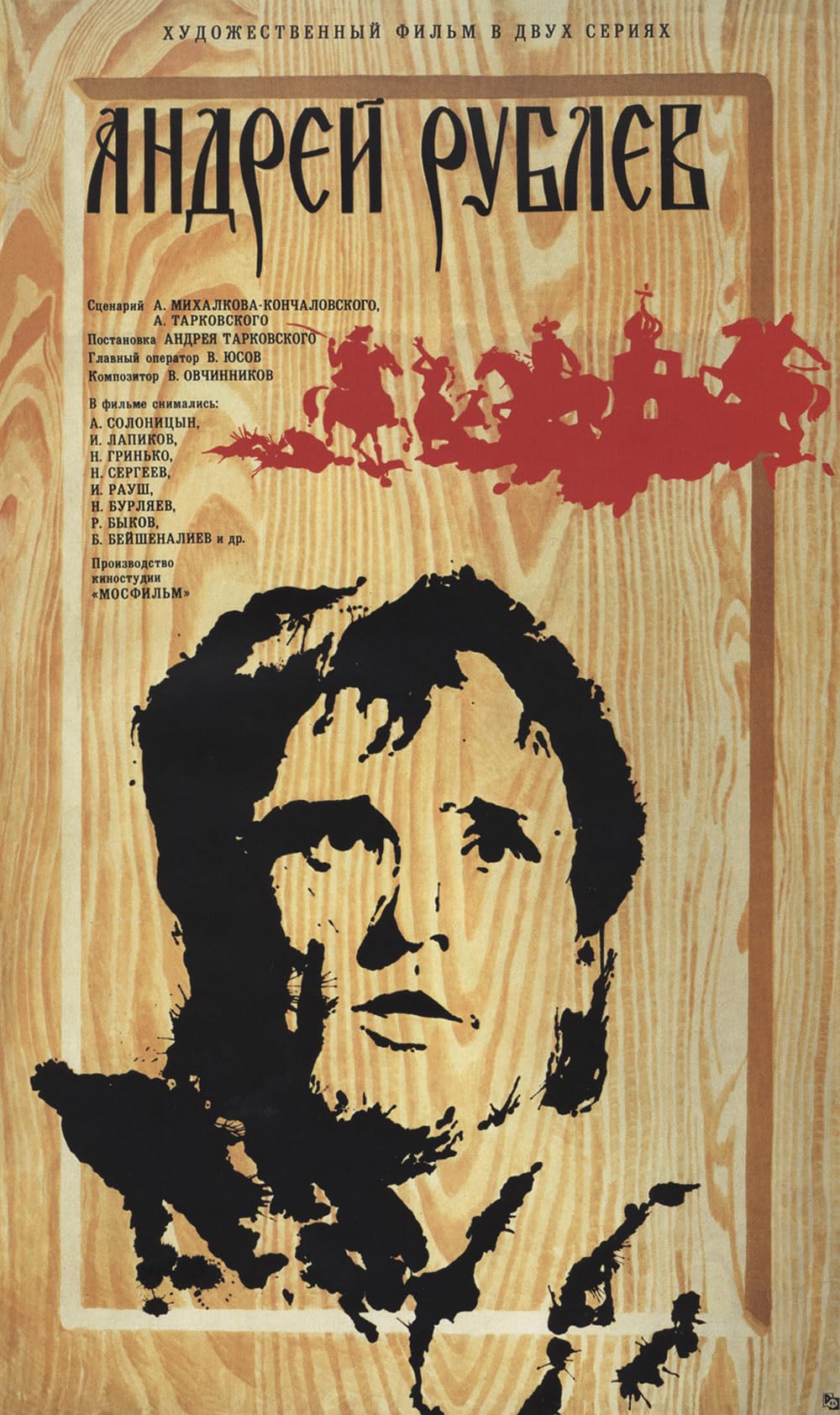
Andrei Rublev
1966 filmWikipedia
14
MENTIONS
9
EPISODES
9
PODCASTS
Search complete. 14 mentions across 9 episodes found for "Andrei Rublev".
Sep 25, 2026

Thomas MirusHOST
It depicts...
Thomas MirusHOST
the whole of Russian life during the period around the invasion of Napoleon in 1812 with a lot of different characters, but particularly one really main character, Pierre Bezahov, and also Prince Andrei Volkonsky and Natasha Rostov, who are kind of the main three characters in this film insofar as it was released in four parts, and three of the parts are named after characters, and those are the characters that they're named after.
Thomas MirusHOST
So in 1959, King Vidor, a great Hollywood director, made this adaptation of War and Peace starring Audrey Hepburn.
Thomas MirusHOST
And it was a huge hit in Russia, not because they thought it was accurate, but because they loved Audrey Hepburn.

YuiGUEST
I don't own any of his films on my Criterion Collection set.
YuiGUEST
Yeah, actually, I used to have Andrei Rublev, but I gave it away to someone who wanted to see it.
YuiGUEST
Do you watch it on a
Dave MaherHOST
computer, on TV, or okay? As God
50 MINS LATER
Dave MaherHOST
it newly.
Dave MaherHOST
Not culturally new at all.
YuiGUEST
Yeah, because, you know, the – Andrei Rublev's paintings at the end, you know, an iconic painting in that way is not really – it's not directing too much.
YuiGUEST
There's a flatness to it.

JasonGUEST
Markita Lazarova, really good 60s, new wave, Czechoslovakian film.
JasonGUEST
I love Andrei Rublev, you know, Tarkovsky.
JasonGUEST
Yeah, yeah, yeah.
JasonGUEST
Yeah, he's a pretty heavy, epic film.

WillHOST
Great movie.
WillHOST
No, so actually, because the reason I thought it was interesting, given we were talking about Stalker last time, Andrei Tarkovsky's Andrei Rublev.
NickHOST
Oh,
WillHOST
yeah.

Danny O'DwyerHOST
I've seen parts of lots of his stuff, but this, I believe, is the first time I've ever sat down and watched one of his movies, uh, from start to finish.
Danny O'DwyerHOST
I know that, um, his second film, Andrei Rublev, about the seminal Russian painter, was another one that sort of broke containment.
Danny O'DwyerHOST
But yeah, how, how familiar are you with his, with his work?
Jeremy JayneGUEST
I have seen this, and I've seen, uh, Mirror.

DestinyHOST
Yeah.
Randy OglesbyGUEST
Do you ever see Andrei Rublev? I don't think so.
Randy OglesbyGUEST
It's black and white.
Randy OglesbyGUEST
It's just, oh, wow.
Randy OglesbyGUEST
He was a great director, Tarkovsky.
DestinyHOST
I'll have to look that up.
Randy OglesbyGUEST
Yeah, yeah, Andrei Rublev.
Randy OglesbyGUEST
He's a Russian icon painter in the Middle Ages.

BlakeHOST
Yeah, and so is the rest of his filmography, right? Tarkovsky, most famously known not only for Stalker, but also for...
BlakeHOST
Solaris, Andrei Rublev, and Mir are, I think, the ones he's most famous for.
BlakeHOST
And then he also did a couple of movies outside of the Soviet Union because after this movie, his friction with the Soviet Union kind of came to a head and he left the Soviet Union.
BlakeHOST
I can't imagine why.

Tasha RobinsonHOST
But looking at Tarkovsky's quote in context of the rest of the interview, it becomes very clear that he was not making the film as an answer to Kubrick at all.
Tasha RobinsonHOST
He wanted to adapt the source material, a 1961 novel by Polish science fiction author Stanislaw Lem, as a continuation of the themes Tarkovsky had explored in his first two movies, Ivan's Childhood in 1962 and Andrei Rublev in 1966.
Tasha RobinsonHOST
Here he is laying out the connection.
Tasha RobinsonHOST
Quote, I wanted to explain why I decided to adapt Lem's novel Solaris.

John YorkeGUEST
Yeah.
John YorkeGUEST
The great thing about art house films, and I love them, and I can talk about until the cows come home, they're my natural home, really, is when you watch an Alan Rene film like Hiroshima More or Last Year in My Own Bad, or if you look at Tarkovsky, like Andrei Rublev, which I talk a lot about in the book, they're lovely, they're brilliant, but they feel odd and strange and they don't do what you expect a story to do.
John YorkeGUEST
And that sentence is key because it suggests that we have an innate expectation that if a criminal commits a crime, they will be caught.
John YorkeGUEST
So we have an innate understanding of melody.