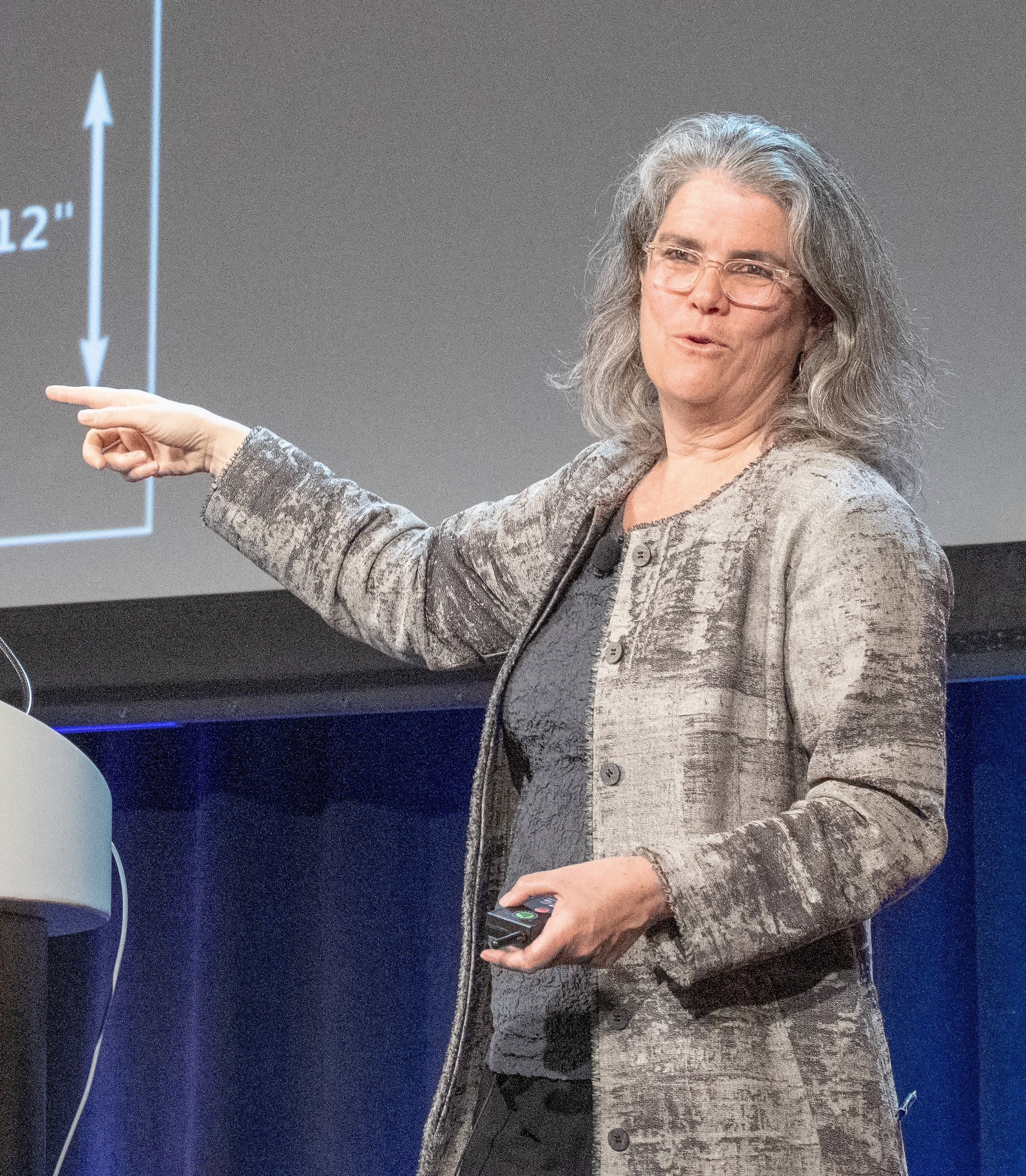
Andrea M. Ghez
American astrophysicistWikipedia
8
MENTIONS
6
EPISODES
6
PODCASTS
Search complete. 8 mentions across 6 episodes found for "Andrea M. Ghez".
Oct 16, 2026

Lester NareHOST
So-
Krishna ChoudharyHOST
Um, for the, that was Andrea Ghez-
Lester NareHOST
That's right
Krishna ChoudharyHOST
... and cohort for The Sagittarius A* star Milky Way

Janna LevinGUEST
You need something light, some source of light.
Janna LevinGUEST
And so stars were providing that for Andrea Ghez, who shared in the Nobel Prize for the discovery of the super massive black hole at the center of our galaxy.
Janna LevinGUEST
She couldn't take a picture of it, but she watched stars for over 15 years orbiting this tiny nothingness.
Janna LevinGUEST
[laughs] And, um, and so she needed the star to map the space time.

speaker_3HOST
Yeah.
speaker_3HOST
Starting in the early 1990s, two independent teams of astronomers, one in Germany led by Reinhard Genzel, and one in the United States led by Andrea Ghez.
speaker_3HOST
They decided to use the largest telescopes on Earth to track individual stars at the very center of the galaxy.
speaker_2HOST
But as I mentioned, they faced those massive obstacles.
speaker_3HOST
Exactly.
speaker_2HOST
So a super massive black hole was literally the only physical explanation that fit the data.
speaker_3HOST
And that undeniable decades-long body of work is what earned Genzel and Ghez a shared half of the 2020 Nobel Prize in Physics.
speaker_2HOST
Wow.

Allison SheridanHOST
And I actually wish it was more trained on Apple stuff.
Allison SheridanHOST
Now, on the other hand, when I asked Siri AI whether physics Nobel laureate and my personal hero, Dr. Andrea Ghez, and her team were the group who discovered and tracked the star S301 with an even faster elliptical orbit around the supermassive black hole at the center of the galaxy, Siri AI easily and quickly explained that it was the team of her Nobel co-laureate.
Allison SheridanHOST
Wasn't the answer I wanted, but it also gave me more detail about what telescope was used, the Very Large Telescope Interferometer in Chile, and information on how fast this star is going.
Allison SheridanHOST
It's over 8% the speed of light.

PeterHOST
In 2019, scientists dropped the first portrait of the M87 black hole, a super massive beast 6 billion times the mass of the sun.
PeterHOST
Just three years later, scientists used the work of Andrea Ghez and Reinhard Genzel, who won the 2020 Nobel Prize for mathematically proving a super massive black hole existed in our galaxy, to reveal something much more intimate.
PeterHOST
This photo of Sagittarius A*, the super massive black hole at the center of the Milky Way that's located just 26,000 light years from Earth.
PeterHOST
Imagine you spend 30 years tracking stars orbiting an invisible object at impossible speeds, pretty sure that something with 4 million times the mass of the sun was hiding at the center of our galaxy, and then finally seeing it.

PeterNARRATOR
In 2019, scientists revealed the first portrait of the black hole M87, a supermassive beast 6 billion times the mass of the sun.
PeterNARRATOR
Only three years later, scientists used the work of Andrea Ghez and Reinhard Genzel, who won the 2020 Nobel Prize for mathematically proving that a supermassive black hole existed in our galaxy, to reveal something much more intimate.
PeterNARRATOR
this photo of Sagittarius O'Rear, the supermassive black hole in the center of the Milky Way, which is located only 26,000 light years from Earth.
PeterNARRATOR
Imagine that you spend 30 years tracking stars orbiting an invisible object at impossible speeds, almost certain that something with 4 million times the mass of the Sun was hidden in the center of our galaxy and then finally see it.