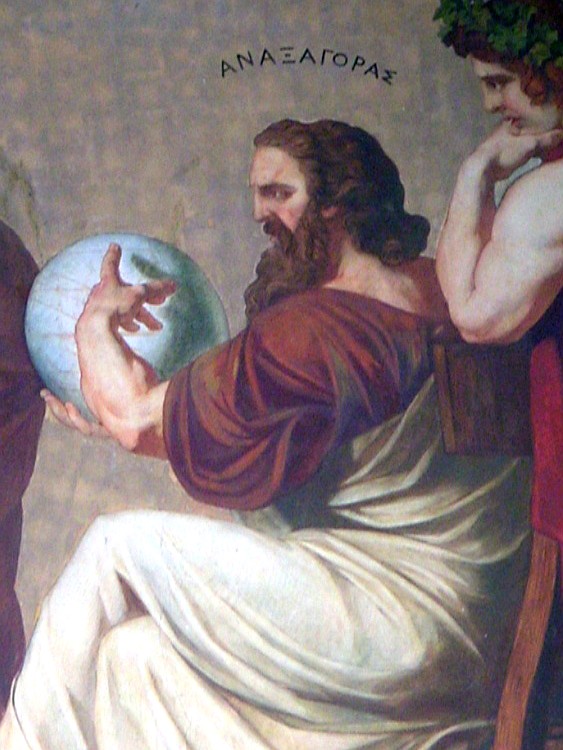
Anaxagoras
PhilosopherWikipedia
326
MENTIONS
67
EPISODES
50
PODCASTS
Search complete. 326 mentions across 67 episodes found for "Anaxagoras".
Nov 2, 2026

Lawrence M. KraussHOST
But there's a man who put his money where his mouth was.
Lawrence M. KraussHOST
And Anaxagoras was around the same time.
Lawrence M. KraussHOST
And he presaged a mother modern idea that it's not that there's some special substance, that everything is special, that everything comes from everything.
Lawrence M. KraussHOST
that all substances can be created from other substances, that there's nothing fundamental.
Lawrence M. KraussHOST
Okay, the birth of the modern ether, because I want to get to more modern science, but the modern ether began with these people.
Lawrence M. KraussHOST
It began to occupy a more special role after they'd introduced it.
Lawrence M. KraussHOST
And Anaxagoras said, all things are interchangeable, but the dominant components were air and ether.
Lawrence M. KraussHOST
For air and ether covered everything.

speaker_5NARRATOR
The earlier Greek philosophy lasted, roughly speaking, for about two thousand and fifty years, say from 600 B.C. onwards.
speaker_5NARRATOR
Such men as Thales, Heraclitus, Pythagoras, Parmenides, Anaxagoras, Empedocles, Democritus, were mathematicians, theologians, politicians, astronomers, and physicists.
speaker_5NARRATOR
All the learning of their time, such as it was, was at their disposal.
speaker_5NARRATOR
Plato and Aristotle continued their tradition.

Philip KubasovGUEST
There's
Zach StehuraHOST
also – he comes across two pre-Socratic philosophers, Anaxagoras and Thales.
Zach StehuraHOST
And they're kind of having a discussion, a geological discussion about – I was reading in the footnotes.
Zach StehuraHOST
I guess one of them was taking the position of volcanism.

Beth ThomasNARRATOR
such a thought makes an epoch in the annals of human intelligence.
Beth ThomasNARRATOR
Aristotle says of Anaxagoras, as the originator of the thought in question, that he appeared as a sober man among the drunken.
Beth ThomasNARRATOR
Socrates adopted the doctrine from Anaxagoras, and it forthwith became the ruling idea in philosophy,
speaker_7NARRATOR
except in the school of Epicurus, who ascribed all events to chance.
speaker_7NARRATOR
I was delighted with the sentiment, Plato makes Socrates say, and hoped I had found a teacher who would show me nature in harmony with reason.
speaker_8ADVERTISER
Start for free at Shopify.com.
Beth ThomasNARRATOR
I would not have surrendered this hope for a great deal.
speaker_7NARRATOR
But how very much was I disappointed when, having zealously applied myself to the writings of Anaxagoras, I found that he adduces only external causes, such as atmosphere, ether, water, and the like.

Bill BoerstNARRATOR
As to the nature of happiness, there was the utmost variety of opinion.
Bill BoerstNARRATOR
Democritus had made it consist in mental serenity, Anaxagoras in speculation, Socrates in wisdom, Aristotle in the practice of virtue with some amount of favor from fortune, Aristippus simply in pleasure.
Bill BoerstNARRATOR
These were the opinions of the philosophers.
Bill BoerstNARRATOR
But besides these, there were the opinions of ordinary men, as shown by their lives rather than by their language.
Beth ThomasNARRATOR
chapter six the atomists i anaxagoras anaxagoras was born at clazimene a city of iona about the year five hundred b c at the age of twenty he removed to athens of which city clazimene was for some time a dependency This step, on his part, may have been connected with the circumstances attending the great invasion of Greece by Xerxes in the year 480, for Xerxes drew a large contingent of his army from the Ionian cities which he had subdued, and many who were unwilling to serve against their mother country may have taken refuge about that time in Athens.
Beth ThomasNARRATOR
At Athens he resided for nearly fifty years, and during that period became the friend and teacher of many eminent men, among the rest of Pericles, the great Athenian statesman, and of Euripides, the dramatist.
Beth ThomasNARRATOR
like most of the ionian philosophers he had a taste for mathematics and astronomy as well as for certain practical applications of mathematics among other books he is said to have written a treatise on the art of scene designing for the stage possibly to oblige his friend and pupil euripides in his case as in that of his predecessors only fragments of his philosophic writings have been preserved and the connection of certain portions of his teaching as they have come down to us remains somewhat uncertain with respect to the constitution of the universe we have the following origination and destruction are phrases which are generally misunderstood among the greeks nothing really is originated or destroyed the only processes which actually take place are combination and separation of elements already existing these elements we are to conceive as having been in a state of chaos at first infinite in number and infinitely small forming in their immobility a confused and characterless unity about this chaos was spread the air and ether infinite also in the multitude of their particles and infinitely extended before separation commenced there was no clear colour or appearance in anything whether of moist or dry of hot or cold of bright or dark but only an infinite number of the seeds of things having concealed in them all manner of forms and colours and savours there is a curious resemblance in this to the opening verses of genesis the earth was without form and void and darkness was upon the face of the deep nor is the next step in his philosophy without its resemblance to that in the biblical record as summarized by diogenes laertius it takes this form all things were as one then cometh mind and by division brought all things into order conceiving as aristotle puts it that the original elements of things had no power to generate or develop out of themselves things as they exist philosophers were forced by the facts themselves to seek the immediate cause of this development they were unable to believe that fire or earth or any such principle was adequate to account for the order and beauty visible in the frame of things nor did they think it possible to attribute these to mere innate necessity or chance one anaxagoras observing how in living creatures mind is the ordering force declared that in nature also this must be the cause of order and beauty and in so declaring he seemed when compared with those before him as one sober amidst a crowd of babblers elsewhere however aristotle modifies this commendation anaxagoras he says uses mind only as a kind of last resort dragging it in when he fails otherwise to account for a phenomenon but never thinking of it else and in the fido plato makes socrates speak of the high hopes with which he had taken to the works of anaxagoras and how grievously he had been disappointed as i proceeded he says i found my philosopher altogether forsaking mind or any other principle of order and having recourse to air and ether and water and other eccentricities anaxagoras then at least on this side of his teaching must be considered rather as the author of a phrase than as the founder of a philosophy the phrase remained and had a profound influence on subsequent philosophies but in his own hands it was little more than a dead letter his immediate interest was rather in the variety of phenomena than in the conceived principle of unity he is theoretically perhaps on the side of the angels in practice he is a materialist mind he conceived as something apart sitting throned like zeus upon the heights giving doubtless the first impulse to the movement of things but leaving them for the rest to their own inherent tendencies as distinguished from them it was he conceived the one thing which was absolutely pure and unmixed all things else had intermixture with every other the mixtures increasing in complexity towards the centre of things on the outmost verge were distributed the finest and least complex forms of things the sun the moon the stars the more dense gathering together to form as it were in the centre of the vortex the earth and its manifold existences by the intermixture of air and earth and water containing in themselves the infinitely varied seeds of things plants and animals were developed the seeds themselves are too minute to be apprehended by the senses but we can divine their character by the various characters of the visible things themselves each of these having a necessary correspondence with the nature of the seeds from which they respectively were formed thus for a true apprehension of things sensation and reason are both necessary sensation to certify to the apparent characters of objects reason to pass from these to the nature of the invisible seeds or atoms which cause those characters taken by themselves our sensations are false inasmuch as they give us only combined impressions yet they are a necessary stage towards the truth as providing the materials which reason must separate into their real elements from this brief summary we may gather that mind was conceived so to speak as placed at the beginning of existence inasmuch as it is the first originator of the vortex motions of the atoms or seeds of things it was conceived also at the end of existence as the power which by analysis of the data of sensation goes back through the complexity of actual being to the original unmingled or undeveloped nature of things but the whole process of nature itself between these limits anaxagoras conceived as a purely mechanical or at least physical development the uncertainty of his view as between these two alternative ways of considering it being typified in his use of the two expressions atoms and seeds the analogies of this view with those of modern materialism which finds in the ultimate molecules of matter the promise and the potency of all life and all existence need not be here enlarged upon after nearly half a century's teaching at athens anaxagoras was indicted on a charge of inculcating doctrines subversive of religion it is obvious enough that his theories left no room for the popular mythology but the athenians were not usually very sensitive as to the bearing of mere theories upon their public institutions it seems probable that the accusation was merely a cloak for political hostility Anaxagoras was the friend and intimate of Pericles, leader of the democratic party in the state, and the attack upon Anaxagoras was really a political move intended to damage Pericles.
Beth ThomasNARRATOR
As such, Pericles himself accepted it, and the trial became a contest of strength, which resulted in a partial success and a partial defeat for both sides.
Beth ThomasNARRATOR
Pericles succeeded in saving his friend's life, but the opposite party obtained a sentence of fine and banishment against him.
Beth ThomasNARRATOR
Anaxagoras retired to Lampsacus, a city on the Hellespont, and there, after some five years, he died.
Beth ThomasNARRATOR
End of section 6 Section 7 of A Short History of Greek Philosophy by John Marshall.
Beth ThomasNARRATOR
This LibriVox recording is in the public domain.
Bill BoerstNARRATOR
As to the nature of happiness, there was the utmost variety of opinion.
Bill BoerstNARRATOR
Democritus had made it consist in mental serenity, Anaxagoras in speculation, Socrates in wisdom, Aristotle in the practice of virtue with some amount of favor from fortune, Aristippus simply in pleasure.
Bill BoerstNARRATOR
These were the opinions of the philosophers.
Bill BoerstNARRATOR
But besides these, there were the opinions of ordinary men, as shown by their lives rather than by their language.

Z. Mann ZillaHOST
So its ubiquity and its associations with fortune-telling are pretty well established, but it is important to note that independent of them, a form of palmistry was also arising in Greece.
Z. Mann ZillaHOST
Now, we talked during the astrology episode about the skepticism movement, but what's interesting here is that palmistry was something that was actually being practiced by many of the philosophers, in particular Anaxagoras.
Z. Mann ZillaHOST
Now, he was a practically-minded philosopher.
Z. Mann ZillaHOST
In fact, one of the notable things that he came up with was a guess for how eclipses worked, and it turned out to be a correct one.

speaker_5NARRATOR
Why do you think so, Belitis? Do you mean that I do not believe in the Godhead of the sun or moon like other men? I assure you, judges, that he does not, for he says that the sun is stone, and the moon earth.
speaker_5NARRATOR
Friend Meletus, you think that you are accusing Anaxagoras, and you have but a bad opinion of the judges, if you fancy them illiterate to such a degree as not to know that these doctrines are found in the books of Anaxagoras, the Clasomanian, which are full of them.
speaker_5NARRATOR
And so, forsooth, the youth are said to be taught them by Socrates, when there are not unfrequently exhibitions of them at the theatre.
speaker_5NARRATOR
And they might pay their money and laugh at Socrates, if he pretends to father these extraordinary views.

Asher SorylGUEST
Yeah.
Asher SorylGUEST
So the term panspermia, coined by a Greek philosopher, Anaxagoras, means essentially like life coming from the cosmos, falling to the earth as seeds.
Asher SorylGUEST
And it was originally proposed as a hypothesis to explain the origin of life on earth.
Asher SorylGUEST
directed panspermia kind of flips that and says, you know, or it could be an explanation for life on earth, but typically it's discussed as something that humans could do.
57 more episodes mention Anaxagoras.
Create an account to see the whole feed, search across every transcript, and follow the entities you care about.