amygdala
18
MENTIONS
16
EPISODES
16
PODCASTS
Search complete. 18 mentions across 16 episodes found for "amygdala".
Nov 10, 2026

Renee AllenHOST
That's where you have the executive dysfunction, working memory.
Renee AllenHOST
And the other is the amygdala, hippocampus, memory consolidation.
Renee AllenHOST
Amygdala is the brain's emotional threat and reward center.
Renee AllenHOST
That's the emotional memory.
Renee AllenHOST
That's pretty interesting.

Lyssa deHartHOST
But I think what you're saying is providing a place where somebody takes the kind of like, I know this stuff, but really understanding it.
Lyssa deHartHOST
Because I think the other thing that I'm hearing, at least my experience has been understanding something so that you can actually communicate about it simply and not make it into kind of neuro babble and just be throwing out words about Amygdala, limbic brain, prefrontal cortex, whatever the jargon is that somebody might be using, but rather understand the whole mechanism so that they can use what they know to inform their curiosity maybe is another way of thinking about it.
Justin James KennedyGUEST
So it really is about the application.
Justin James KennedyGUEST
There is a lot of noise or even pollution around what the brain does or doesn't do from I'm a left brain person or the amygdala made me do it or whatever.

SamHOST
Our players tonight are going to be Johnny Rome, Josie Ingram, and John Calvert.
SamHOST
And we are going to be playing a Next Quest original TTRPG, Thoughts of the Amygdala.
SamHOST
This is something we've been working on as a group while we try to figure out a way to play a game like Dread that is mostly focused on the roleplay with a fun game mechanic online.
SamHOST
I will be putting an in-depth outline of the rules in the episode description, but the gist of it is this.

Sissy GoffHOST
Their downstairs brain activates, then ours activates.
Sissy GoffHOST
Amygdala meets amygdala.
Sissy GoffHOST
And suddenly everybody is downstairs having a dance party.
Sissy GoffHOST
No one is thinking, no one is listening, and we're often saying things we'll regret later.

Louisa DaldinHOST
Oh, my God.
Louisa DaldinHOST
Neurological overreaction brain imaging shows that direct gaze can trigger an overactive amygdala.
Louisa DaldinHOST
Amygdala.
Louisa DaldinHOST
Amygdala, the brain's threat detection sensor, causing genuine stress, fear, or anxiety.
Louisa DaldinHOST
Oh, great.
Jack ArchdaleHOST
So neurologic overactivation.

Neil NathanGUEST
There's Annie Hopper's Dynamic Neural Retraining Program.
Neil NathanGUEST
There's Asha Gupta's Amygdala Retraining Program.
Neil NathanGUEST
Amygdala is another word for limbic.
Neil NathanGUEST
There's Kathleen King's Primal Trust.
Neil NathanGUEST
Those are three of my favorites.

StephanieHOST
And that's where your dashboard, your insula reads that dashboard.
StephanieHOST
It could be a little bit of nervous, nervousness, resentment, annoyance, whatever that feeling is that you're getting, your dashboard is reading that and trying to interpret it, right? And that message, not only does it go back to the amygdala because it's, Amygdala, insula is a two-way street.
StephanieHOST
So you're doing this.
StephanieHOST
But it also eventually, because there's a bit of a lag, goes to that free, let me say it again, prefrontal cortex, all these big biology words I'm trying to deal with.

Daniela SchillerGUEST
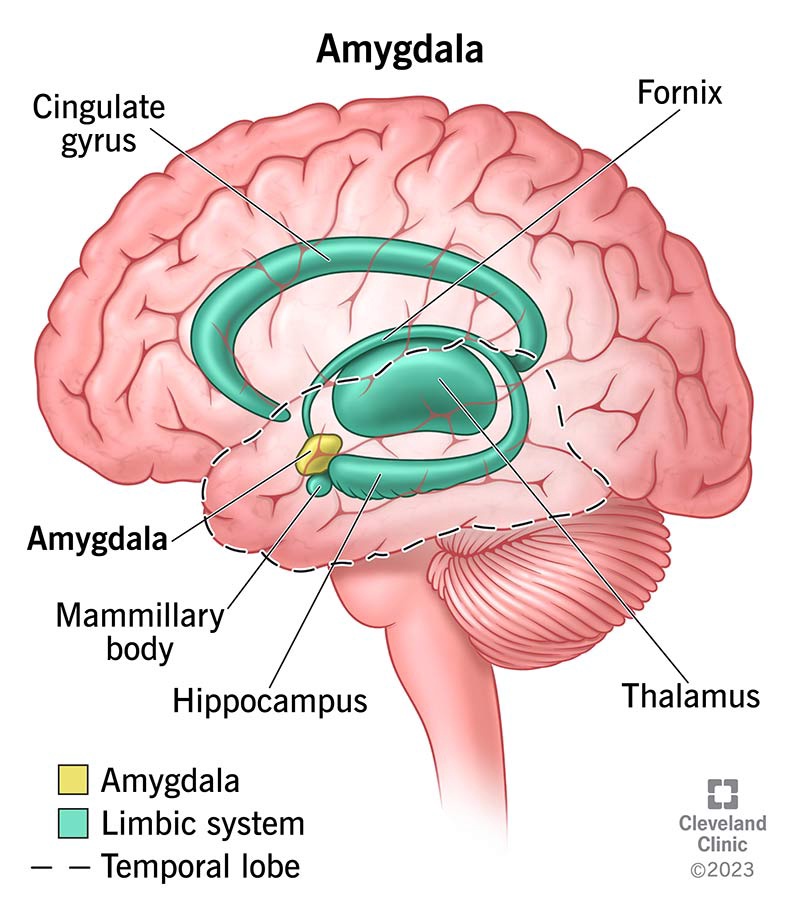
This is where the amygdala is.
Daniela SchillerGUEST
So it's a small region.
Daniela SchillerGUEST
Amygdala is from Greek for nut because it's like almond shaped.
Daniela SchillerGUEST
And what was found is that this region, when you trigger it or when you lesion it, all sorts of experiments, it really determines the emotional reaction, especially fear.
Daniela SchillerGUEST
So if you take like a little animal and you stimulate that region, the animal will freeze.

Leslie GreenbergGUEST
And it's the first step that's very helpful, which is to actually name an emotion.
Leslie GreenbergGUEST
It's been shown that naming an emotion actually reduces amygdala arousal.
Leslie GreenbergGUEST
Amygdala is a source of many of the threat emotions.
Leslie GreenbergGUEST
And naming emotion isn't the total process, but it is an important first step.
Leslie GreenbergGUEST
Many of us were not brought up to have words for emotion.

Ershad AlamgirHOST
So how does the brain kickstart the whole stress response? So it starts with amygdala.
Ershad AlamgirHOST
So when we talk about amygdala, let's break it down a little bit more.
Ershad AlamgirHOST
Amygdala is a paired almond-shaped cluster of nuclei located deep within the medial temporal lobes of the brain, one in each hemisphere.
Ershad AlamgirHOST
It deals with emotion and fear, sends a message to the hypothalamus.
Ershad AlamgirHOST
Now the question comes, what is a hypothalamus?
6 more episodes mention amygdala.
Create an account to see the whole feed, search across every transcript, and follow the entities you care about.