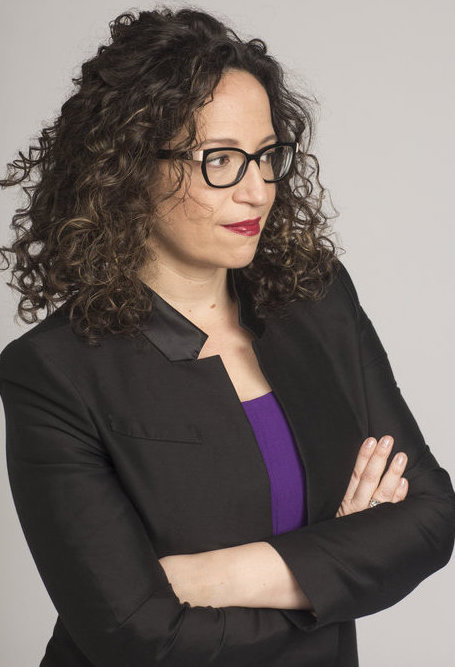
Amy Webb
American futurist and author
11
APPEARANCES
11
PODCASTS
Sep 19, 2026


Rana el KalioubyHOST
So I'm curious, how do you think about the cost of compute versus cost of labor?

Amy WebbGUEST
I will say that as a maxim, history is not necessarily a good predictor of what the future is going to look like because, you know, you have to update your priors.
Amy WebbGUEST
With a lot of technologies that fall within the realm of things that are automated, with some time, the cost of running something automated increases.
Amy WebbGUEST
So the cost always starts high and ends at zero, right, or negative relative to what it would cost for a human.
16 MINS LATER


Ros AtkinsHOST
But there's a more positive version of this AI future which says, yes, some of the more simple or administrative tasks get done by technology and that frees us all up to do the more challenging stuff and we can create more and be more ambitious.
Amy WebbGUEST
So fine, we've got all of these lawyers who no longer have to toil through reading things manually, doing all this stuff.
Amy WebbGUEST
So what does that organizational process look like inside of the organization? We don't know yet.
Ros AtkinsHOST
So we moved on to what we're all supposed to do when faced with such an array of disorientating circumstances.

5:35
So what have we lost in the last better part of a decade, not acting on what you suggested and coming to it at this point?
Amy WebbGUEST
It's really tough to allow a technology to develop and at the same time dictate how it should be developed.
Amy WebbGUEST
But there are examples of how to do this in other fields, one of which is biotechnology.
Amy WebbGUEST
There are rules in place that allow innovation to happen and basically regulate the end product.
9:30
What do you hope our listeners take from this moment? How should average citizens be thinking about what's going on and what agency they have in all of this?

5:47
So what have we lost in the last, you know, better part of a decade not acting on what you suggested and, and coming to it at this point?
Amy WebbGUEST
It's really tough to allow- A technology to develop and at the same time dictate how it should be developed, but there are examples of how to do this in other fields, one of which is biotechnology.
Amy WebbGUEST
You can't just go into a lab and tinker [laughs] with genetics totally, uh, on your own.
Amy WebbGUEST
Um, there are rules in place that allow innovation to happen and basically regulate the end product.
9:42
What do you hope, you know, our listeners take from this moment? You know, how should, like, average citizens be thinking about what's going on and what agency they have in all of this?

Amy WebbGUEST
So these are just individual, "Here is a thing that we have noticed and the trajectory that we see it headed in." And at the moment, you know, we've got a thousand plus persistent trends that are evolving as they're emerging that we're tracking because we have to track that for the-- for as building blocks for other inputs to our work.
Amy WebbGUEST
A convergence is the intersection of multiple forces and trends and uncertainties that intersect and create the sort of net new.
30 MINS LATER
Rana el KalioubyHOST
How do you reconcile some of this, like, big thinking with, like, "We gotta be on the ground, like, doing the work"? Are you nudging your companies to, like, experiment?

14:53

What, to you, does a good future with AI look versus a bad one? And where are we now?
Amy WebbGUEST
Agency that is charged with reviewing the data and the algorithms, making sure that what's being developed is in the best interest of the public, and having some system to enforce.
14 MINS LATER
29:08
And there's entire conversations around is grades, is going to a university in the end going to be necessary, yes or no? What do we actually need to know? What is the most important of three skills,


Amy WebbGUEST
From my point of view, uh, there's a big war happening that the United States launched so there's you know, that and China and Iran historically have relations whereas we, we don't.
Amy WebbGUEST
So I think that there was some amount of, uh, let's see if we can figure some of this out.
Amy WebbGUEST
Um, Ch- China is very, very in- where this is a little bit of, um, a little bit of 1914, uh, where we had all of these hotspots around the world starting to, to heat up because there were these political, um, political problems all over the place.
Amy WebbGUEST
So it feels a little bit like that right now and, um, you could, you could look at this as like she may, she- China may see this as an opening to take Taiwan by force, which they've certainly talked about.
1 HR 56 MINS LATER


Amy WebbGUEST
It's a, um, terrific organization that brings together American leaders and Japanese leaders, um, who actually live in other places around the world besides just Japan and the United States.
Amy WebbGUEST
And the point is to establish a network and relationships for the purpose of bringing the two countries more firmly together over time.
2 HRS 18 MINS LATER

Amy WebbGUEST
You know, everybody who's probably listening to this is either a leader or on track to be a leader in some kind of organization, and undoubtedly you have noticed that sometimes organizations stay on the same path when it's pretty clear that that path is going nowhere, and the world around them is changing, and what they need to do is either adapt to that change or reinvent for that change because that change is inevitable.
Amy WebbGUEST
There were so many fundamental changes happening that it seemed inevitable that those changes would coalesce and s- sort of form new things, and it reminded me of Joseph Schumpeter, and then I found this book, which I read.
Amy WebbGUEST
It's Capitalism, Can Capitalism Survive? It was written in the '40s, so it's, it's, it's heavy, but the third chapter is called "The Process of Creative Destruction." Basically, what he describes is through this convergence of different forces, typically technology-focused, but others as well, the old structures are destroyed and something new hits and exists in its place.
Amy WebbGUEST
That is always happening in some way, but it's really intensified over the past few years.
Amy WebbGUEST
In our case, as an organization, it just did not make sense to continue publishing a gigantic static report.
11 MINS LATER

Amy WebbGUEST
And I had a professor, um, who was very adamant that we, we did not use this advanced calculator technology.... uh, (laughs) you know, and I think everybody's been s- through some version of that.
Amy WebbGUEST
Um, a calculator is just a brick if you don't know basic math, uh, and in a way, AI is also kind of a, a brick if you don't know what to do with it.
Amy WebbGUEST
So, this is really up to everybody and it kind of relates to the vibe coding conversation earlier.
Amy WebbGUEST
You know, one of the key pieces of missing information is not what do you put into the prompt window, but as a company, how comfortable are we dumping in the corpus of our own data so that people can build stuff with it? I'm much, much more concerned about the lack of depth about what happens when you sell or license, um, your data or you allow employees to dump your data into a, a corpus or to make their own corpus and then throw, like, a LLaMA on top of it, a, an open source tool, um, what the potential consequences of that in terms of lost revenue in the future or lost ability to make revenue or now all of your stuff is out there for anybody to use.
Amy WebbGUEST
Those are the kind of fundamental thinking questions that I think we s- should be spending more time with.
11 MINS LATER

Kara SwisherHOST
So if AI adoption is inevitable, I'd like each of you... what is the smartest way for leadership to shape it rather than chase it? Amy and then Sayash and Rajiv.

Amy WebbGUEST
So, just as the Cold War was heating up, um, there was a man named Herman Kahn who had been hired by the Air Force to help predict the aftermath of a full-blown nuclear war, because at that point, the United States was building up a gigantic stockpile of warheads, as was the Soviet Union. So, it was a very dangerous, horrific time. Um, at that point, Herman Kahn was trying to explain, "Look, there are probably many different futures depending on the decisions that get made," but military strategists only saw two. We continue to buil- everybody's continuing to feel anxious 'cause we have all of these warheads, or total annihilation. There was no in-between. Herman Kahn did not want total annihilation, but also couldn't get these people to change their minds. So instead, he borrowed from Hollywood. He knew that the data alone you could use to predict, but it wasn't enough to influence the decisions that a leader might make. So instead, he came up with the idea of a scenario, a scene, and started telling stories about what might happen in the aftermath of an attack, and these stories were so visceral, they weren't emotional, but they evoked emotion. They were visceral, they were detailed. He described every child's lunch, their milk containers would explain exactly how much radiation was in it, and- and what that might be like, and his approach was to describe not total annihilation, but a world in which we all survived. So, the way that I like to describe what I do, because there is a predictive piece of it, and th- there is a heavy amount of quantitative and qualitative research, but none of that matters if we don't influence how people make their decisions. The future is not aspirational, it's not optimistic or dystopian. You have to take a pragmatic approach because the future arrives through the decisions that we make in the present, and oftentimes, those decisions are the result of how people feel in a moment, which could be influenced by 100 things that have nothing at all to do with the decision that they're actually making.
20 MINS LATER

Esther PerelHOST
So I, uh, when, when I began to think about this conversation, I called my husband, Jack Soll. And Jack is a psychologist who works in collective trauma and collective resilience worldwide. And basically, he said... I said, "I just came out of this presentation, and I'm, I, I'm really going through this rollercoaster, and I'm wondering, does she actually think about the emotional response of the people who are listening to what she's saying? She's taking us on the..." I thought it was brilliant, eh? The, the, let's be really clear. And then he said, "Look, when people are traumatized or when they experience threat, their imagination is constricted. And so instead of just talking about future, try to think about the preferred future," which I think is what you are actually aiming for, and I think is what Frederik is also alluding to. And a preferred future is a future in which you participate. But in your scenarios, if you work with people who are themselves numb and not allowing themselves to experience the consequences of their actions, how can they actually make decisions?
Amy WebbGUEST
So, in my world, the concept of a preferred future came from Herman Kahn. So that was the, the man that I mentioned at the beginning. This is not, uh, necessarily optimistic. It is, again, a little bit more pragmatic. So given what we can know to be true today, the data that we have access to, we can't just imagine a total optimistic utopian future that is very likely implausible. Um, so while it may feel good to do that, in practical terms, we're not gonna get there. So a preferred future is, given what we know to be true, what we can control, acknowledging what we can't, what is our best possible outcome at that, at this moment? And I think that's the piece of this that people, um, certainly in business and government, but I think everyday people get wrong. There is a enormous difference between aspiration and action, and it's good to create a vision, you know, for what you want the future to become. But it has to be rooted in reality, and rooting things in reality sometimes means acknowledging pain or discomfort or the facts as they exist that may not align with your worldview. That's a very tough thing to do. And when we advise people to rehearse futures, reh- by, by which I mean almost, you know, play out a movie of how things, the, the many, many different ways things could turn out, that starts with asking the question, "What if?" And it may seem like a simple thing to do, to ask, "What if?" But asking, "What if?" for real is a radical act. Um, doing that on your own is difficult. Doing that in a team of your peers, or in a, if you're, you know, with a lot of other people, asking, "What if?" and having a real conversation, that is a hard, hard thing to do. But it is necessary if you want to get to your preferred version of the future, given where we all are. And that's true whether that's your personal life, you know, or your business, or your government, you're working together as a group, whatever it might be.