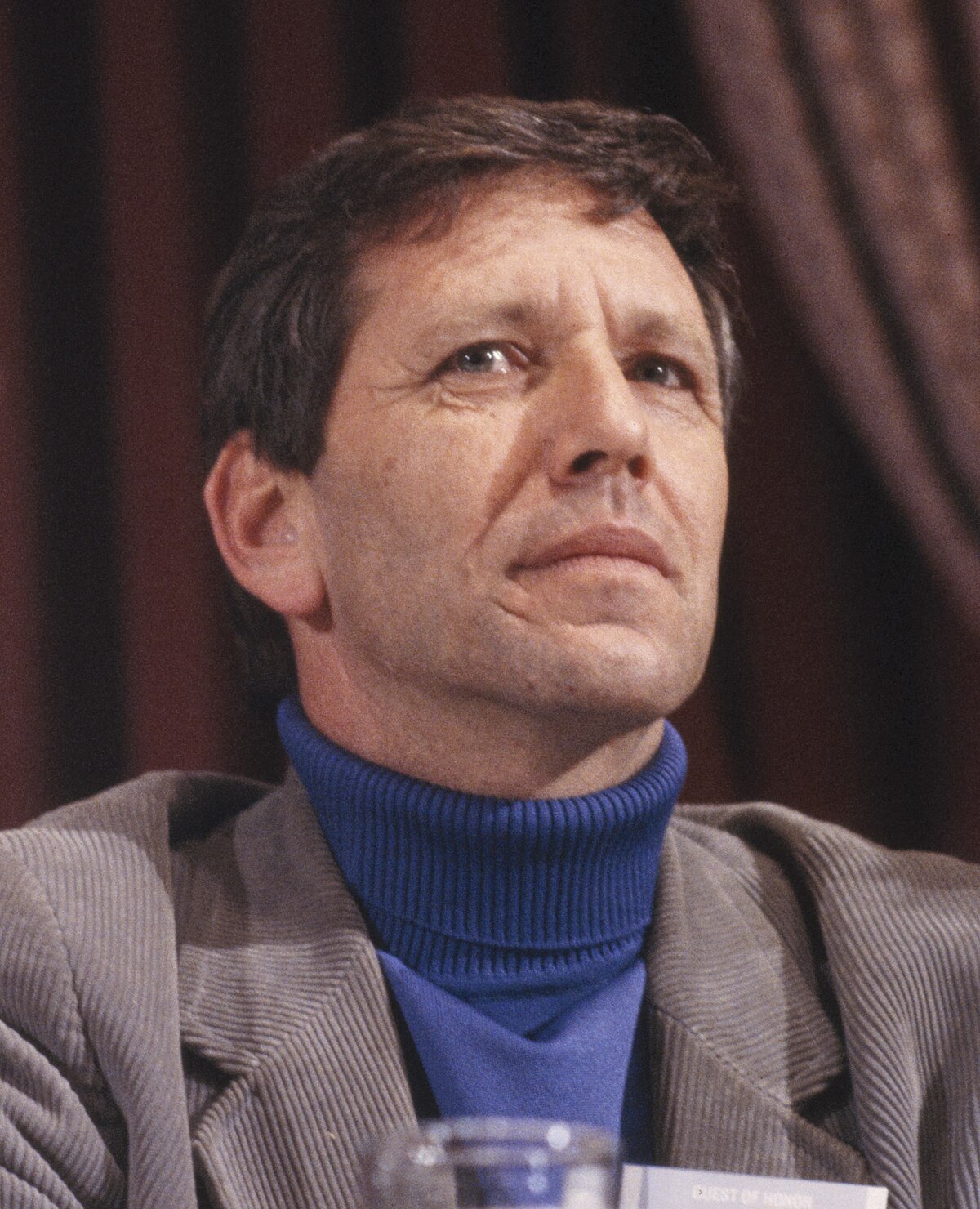
Amos Oz
Israeli writer and novelistWikipedia
12
MENTIONS
7
EPISODES
7
PODCASTS
Search complete. 12 mentions across 7 episodes found for "Amos Oz".
Sep 30, 2026

Mark GordonHOST
Just to continue the story of the Jewish relationship to this building, as we mentioned, this Paulskirche principle spread through the rest of Germany up until 1871, where other parliaments and other states adopted it.
Mark GordonHOST
And the fundamental importance of this building means that when they've had book prizes here to do with human rights, we've had famous Jewish speakers like Martin Buber and Amos Oz come and speak in this building.
Mark GordonHOST
[gentle music]
David HarrisHOST
You can see the world in 2D, and you can see the world in 3D.

Sebastian FaulksGUEST
And a lot of, I mean, I've just been reading, so I'm not talking, this is not my opinion.
Sebastian FaulksGUEST
Amos Oz is a great Israeli novelist and writer.
Sebastian FaulksGUEST
He was born about, I think, 1939, 40.
Sebastian FaulksGUEST
So he was a child during the time I'm writing about the last days of the mandate.
Sebastian FaulksGUEST
They didn't really like America.
Sebastian FaulksGUEST
So they went back to Odessa.
Sebastian FaulksGUEST
And very reluctantly, they found themselves in It's actually quite funny, Amos Oz writes very funnily about the snobbery among all the different waves of Jewish immigration.
Sebastian FaulksGUEST
And, you know, the Europeans rather look down on the Africans in the Middle East and Jews who come in.

Sebastian FaulksGUEST
I mean, I've just been reading, so I'm not talking, um, this is not my opinion.
Sebastian FaulksGUEST
Amos Oz, who's a great Israeli novelist and writer, his, um, he was born about, I think, 194- 39, '40.
Sebastian FaulksGUEST
So he was a child during the time I'm writing about, the last days of the mandate.
Sebastian FaulksGUEST
And his, um, family came from Europe.
Sebastian FaulksGUEST
They didn't really like America, so they went back to Odessa, and very reluctantly, they found themselves in, in Israel.
Sebastian FaulksGUEST
Um, and you know, it's, it's actually quite funny.
Sebastian FaulksGUEST
Amos Oz writes very funnily about the sort of, the snobbery among all the different waves of Jewish immigration.
Sebastian FaulksGUEST
And, you know, the Europeans rather look down on the Africans and the Middle Eastern, um, Jews who come in.

Yoav AvniGUEST
He's really funny.
Yoav AvniGUEST
And another thing is people probably say Amos Oz or Aleph Bet Yehoshua or David Grossman, but... thing about my biography is I played I'm a really bad football soccer player but I played for the Israeli national authors team so I was really bad but I have many friends from there like my own generation of writers Asaf Gavron and Udi Sharabani and I like to check out and see their work because they speak my language in many other ways so this is what I'm focusing about but like I said I want to read stories and characters.
Yoav AvniGUEST
Most of the writers that I follow are foreign, are from UK and the USA probably.
Yoav AvniGUEST
Stories are stories.

Rusty RenoGUEST
But the ancients were recognized to be homeless, to be adrift, to live in a world where no one speaks your language or shares your memories is a terrible fate.
Rusty RenoGUEST
And I think if you talk to, they're all dead now, but I'm old enough to have met and talked to kind of intellectual refugees, Jewish refugees from places like Vienna, And Amos Oz famously said about his father, who left Vienna on the Anschluss and moved to Israel, he said his father has been living in Israel for 40 years, but he never left Vienna.
Jonathan PageauHOST
Mm-hmm.
Rusty RenoGUEST
spiritually, and that's a hard, hard fate.

Sebastian FaulksGUEST
And if, if, if European countries, I mean, and really all of us, um, most especially Holland, Lithuania, Russia, Romania, Poland, France and Germany obviously, if, if we'd behaved in a more humane way over a long period of time, it w- it wouldn't really have been necessary.
Sebastian FaulksGUEST
And, um, if you-- It's very interesting reading a great Israeli writer, Amos Oz, who wrote a wonderful, um, autobiography about growing up at this time.
Sebastian FaulksGUEST
He was a child, um, and in the last days of the British mandate.
Sebastian FaulksGUEST
And they really loved Europe, um, his family.
6 MINS LATER
Sebastian FaulksGUEST
Yes.
Sebastian FaulksGUEST
Um, and he, he, he's a very sort of minor character who's there really just as a sort of butt of that kind of joke.
Sebastian FaulksGUEST
But he does have a part to play later in the book, and, um, that's something I learned in my very early days as a writer.
Sebastian FaulksGUEST
It was some advice I was given, actually, by an editor.

Adir ShiffmanHOST
And like, you know, different not-for-profits have got different levels of time and demands as well, right? I just am generally against blanket rules.
Adir ShiffmanHOST
You know, I always quote this Amos Oz comment, which is, all borders are blurry, but borders are important.
Adir ShiffmanHOST
So yeah, I think there should be a line and you can make some lines.
Adir ShiffmanHOST
But the truth is, sometimes I think it's really beneficial to a CFO, a CEO or C-suite person.