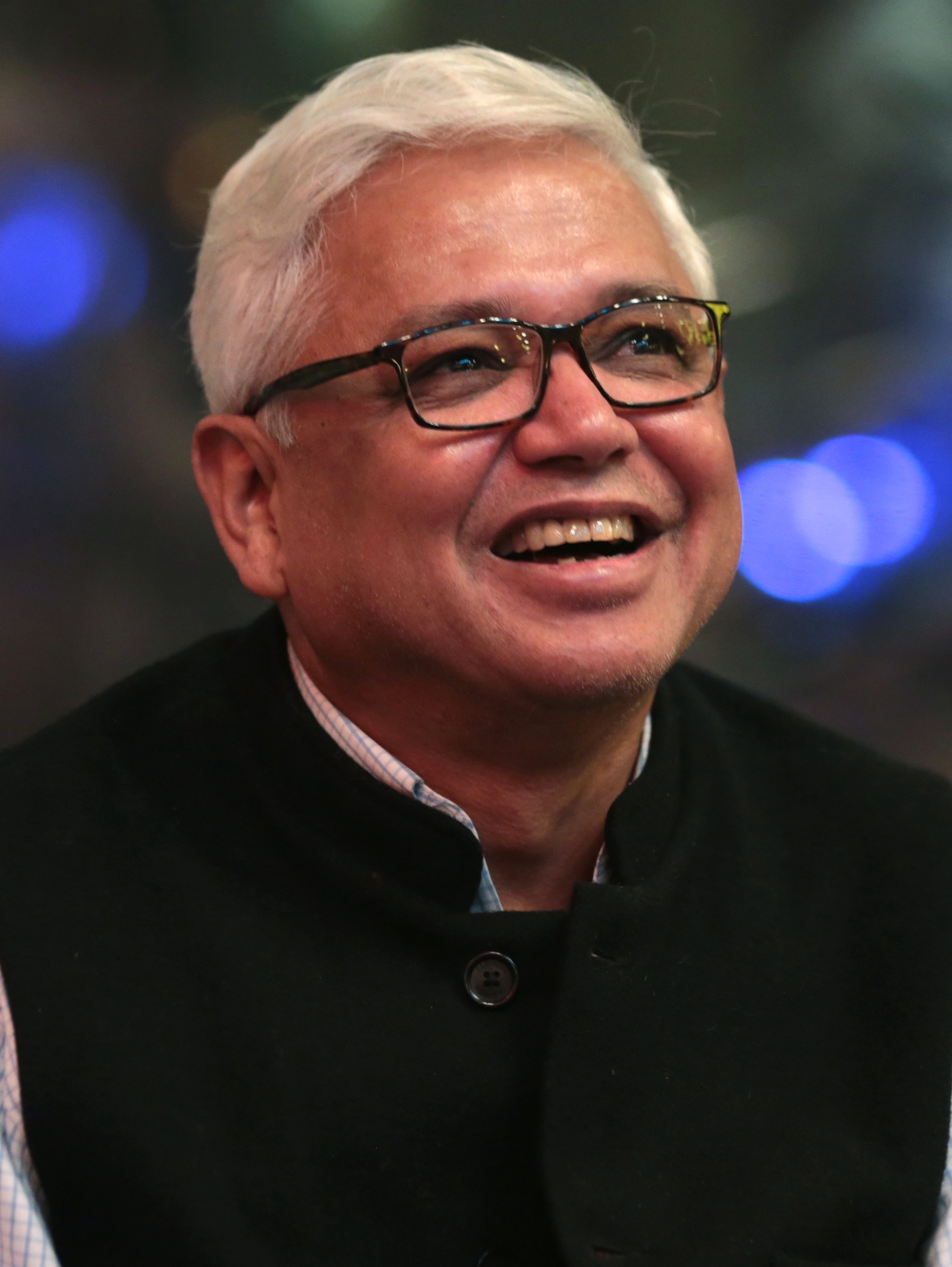
Amitav Ghosh
American writerWikipedia
12
MENTIONS
10
EPISODES
10
PODCASTS
Search complete. 12 mentions across 10 episodes found for "Amitav Ghosh".
Sep 21, 2026

Pierre Cassou-NoguèsGUEST
Uncanny.
Pierre Cassou-NoguèsGUEST
But I think as I take up the idea of the uncanny for the environmental crisis from Amitav Ghosh, and I think that's really a good point.
Pierre Cassou-NoguèsGUEST
And what is, I think, in the work with Gwenola, what I find interesting is the way these images can be used to produce an uncanny in a very different way from the text.
Pierre Cassou-NoguèsGUEST
And there's, to me, really when we started working on Erebon, one of the most striking experience was how little text you have on the film even on the film that's very talkative and you have an hour long film and you have like the text is you know five pages so you really have to choose what you're going to say very easily very carefully and Because, of course, the images show a lot of things that the text doesn't have to say.

Janet de NeefeGUEST
Yeah, there's been so many.
Janet de NeefeGUEST
I'd have to say in the second best of all, we had Amitav Ghosh, who's become like a lifelong friend of ours, and Michael Ndachi.
Janet de NeefeGUEST
But we also had Shanana Gustav.
Janet de NeefeGUEST
in the second year.

Edwin RaphaelGUEST
And then it kind of kicked into high gear by the time I was almost done school because the drive to make music was heavier because of my situation.
Edwin RaphaelGUEST
I just finished this book called The Hungry Tide by Amitav Ghosh.
Edwin RaphaelGUEST
And it is an incredible book.
Edwin RaphaelGUEST
It's actually the first book of his that I've read.

Sophie StrandGUEST
And I think one way we can hold this is by shifting the way we tell stories about a life.
Sophie StrandGUEST
And there's a recent book that was written by one of my favorite... climate writers and fiction writers and non-fiction writers, Amitabh Ghosh, called Ghost Eye.
Sophie StrandGUEST
And in it, it's a fictional book set in India and in the Sundarbans, and it's very much about paradigms of reincarnation and how it's impossible to think about climate change and to think about anything when you are stuck within a single species, a single species arc in extinction, or a single life.
Sophie StrandGUEST
And that we need to think with deep time, deep ecology, and think with material reincarnation.

Sophie StrandGUEST
And I think one way we can hold this is by shifting the way we tell stories about a life.
Sophie StrandGUEST
And there's a recent book that was written by one of my favorite... climate writers and fiction writers and non-fiction writers, Amitabh Ghosh, called Ghost Eye.
Sophie StrandGUEST
And in it, it's a fictional book set in India and in the Sundarbans, and it's very much about paradigms of reincarnation and how it's impossible to think about climate change and to think about anything when you are stuck within a single species, a single species arc in extinction, or a single life.
Sophie StrandGUEST
And that we need to think with deep time, deep ecology, and think with material reincarnation.

William R. HandleyGUEST
And, you know, the meanings of that image, that match cut, are so endless.
William R. HandleyGUEST
But also, you know, one of the things that a lot of Anthropocene scholars point out is that Amitav Ghosh is one in his book, The Great Derangement, Climate Change and the Unthinkable.
William R. HandleyGUEST
And he's like, the realist novel can't capture the time scale that we're thinking about now in the Anthropocene.
William R. HandleyGUEST
And so I became interested in how well you can capture deep time in a film.
19 MINS LATER
Miranda MelcherHOST
So is there anything kind of additionally extra layers maybe that we might notice that readers then wouldn't have?
William R. HandleyGUEST
Absolutely.
William R. HandleyGUEST
I do talk about Amitav Ghosh's arguments about why the contemporary realist novel is sort of failing the challenge of the Anthropocene in representing unthinkable catastrophe.
William R. HandleyGUEST
And he defines the realist novel.

Radhe JaggiGUEST
I could not not say that.
Radhe JaggiGUEST
But one of my favorite trilogies is the Ibis trilogy, which is by Amitav Ghosh.
Radhe JaggiGUEST
Oh, yes.
Radhe JaggiGUEST
It starts with the Sea of Poppies.
Radhe JaggiGUEST
And it's set in this really turbulent time in history.
Radhe JaggiGUEST
It's amazing.
Radhe JaggiGUEST
And Amitav Ghosh's ability to describe things is really beautiful.
Radhe JaggiGUEST
And again, it was one of those things.

David NaimonHOST
And then in fiction, you're going to find a million iterations of that as well, let alone people writing about literary theory or writing about philosophy with regards to narrative.
David NaimonHOST
Like Amitav Ghosh has whole essay collections on questions of human and non-human representation in narrative and also the history of narrative.
Anne DeMarkinMODERATOR
It sounds like you're saying the very diversity of voices in the field should help alleviate any sense of being an imposter? I guess maybe
David NaimonHOST
check it out and see what moves you because there isn't a way to do it.

Mark RavenhillGUEST
Uh, y- well, yeah.
Mark RavenhillGUEST
There's some great authors, and there's like Margaret Atwood, and Amitav Ghosh, and the writer David Mitchell.
Mark RavenhillGUEST
And yeah, um, but, uh, I'm optimistic, Tom.
Tom SutcliffeHOST
Uh [laughs].

Claire ScobieGUEST
And in general, writers haven't done enough.
Claire ScobieGUEST
Amitav Ghosh talks about that really beautifully.
Claire ScobieGUEST
And he talks about how the failure to address the climate crisis is a failure of the imagination.
Claire ScobieGUEST
And again, I think as writers, speaking for myself, it was something that someone else could fix.