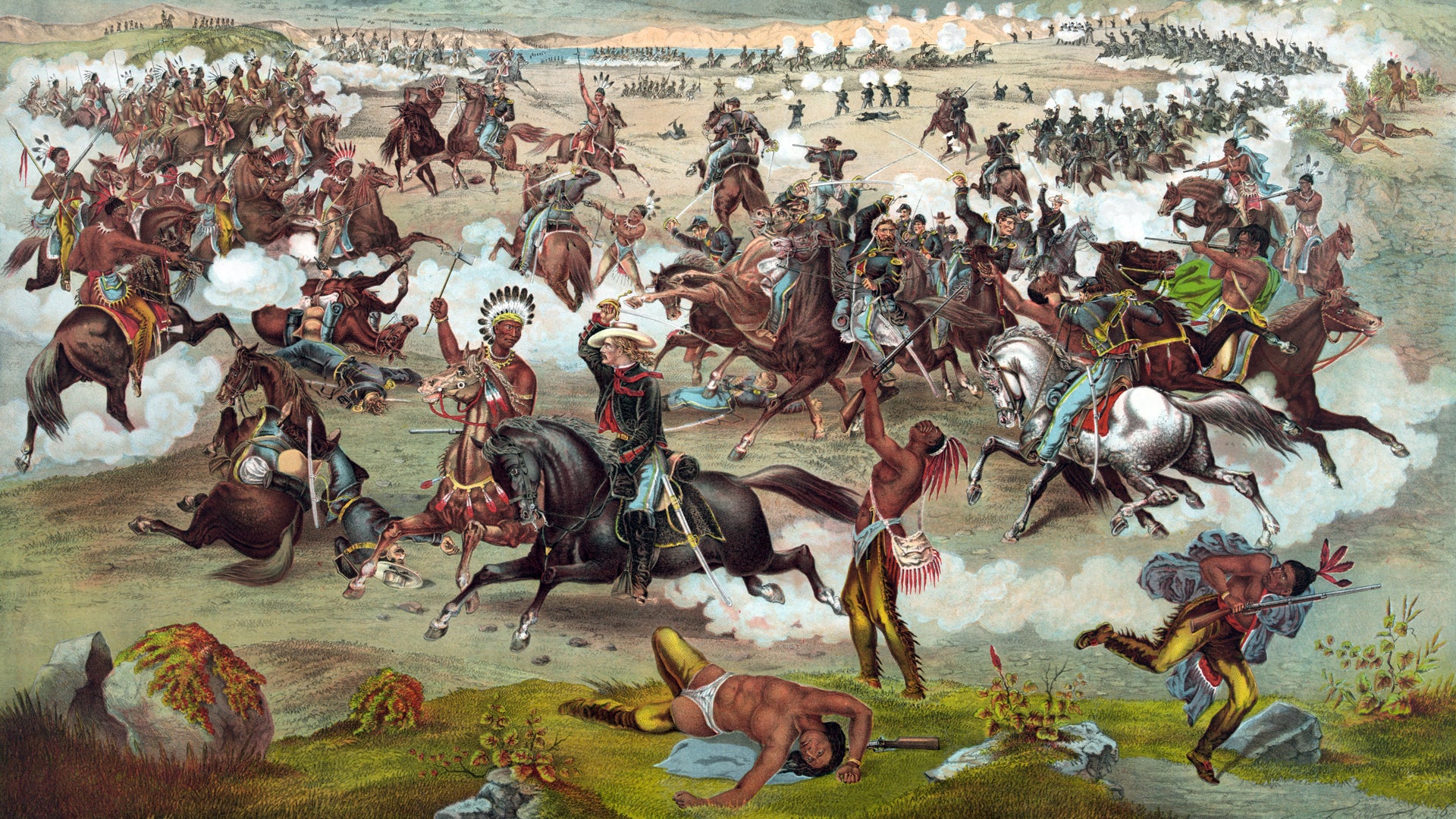
American Indian Wars
WarWikipedia
81
MENTIONS
62
EPISODES
49
PODCASTS
Search complete. 81 mentions across 62 episodes found for "American Indian Wars".
Nov 4, 2026

Lindsay GrahamHOST
The man in charge of this mission was 30-year-old Army Lieutenant Ernest Garlington.
Lindsay GrahamHOST
He had no experience on the open ocean, but he was a respected veteran of the Indian Wars, where he had impressed his superiors with his bravery and dedication.
Lindsay GrahamHOST
Garlington knew there was a chance the sea ice would be too thick even for the Proteus to make it all the way to Fort Condor.
Lindsay GrahamHOST
If that was the case, his orders were to leave caches of supplies at predetermined locations along the southern coast of Ellesmere Island.

Chris WimmerHOST
carried news of the killings eastward in hours.
Chris WimmerHOST
Edward Camby would go down in history as the only U.S. general killed in the Indian Wars and the highest-ranking military officer ever killed in conflict with Native Americans.
Chris WimmerHOST
By Sunday morning, April 13, two days after the assassinations, newspapers across the country were printing the story in the largest type they owned.
Chris WimmerHOST
the San Francisco Chronicle gave its entire front page to a single banner headline, The Red Judas.
Chris WimmerHOST
Edward Fox, a reporter who had slipped into the stronghold weeks earlier and interviewed Captain Jack, led with a more political thrust.
Chris WimmerHOST
The peace policy and the Indian Bureau had accomplished their bitter end and offered, as martyrs to the cause, the lives of a general and a minister.
Chris WimmerHOST
General Canby's death dominated the national conversation in a way that no event in the Indian Wars had since the Fetterman disaster on the Bozeman Trail in 1866.
Chris WimmerHOST
And in some respects, Canby's murder was worse.

Erin HallGUEST
Well, I think a lot of like the history, especially with like the Pequot War, the tactics that were used against the Pequot people in the 1600s keep happening to Native people throughout history all the way up until today.
Erin HallGUEST
the last of the Indian Wars out west.
Erin HallGUEST
And people don't know that this happened right here.
Erin HallGUEST
So I think it's important to learn that history because it pertains to other Native tribes as well.

speaker_0NARRATOR
the soldiers who came to be known as the Buffalo Soldiers.
speaker_0NARRATOR
Fort Davis was abandoned by the Army in 1891 after the Indian Wars in Texas had ended and the railway had made the old road unnecessary.
speaker_0NARRATOR
Its stone and adobe buildings still stand in their canyon beneath the Red Cliffs, cared for today as a National Historic Site, one of the best-preserved frontier forts in the American Southwest.
speaker_0NARRATOR
The town of Fort Davis grew up beside it, and in the hills above it, many years later, the MacDonald Observatory was built.

Buck SextonHOST
I have it sort of organized by subject matter, not obviously by alphabetical.
Buck SextonHOST
And so I'm looking at Indian Wars of Texas, Lone Star, Empire of the Summer Moon, all these different books.
Buck SextonHOST
But back to Texas...
Buck SextonHOST
This was really interesting because we've talked about this long ago on the show.

Guscilla JohnsonPANELIST
I think that, yes, there definitely was something going on, but then I think that the girls started to lean more into it when they saw the benefit of those accusations and what they had to gain from it.
Mercedes KirtleyPANELIST
I think it's also important to consider, obviously, the Indian War, like, you know, just happened.
Mercedes KirtleyPANELIST
And, like, you know, a lot of these people have lost their homes and lost their families.
Mercedes KirtleyPANELIST
And, I mean, PTSD can, flashbacks can be fully immersive.
Mercedes KirtleyPANELIST
This time Puritan, like, religion was very fear-based.
Mercedes KirtleyPANELIST
And, like... atoning for like the sin of being human and like being god's creation so you already feel a guilt for literally just existing and a fear that you might not be one of the chosen people to go to heaven and you know i mean if you're not chosen to go to heaven then where else are you gonna go we're susceptible to obviously making signing little books for the devil
Lorelai KirtleyPANELIST
I think mentioning the Indian War is very important because of the fact that so many of the apparitions that they saw were, like, Black men, but not in the sense that we think of them.
Lorelai KirtleyPANELIST
It's the, like, it's the Native people to the land that they were most likely imagining because of, I mean, the Indian War was brutal.

Peter RowanGUEST
But it took me out to the land of the Navajo and it took me out to camping and living in the desert and writing that song in the land of the Navajo.
Peter RowanGUEST
I was really, really wondering what it was that had divided this country from its native indigenous people in the Indian Wars.
Peter RowanGUEST
So that's what I began studying.
Peter RowanGUEST
And also, you know, it's generational, the 60s generation.

AndreaGUEST
I'm going to send you it.
AndreaGUEST
You can – link it and i actually have um uh um an x feed and i put shorts out on um youtube of information like this but yeah no these are historical records of marion county ohio records ohio history records these are um jp wilbarger's um indian depredations against the white settlements these are books like um indian wars of 1812 these are historical records and then some of them our account of like, um, revolutionary era but some of these records that i have found go all the way back to the like late 1500s early 1600s when they were still mapping out the ohio rivers and kentucky and all that kind of stuff was still being mapped out and they're talking about these encounters with the natives and and these burial sites and actually you know where they believe the natives came from and and who was here before them and it's all kind of recorded as fact you know but I don't know if it's just kind of been abandoned for other ideas or or what.
AndreaGUEST
But, yeah, there's a lot of records.
AndreaGUEST
If you know where to look, a lot of them I came across researching our personal family history.
AndreaGUEST
When I was doing our ancestry, I would find different people in my and Joe family.
AndreaGUEST
We have family members that have fought in every war since before the revolution, you know.
AndreaGUEST
the Indian Wars and so forth.
AndreaGUEST
And they would be a story about like one of our ancestors.

Michael BerryHOST
So I decide I'm going to see I usually go to YouTube because I'll find a subject.
Michael BerryHOST
And then I'll study that at the beginnings of the AFL, for instance, or the Indian Wars in Tennessee and Sam Houston's involvement.
Michael BerryHOST
You can find there's some little mini documentary that someone has put up.
Michael BerryHOST
Some of them are good.

speaker_3NARRATOR
Her courage became legend.
speaker_3NARRATOR
Thousands of warriors and soldiers clashed for eight intense hours, making this one of the largest battles of the American Indian Wars.
speaker_3NARRATOR
Native American warriors fought fiercely, successfully halting Crook's advances.
speaker_3NARRATOR
Eight days later, without Crook's support, Colonel Custer and his troops faced defeat at the Battle of the Little Bighorn.
52 more episodes mention American Indian Wars.
Create an account to see the whole feed, search across every transcript, and follow the entities you care about.