Amazon Redshift
Computer programWikipedia
50
MENTIONS
15
EPISODES
12
PODCASTS
Search complete. 50 mentions across 15 episodes found for "Amazon Redshift".
Sep 21, 2026

BaluHOST
Option B, Amazon DynamoDB.
BaluHOST
Option C, Amazon Redshift.
BaluHOST
And option D, Amazon Athena.
BaluHOST
Let's pause here.
BaluHOST
The correct answer here is option C, Amazon Redshift.
BaluHOST
And here's why it's right.
BaluHOST
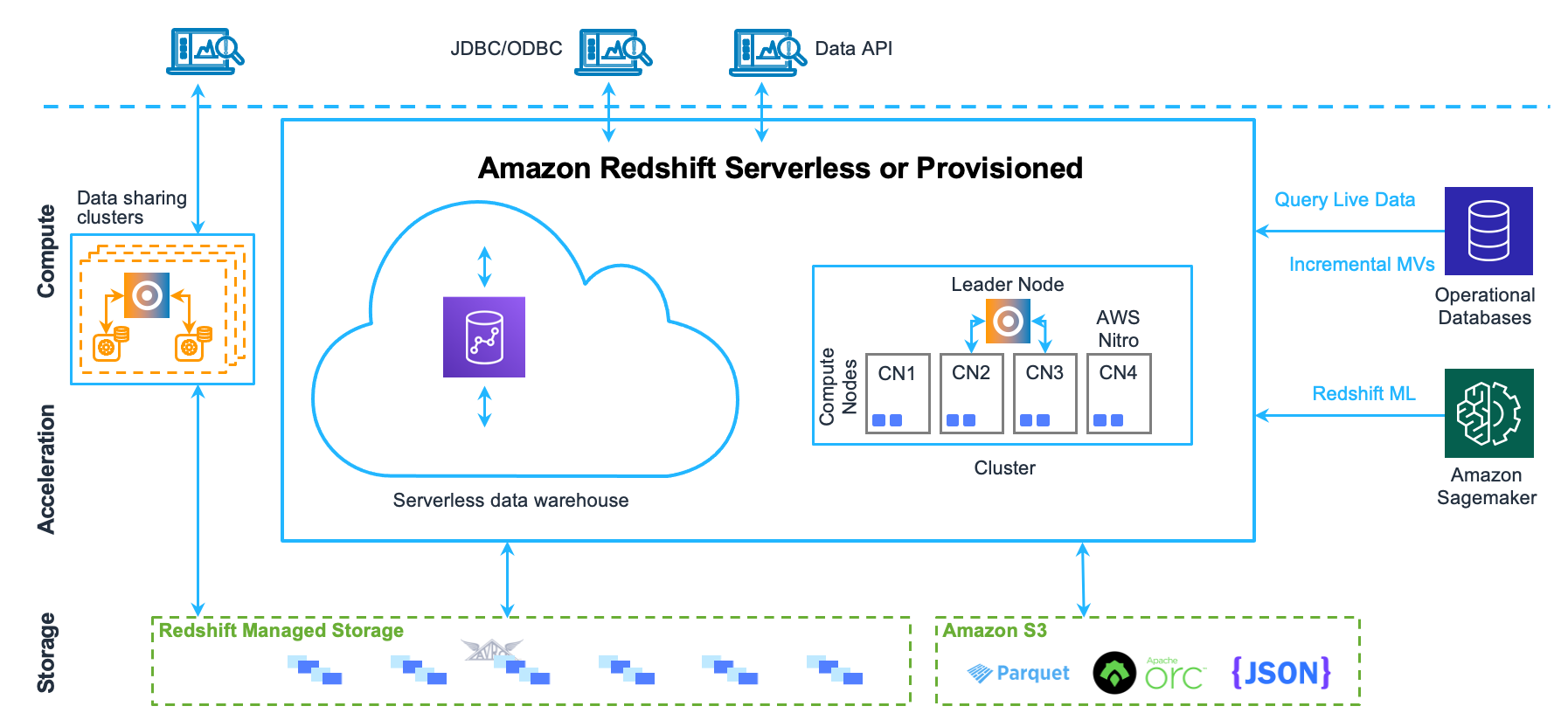
Redshift is AWS's fully managed data warehouse, purpose-built for online analytical processing.
BaluHOST
For a dedicated high performance warehouse handling heavy constant analytical queries with columnar storage, Redshift is the stronger fit here and it's one of the questions wordings that points to it.

Tommy PugliaHOST
The support of connectors.
Tommy PugliaHOST
There are Snowflake Databricks, BigQuery, Redshift, Dreamio, Spark, and generic ODBC LLDB connections.
Tommy PugliaHOST
So Mike, when I first started with Power BI, most of our things were done via ODBC.
Tommy PugliaHOST
And it was a pain in the gun because we had a virtual machine that allowed us to do so.

Calvin Hendryx-ParkerHOST
Most folks probably lie in the medium sized data, but Pandas definitely tops out.
Calvin Hendryx-ParkerHOST
I mean, he does some interesting benchmarks in here, gives a couple of good code examples, actually shows a really interesting post from Amazon Redshift team.
Calvin Hendryx-ParkerHOST
where they were looking at the composition of many of the tables that are out there in the Redshift environment.
Calvin Hendryx-ParkerHOST
If anybody's going to have a good view on what the size of data is and what big data could be, they're probably the ones to look at that.
![[YOU] on AI · Ahora](https://particle.news/cdn-cgi/image/format=auto,width=128/https://cdn.particle.pro/url/media/4e91d5b0-2117-58a6-bbc5-99f50507c704/4ba59d61cb1532c3192cbd071151c34c20f282a4cc8dbcff1e4711bdb0859bab)
AmberCORRESPONDENT
Corre sobre una arquitectura de mezcla de expertos con trescientos veinte mil millones de parámetros y licencia MIT, devolviendo un rendimiento de codificación de nivel frontera a manos abiertas a una fracción del costo de los modelos cerrados.
AmberCORRESPONDENT
También en el plano de infraestructura, AWS y Stardog lanzaron esta semana una capa semántica para IA agéntica, que permite a los agentes consultar bases de datos de Aurora y Redshift directamente sin ningún pipeline ETL.
AmberCORRESPONDENT
La integración se apoya en Bedrock Agent Core y preserva el contexto relacional, eliminando un cuello de botella importante en los despliegues de agentes empresariales.
Edo SegalHOST
Daniel, ¿qué hay de nuevo en los frentes de datos y diseño?

Nathaniel WhittemoreHOST
[whooshing] The last one from OpenAI is their new data agent for ChatGPT Work.
Nathaniel WhittemoreHOST
The agent is designed for handling proprietary data within an organization with connections to data providers like Amazon Redshift, Datadog, Google BigQuery, ClickHouse, Databricks, MongoDB, and Snowflake.
Nathaniel WhittemoreHOST
OpenAI says the features can be used to ingest sales data and generate insights around core metrics like sales conversions and retention.
Nathaniel WhittemoreHOST
The goal is to realize the promise of being able to talk to your data and perform real analysis without needing to touch additional tools.

Dumky de WildeHOST
... uh, presumably on these, these kind of things, where you can query your S3, uh, data directly through DuckDB.
Dumky de WildeHOST
Um, of course there is, you know, we cannot let this go without mentioning Redshift, and I think we've all known for a long time that, you know, Redshift is definitely not the product that you recommend to, um, anyone [laughs] if you're not already a Redshift user or like you have to be on AWS for your, your columnar database.
Dumky de WildeHOST
I think even, uh, maybe you mentioned this, Mady, uh, as a kind of a, uh, a joke or funny because it's true that, uh, AWS people will recommend Snowflake on AWS, um, because it's just a better-
Mehdi OuazzaHOST
Yeah
Mehdi OuazzaHOST
There is many ways.
Mehdi OuazzaHOST
Uh, data pipeline, as you mentioned, there is even more, and so there is some competition, uh, happening between the teams.
Mehdi OuazzaHOST
And yes, uh, in the past, you know, there is al- also a lot of saying that, um, success of Snowflake is due to Redshift's failure because AWS was making a lot of good margin on the compute selling, uh, Snowflake rather than, than Redshift.
Dumky de WildeHOST
Yeah.

Joe ReisHOST
It is what it is.
Sami HeroGUEST
Yeah, we had, we had queries that would run like 75 minutes and, and, and against Redshift, which was supposedly good.
Sami HeroGUEST
But, you know, we, we didn't-
Joe ReisHOST
Yeah
Sami HeroGUEST
... again, it's like, that's the other thing is that when, when you do the, the physical modeling, and that's why it's actually these layers, like conceptual, logical, and physical are quite important, is that y- when, well, when you're going from logic- logical to physical, you kind of need to think about, am I building a dimensional model or data vault or whatever methodology I want to use?
Joe ReisHOST
Yeah.
Sami HeroGUEST
But also, what is my environment looking like? Am I doing Snowflake, Databricks, or Redshift or BigQuery or...
Sami HeroGUEST
Because, like, you need to, you need to take some, um, optimization decisions at that level.

Tristan HandyGUEST
Stitch and Fivetran were really the two first modern data stack native data ingestion tools.
Tristan HandyGUEST
They were originally like load data from Salesforce into Redshift.
Tristan HandyGUEST
So I'd known George and Taylor forever.
Tristan HandyGUEST
And he collaborated often over the years.
Tristan HandyGUEST
I think it was 2018.
Tristan HandyGUEST
It was the first real cloud-native data warehouse that I used.
Tristan HandyGUEST
I used Redshift before, but I would call that kind of a different thing.
Tristan HandyGUEST
And the fact that Snowflake could do what it could do was magic it was just uh and and every single time you know their sequel coverage was actually not that good back then and uh so every time that they would release a new window function i would like read the release notes with bated breath i was like oh my god they now support rolling averages yet now we are whatever eight years beyond that and The idea that you would have a cloud-native SQL engine that reads from blob storage and has scale-out compute and has complete coverage of the SQL dialect, all of that is kind of expected.
BaluHOST
Which configuration should they use? Here are your options.
BaluHOST
Option A, create a read replica in the same availability zone.
BaluHOST
Option B, Let's pause here for a few seconds.
BaluHOST
The correct answer is B, enable RDS multi AZ deployment.
BaluHOST
Automatic failover to another availability zone with minimal downtime.
BaluHOST
Now let's eliminate the others.
BaluHOST
Option A, that's a read replica in the same availability zone is wrong for two reasons.
BaluHOST
Read replicas are for scaling read traffic and not for automatic failover and putting it in the same availability zone means an availability zone failure would take out both the primary and the replica.
AmberCORRESPONDENT
De vuelta contigo, Edo.
Edo SegalHOST
AWS realizó un segundo movimiento agentico hoy asociándose con Stardog para darle a los agentes una capa semántica que les permite consultar bases de datos Aurora y Redshift directamente, sin necesidad de un pipeline ETL.
Edo SegalHOST
La integración corre sobre Bedrock Agent Core.
Edo SegalHOST
Para nuestra historia final, le damos la palabra a Daniel.
5 more episodes mention Amazon Redshift.
Create an account to see the whole feed, search across every transcript, and follow the entities you care about.