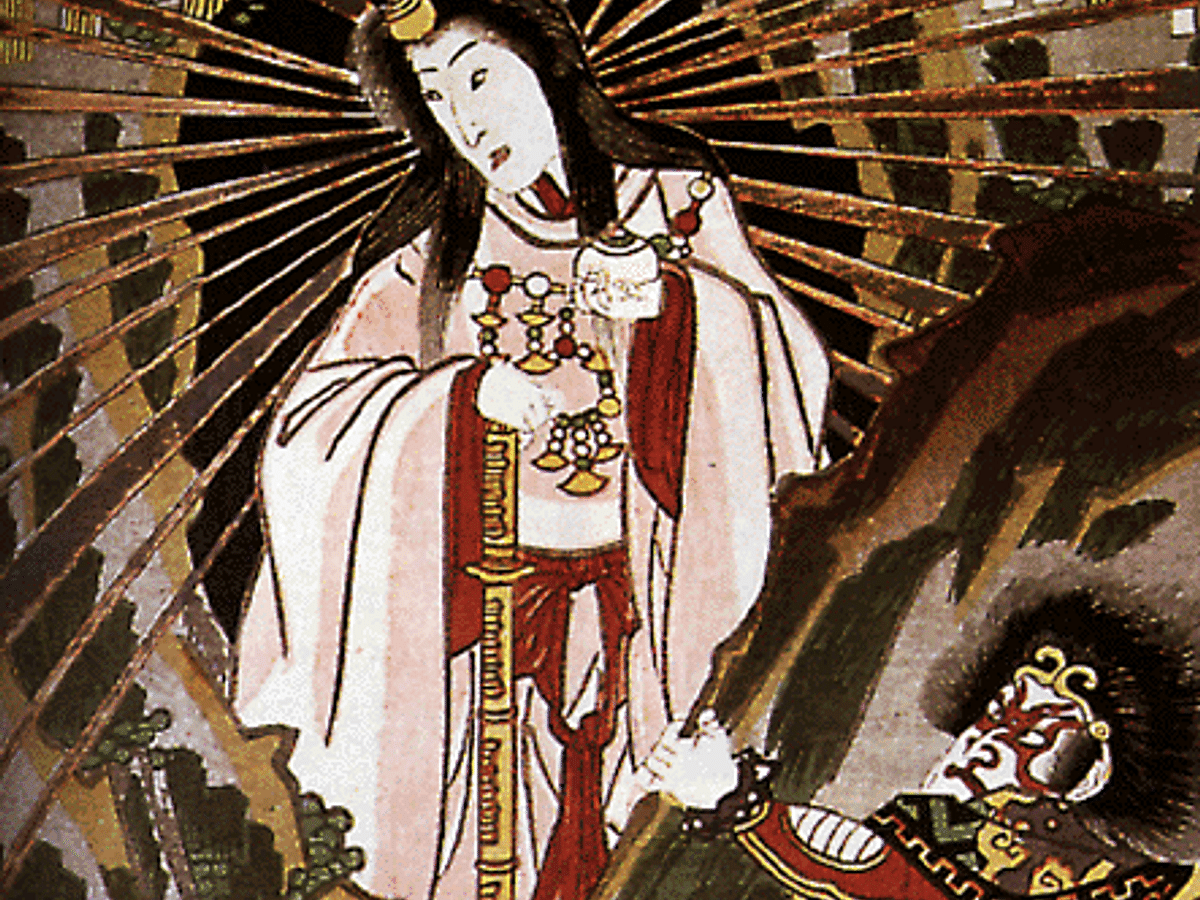
Amaterasu
GoddessWikipedia
65
MENTIONS
25
EPISODES
20
PODCASTS
Search complete. 65 mentions across 25 episodes found for "Amaterasu".
Oct 24, 2026

Nate BestmanHOST
And it's the death, I am fulfilling the promise that Tom made with the Japanese people to be their chosen one.
Nate BestmanHOST
I am Amaterasu, come again.
Nate BestmanHOST
And yeah, I've watched the movie many times.
Nate BestmanHOST
I love it.
25 MINS LATER
speaker_4SOUNDBITE_SPEAKER
of Buddha.
Nate BestmanHOST
Yeah, so, right, clearly there's a destiny angle going on here as well.
Nate BestmanHOST
Is Tom the chosen one? Am I the chosen one? I am the reincarnation of Amaterasu who will set the Japanese people free.
Nate BestmanHOST
So, yeah, wait, that's going to be quite an episode of Internet Genius.

Lindsey GrahamSOUNDBITE_SPEAKER
Today, the Japanese imperial envoy has traveled to the Grand Shrine with a critical assignment to pray for victory against the impending second Mongol invasion.
Lindsey GrahamSOUNDBITE_SPEAKER
The envoy walks to the shrine of Amaterasu, the goddess of the sun and mythical ancestor of the imperial family.
Lindsey GrahamSOUNDBITE_SPEAKER
There he worships with the chief priestess and prays for the defeat of the Mongols.
Lindsey GrahamSOUNDBITE_SPEAKER
The envoy also requests that the priestess record a curse, punishing the Mongols for threatening Japan and the emperor.

AdamHOST
And this is a, it's one of these fun stories where you have, uh, Susanoo, who was a storm god.
AdamHOST
He was the brother of the sun goddess, uh, Amaterasu.
AdamHOST
He's banished from the high plain of heaven after a series of destructive pranks against his sister.
ChrisHOST
Oh, what a trickster.

Abby BrinkerHOST
And in Japanese mythology, Tsukuyomi is a Shinto moon god born from the right eye of the creator deity Izanagi.
Abby BrinkerHOST
He is the counterpart to Amaterasu, the goddess of the sun, who was born from Izanagi's left eye.
Abby BrinkerHOST
Ooh, what a mouthful.
Abby BrinkerHOST
So while the details differ enormously, right, culture to culture, there's very clearly recurring patterns of all of these ancient peoples and old mythology trying to explain and understand the patterns of the moon.

KeithHOST
Yes.
DylanHOST
Amaterasu.
DylanHOST
Yes.
KeithHOST
Yes.
Ryan GableHOST
I think it's down about an hour outside of Os- hour and a half, two hours outside Osaka.
Ryan GableHOST
Uh, it's called Ise Jingu, and it's the main Amaterasu sun goddess shrine.
Ryan GableHOST
I'm telling you this because when I went there, I did not know this until I went to the shrine and then went to the museum afterwards, and the central shrine, the main shrine, is incredibly beautiful.
Ryan GableHOST
It's all made out of wood.

Ryan GableGUEST
So, of course, that's what I saw.
Ryan GableGUEST
I never saw the sun goddess Amaterasu because I didn't even know what Japan was when I was a child.
Ryan GableGUEST
So there's no way I could have seen the Japanese sun goddess.
Ryan GableGUEST
I have no context for that.

Ryan GableHOST
Wabi Sabi is the principle, the spirit of impermanence, which is what leads the Japanese to build, every 20 years, a new grand temple to the Shinto, it's not a religion, but the Shinto or domestic pseudo-religious practice of the Japanese at Ise Jingu.
Ryan GableHOST
Ise Jingu is a grand shrine dedicated to the sun goddess Amaterasu.
Ryan GableHOST
It's in Meade Prefecture.
Ryan GableHOST
I've been to it.
Ryan GableHOST
And they've rebuilt this structure every two decades.
Ryan GableHOST
Now, when they build this structure, and you can look this up online, ISE, which funny enough is also how you pronounce ISE, Giza, Isa, Giza, and how you pronounce Isa in Arabic, which is Jesus.
Ryan GableHOST
So Jesus, Isis, and then Isa, Amaterasu in Japan.
Ryan GableHOST
They build this every 20 years because there is beauty in impermanence.

EmilyHOST
Um.
EmilyHOST
Now, if you've been following this series, you might be thinking, like, wait a minute, what about Amaterasu? What about Susanoo? Like, what about all of these other deities that we've talked about? Yes, they are kami as well.
EmilyHOST
So Amaterasu, for example, is one of the most important kami in Shinto tradition and is associated with the sun.
EmilyHOST
There's so many of them, but they all, if you think about the stories that we shared, have something to do with nature or life or the ancestors.
EmilyHOST
Amaterasu is associated with the sun.
EmilyHOST
Susunoo is associated with the storms and sea.
EmilyHOST
Inari... associated with rice agriculture and prosperity and all of these deities and some of the other kami as well have shrines in your head you can imagine with me the architecture that we've seen in so many like Japanese artwork I think we even used it in the artwork for our folklore series episode um it's the red shrines with the red gates with the um kind of swooping rooftops they're called um tori gates those shrines are mostly dedicated to inari another familiar feature of inari shrines are foxes or kitsune um And it's another reason why the concept of kami doesn't always fit into our usual categories.
EmilyHOST
So like they can be associated with particular shrines and kami and have deep connections to the local community and like natural area.
15 more episodes mention Amaterasu.
Create an account to see the whole feed, search across every transcript, and follow the entities you care about.