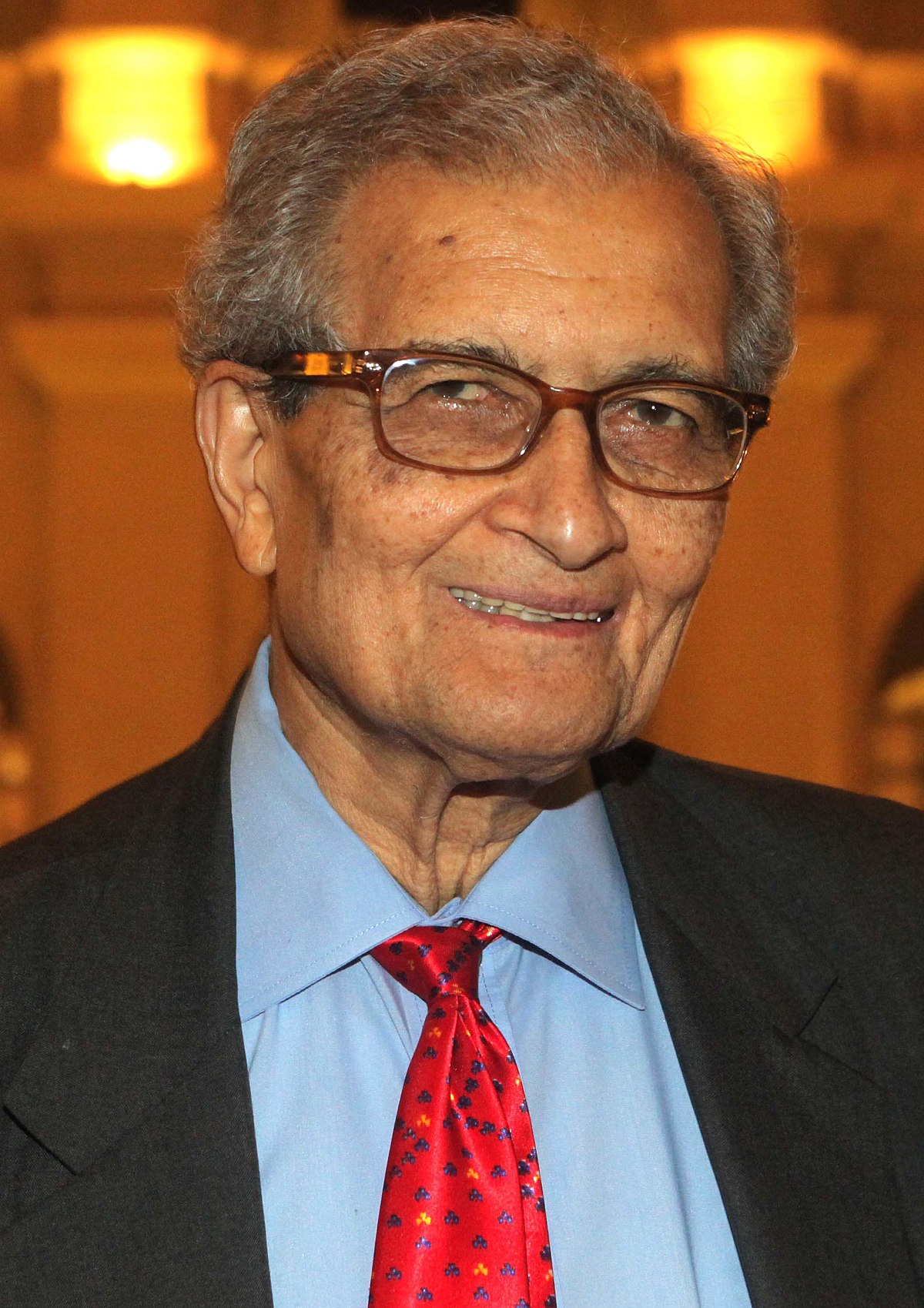
Amartya Sen
Indian economist and philosopherWikipedia
22
MENTIONS
20
EPISODES
20
PODCASTS
Search complete. 22 mentions across 20 episodes found for "Amartya Sen".
Oct 28, 2026

Justin MankinGUEST
It's done so in the past.
Justin MankinGUEST
And so if famine, as Amartya Sen says, is a distributional problem rather than a deficit of calories being produced, I have really big questions about what it should imply for redistribution of food aid around the world in an anticipatory way such that you mitigate any kind of famine-induced losses in different parts of Southern Africa or even in East Africa, where there's going to be an experience of considerable floods and loss of life associated with this.
Justin MankinGUEST
And so these are the kinds of things I'm interested in from the climate side.
Justin MankinGUEST
I think what it implies for markets and things like that, I have no doubt that savvy financiers are going to find ways to price in this risk and perhaps even reduce their downside and or make a profit from this El Nino based on bets they take.

Mike BeggsGUEST
So we'll come back to that question of how you manage that tension, the fact that, as you say, people have different capacities in labor.
Mike BeggsGUEST
The other great vision, modern vision of egalitarianism is a kind of needs-based, you know, the famous from Marx to each according to their needs, which I think has a very good sort of modern take in the form of Amartya Sen, Martha Nussbaum, the capabilities approach, which is saying that essentially equality means making sure that everybody has their basic needs met, that everybody is able to fully participate in social life.
Mike BeggsGUEST
This is in some ways in tension with the resources equality, because to some extent, because of people's different capacities, some people are going to need more of society's resources than others.
Mike BeggsGUEST
Some people are going to be able to work less than others.

Stephen DubnerHOST
And real estate.
Stephen DubnerHOST
There is a paper from a few years back by Lisa Detling, who's with the Federal Reserve Board, and Melissa Carney, who's one of my favorite economists.
Stephen DubnerHOST
She's at the University of Maryland.
Stephen DubnerHOST
She does a lot of work on fertility and family formation.

Synthia CipherNARRATOR
The information that could have saved lives existed, it simply could not travel to the people with the power to act on it.
Synthia CipherNARRATOR
The economist Amartya Sen, made this point memorably when he observed that no substantial famine has occurred in a functioning democracy, with a relatively free press.
Synthia CipherNARRATOR
His argument was not that democracies are wise, or that journalists are saints.
Synthia CipherNARRATOR
It was that when bad news can be published, and leaders can be removed, those in power have strong reasons to respond to bad news before it becomes catastrophe.

Chris JohnsHOST
You and I have done extensive work in the past, Jim, on measuring quality of life and the dozens of indicators that you can use to capture quality of life as a concept.
Chris JohnsHOST
And we very quickly in that research came across, it was Amartya Sen, a Nobel Prize winner in economics, brilliant guy, who wrote books about this subject.
Chris JohnsHOST
And he said, well, if you want to simplify the whole quality of life debate, one indicator captures all of these other indicators somewhat imperfectly.
Chris JohnsHOST
But if you want one single indicator to say quality of life, which will tell you that their diet, their education, and all the other indicators of quality are there, are present without actually having going... to have to measure them.

Mike BeggsGUEST
So we'll come back to that question of how you manage that tension, the fact that, as you say, people have different capacities in labor.
Mike BeggsGUEST
The other great vision, modern vision of egalitarianism is a kind of needs-based, you know, the famous from Marx to each according to their needs, which I think has a very good sort of modern take in the form of Amartya Sen, Martha Nussbaum, the capabilities approach, which is saying that essentially equality means making sure that everybody has their basic needs met, that everybody is able to fully participate in social life.
Mike BeggsGUEST
This is in some ways in tension with the resources equality, because to some extent, because of people's different capacities, some people are going to need more of society's resources than others.
Mike BeggsGUEST
Some people are going to be able to work less than others.

Mike BeggsGUEST
So we'll come back to that question of how you manage that tension, the fact that, as you say, people have different capacities in labor.
Mike BeggsGUEST
The other great vision, modern vision of egalitarianism is a kind of needs-based, you know, the famous... from Marx to each according to their needs, which I think has a very good sort of modern take in the form of Amartya Sen, Martha Nussbaum, you know, the capabilities approach, which is saying that essentially equality means making sure that everybody has their basic needs met, that everybody is able to fully participate in social life.
Mike BeggsGUEST
This is in some ways in tension with the resources equality, because to some extent, because of people's different capacities, some people are going to need more of society's resources than others.
Mike BeggsGUEST
Some people are going to be able to work less than others.

Pooja PrasannaHOST
History proves this again and again.
Pooja PrasannaHOST
Economist Amartya Sen famously noted that democratic countries with a free press and active opposition do not suffer from major famines.
Pooja PrasannaHOST
Why? Because public suffering gets politicized.
Pooja PrasannaHOST
It becomes a threat to the government's survival, which then forces them to act and move food.

Pawan GuptaGUEST
I said, this is very remarkable.
Pawan GuptaGUEST
Just at that time, there was a huge report which came publicized in every magazine, every newspaper in India, because it was done by the great Amartya Sen, the Nobel Prize winner, and John Reyes, the great radical.
Pawan GuptaGUEST
So these two people had done a report called the probe report.
Pawan GuptaGUEST
And they had done many things, but there was no mention of this thing.

Barbara MelckGUEST
I'm going to start this wine business.
Barbara MelckGUEST
And at that stage, he was reading the works of a philosopher called Amartya Sen.
Barbara MelckGUEST
And Amartya Sen said the best way to empower people is to give them choice.
Barbara MelckGUEST
So he went back to the colleagues and he said, OK, well, listen.
Barbara MelckGUEST
Let me give you the choice.
10 more episodes mention Amartya Sen.
Create an account to see the whole feed, search across every transcript, and follow the entities you care about.