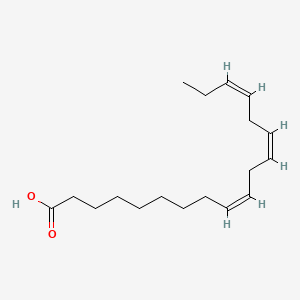
α-Linolenic acid
Chemical compoundWikipedia
23
MENTIONS
9
EPISODES
9
PODCASTS
Search complete. 23 mentions across 9 episodes found for "α-Linolenic acid".
Sep 5, 2026

Pal ManickamHOST
How about omega-3 fatty acids?
ArvindGUEST
Okay, so when it comes to omega-3, we do have omega-3 in the plant kingdom, but they're in the form of ALA, alpha-linolenic acid, which the body then has to convert into EPA and DHA, the long-chain ones.
ArvindGUEST
And the conversion the human body does is, depending on our genes, it changes, and it's not so efficient.
ArvindGUEST
So fish eat algae, which is a plant, and then they have omega-3 in their body.

Joel FuhrmanGUEST
At the same time, we're paying attention.
Joel FuhrmanGUEST
So that's called the ALA, the alpha-linolenic acid, the omega-3 present in those seeds and nuts.
Joel FuhrmanGUEST
So I'm using the salad dressings.
Joel FuhrmanGUEST
By the way, I'll finish that context.
16 MINS LATER
Joel FuhrmanGUEST
And the F70 in Venice Health Study showed a 12% increased risk of dementia among the vegans compared to the non-vegans.
Joel FuhrmanGUEST
And it's borne out by a couple of things here, but mostly the omega-3 index, that as you take out animal products, particularly seafood from the diet, you lower your exposure to preformed DHA and EPA.
Joel FuhrmanGUEST
And even though the body can make ALA, can make some EPA and DHA from the ALA you get from walnuts and flax seeds and green vegetables, that conversion is very genetically dependent and very inefficient, and you don't get an optimal index to protect brain size with aging as you would if you had chronic exposure to an exogenous source of DHA.
Joel FuhrmanGUEST
So supplementing with DHA for a vegan can be even more important And they make vegan DHA.

Joseph AllenHOST
If somebody does not like to eat fish or even take fish supplements because either they have an allergy or there's ethical reasons, if they eat a vegan lifestyle or they're worried about the ecology of fishing practices, then there are plant sources of omega-3.
Joseph AllenHOST
However, we don't call them EPA, DHA, we call them ALA.
Joseph AllenHOST
It stands for alpha linoleic acid, and you get this from ground flax seed, chia seed, walnuts, some canola oil, and soybeans.
Joseph AllenHOST
However, the concern is that the conversion in your body of ALA plant source omega-3 to EPA, DHA is quite low.
Joseph AllenHOST
It's somewhere around 4 to 8% in the literature.
Joseph AllenHOST
And so I'll even share in a little bit, I ate a vegan diet strictly for three months and then ate m- largely a whole food plant-based diet for, for several years, and I wasn't sure if I was getting enough omega-3.

Kieran MaguireHOST
Where is it from? What is it? Why does it matter?
Eliza FreneyGUEST
Okay, so omega-3 is a type of fatty acid So, um, the, the main types of omega-3 we talk about are ALA, EPA, and DHA.
Eliza FreneyGUEST
So most people don't realize that there are even different types of omega-3.
Eliza FreneyGUEST
Um, what you'll commonly hear people say is, "I'm taking a fish oil."
Kieran MaguireHOST
Cool.
Kieran MaguireHOST
All right.
Kieran MaguireHOST
Um, [lip smack] so EPA, DHA, ALA.
Eliza FreneyGUEST
Mm-hmm.

Richard BazinetGUEST
Because the omega-3s they're measuring are EPA and DHA in almost all of these measurements.
Richard BazinetGUEST
They call it the omega-3 index, usually.
Richard BazinetGUEST
It doesn't include that plant ALA1.
Richard BazinetGUEST
And so they show up as really, really low on that.
Richard BazinetGUEST
And you can correlate the omega-3 index inversely with health really well.

Tonje DominguezGUEST
There are a family of different fatty acids, and there are three of them that we usually talk about.
Tonje DominguezGUEST
So there is alpha-linolenic acid, ALA.
Tonje DominguezGUEST
There is EPA, and it's DHA.
Tonje DominguezGUEST
So the ALA, that is a short-chain fatty acid.
Tonje DominguezGUEST
that comes from the plant world.
Tonje DominguezGUEST
And for
speaker_1HOST
example, flaxseed can have ALA.
Tonje DominguezGUEST
And then we have EPA and DHA.

George CromackGUEST
... central nervous system.
AlexHOST
And as a parenthesis, I'm eating flax seeds and chia seeds, and my level of ALA was fine.
George CromackGUEST
Yeah.
AlexHOST
But apparently the conversion to EPA and DHA is not good.
George CromackGUEST
So not every...
George CromackGUEST
That, that, that, that's the problem, right? So those actually aren't long-chain omega-3 fat- fatty acids.
George CromackGUEST
They're omega-3, and some people do and some people don't convert ALA to, um- To, uh, long-chain omega-3 fatty acids.
George CromackGUEST
So that is a huge issue.

Gil CarvalhoHOST
you can also buy it pre-ground, that works too.
Gil CarvalhoHOST
flax seeds are so rich in omega-3s that one tablespoon covers your daily needs of ALA, the essential omega-3 we need to get from our diet.
Gil CarvalhoHOST
so that's how we grind flax seeds and store them, here's some info on grinding chia seeds and more on omega-3s in general.
Gil CarvalhoHOST
see you next time

Nelson NarcisoGUEST
But you get it from fatty fish, so sardines, anchovy, mackerel, et cetera.
Nelson NarcisoGUEST
Now, the thing about plants and fish, what differs is that in the case of a plant, you have what's called alpha-linolenic acid, ALA, which then the human body or animals convert into what's often called the active form of omega-3, which is EPA and DHA.
Nelson NarcisoGUEST
Plants do not contain EPA and DHA.
Nelson NarcisoGUEST
They only contain ALA.
Nelson NarcisoGUEST
The conversion happens in our body.
Nelson NarcisoGUEST
The challenge is that, and for a host of reasons, whether it's someone being obese or they're a smoker, if they have very high intake of omega-6 fats, the conversion efficiency of omega-3 or ALA into the preformed omega-3, EPA and DHA, isn't ideal.
Nelson NarcisoGUEST
So even if people consume adequate amounts of ALA, the plant forms of omega-3, they may still not be getting adequate amounts of EPA and DHA simply because their efficiency isn't there.
Nelson NarcisoGUEST
Now, for those that are vegan, luckily there are vegan sources of EPA and DHA from, for example, algae sourced EPA and DHA.