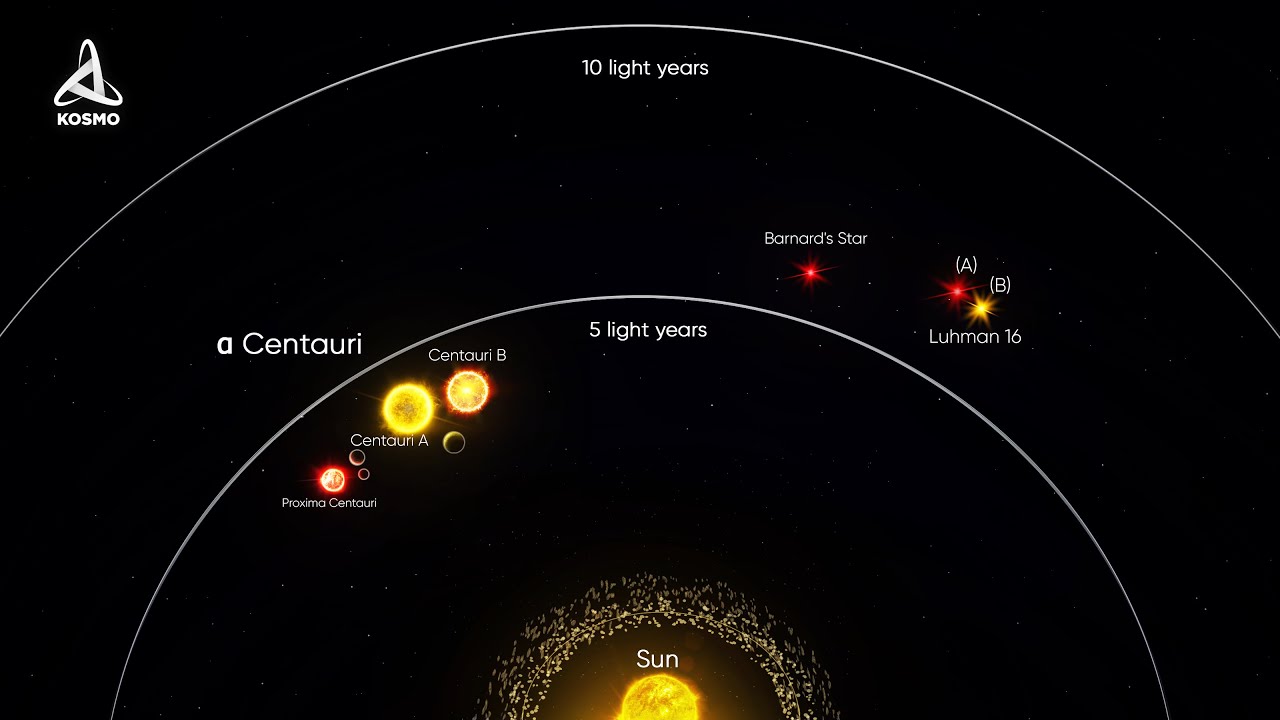
Alpha Centauri
Star systemWikipedia
1.9k
MENTIONS
399
EPISODES
167
PODCASTS
Search complete. 1883 mentions across 399 episodes found for "Alpha Centauri".
Sep 13, 2026

AmandaGUEST
And, um, so then Mars was like the, the next choice.
AmandaGUEST
And then of course once we started sending Mars probes and they realized it was a rather large desert ball, didn't seem to be any vegetative life or anything like that there, then it got time for us to, uh, hear from them that they were moving to like Alpha Centauri or the Pleiades or [laughs] or any, "Oh, we're from the Andromeda Galaxy," or any other of those kinds of things.
AmandaGUEST
You know, places that we could not possibly verify whether they were from there or not is all of a sudden where they're from.
AmandaGUEST
And, uh, that's kind of the way it's been since on that.

Tyler KiwalaHOST
And therefore, the heavier you get, you slow yourself down, not being able to achieve any speed faster than the speed of light.
Tyler KiwalaHOST
So they, they did, they do have a fix for that, but this is an interesting chart here that shows the difference between if you're going to Alpha Centauri, if you were to travel there at the speed of light, it would take you 4.2 light years to get there.
Tyler KiwalaHOST
With warp drive technology, weeks to months.
Tyler KiwalaHOST
With wormhole technology, minutes to hours.

Steven NovellaHOST
So then you get the ability to have locations where you can instantaneously go from, say, one system to the other.
Steven NovellaHOST
We could c- we could settle Alpha Centauri and have a jump gate there and a jump gate, you know, at the Sol system.
Steven NovellaHOST
But that doesn't give the ability for every alien out there in the universe to come find us.
Steven NovellaHOST
But we could slowly expand our civilization with jump gates.
Aaron KuhnHOST
Right?
Alandra MarkmanGUEST
Oh, I, I could also say on the physical level, I'm hybridized with Alpha Centauri humans.
Alandra MarkmanGUEST
Um, so there are some slight differences, um, that make me a little unusual on Earth.
Alandra MarkmanGUEST
Um, but I'd be very average by Alpha Centaurian standards.
Alandra MarkmanGUEST
So there's that connection also.
Tyler KiwalaHOST
So Antarian and Centaurian.
Alandra MarkmanGUEST
[laughs]
Tyler KiwalaHOST
Yeah.
Tyler KiwalaGUEST
Things they can go verify.
Tyler KiwalaGUEST
If we were to jump off planet and say, "Oh, this guy served on Jupiter or Alpha Centauri," whatever, you know, these wild stories, no one, no one can prove that one way or the other, and then you're just-
Aaron KuhnGUEST
Right
Tyler KiwalaGUEST
... you're just telling a story.
Tyler KiwalaHOST
So, you know, we have to ask ourself, if we are getting to these other planets, if we're aware of these other planets, and we're not going through a portal or a jump hole, how is it possible? Because, you know, the biggest issue is that physics proves is that you cannot travel faster than the speed of light because as you increase in speed, you increase in mass because it gets hotter, and therefore you-- the heavier you get, you slow yourself down, not being able to achieve any speed faster than the speed of light.
Tyler KiwalaHOST
So they, they did-- they do have a fix for that, but this is an interesting chart here that shows the difference between if you're going to Alpha Centauri, if you were to travel there at the speed of light, it would take you four point two light years to get there.
Tyler KiwalaHOST
With warp drive technology, weeks to months.
Tyler KiwalaHOST
With wormhole technology, minutes to hours.

Commander KHOST
Oh, yeah.
Commander KHOST
You're in Alpha Centauri
BiggsHOST
already.
BiggsHOST
Yeah, and they're

Phil ChenevertNARRATOR
I alighted on the burning star nearest to our Earth.
Phil ChenevertNARRATOR
This star is called, by our astronomers, Alpha Centaurus, and it is said to be twenty trillion miles away.
Phil ChenevertNARRATOR
This star is much greater than our Sun.
Phil ChenevertNARRATOR
and is the centre of a system of worlds larger and more numerous than those that compose our solar system you cannot imagine my surprise when i reached alpha centaurus and found that it was inhabited by a class of human creatures who were created to live and flourish in fire their customs and habits are so strange that i am not capable of giving an intelligent description of them I know that it is inconceivable to us how life can be developed and sustained in the midst of a burning sun, and I have found that these beings in turn could not conceive how life can exist in a cold world like ours.
Phil ChenevertNARRATOR
These creatures have no digestive organs.
Phil ChenevertNARRATOR
They live in part on the chemical action produced by fire-breathing.
Phil ChenevertNARRATOR
If they were to get away from the heat, this chemical action would cease, and therefore death would be as certain to them as being enveloped in fire would spell death to us.
Phil ChenevertNARRATOR
In our eyes their bodies are misshapen, composed of elements most of which are not found in our world.

speaker_15NARRATOR
In the immensity of space, the sun with all his revolving planets is not even as a drop to the ocean or a grain of sand to the composition of the earth.
speaker_15NARRATOR
there are millions of other suns of larger dimensions with larger attendants wheeling around them in the illimitable fields of space those stars which we erroneously call fixed stars are the centres of other systems vastly greater vastly grander than the one of which our earth forms so insignificant a part of course to us numbers of them appear even when viewed through the most powerful telescopes only as mere luminous points but that is owing to the immensity of distance between them and ourselves but the number that is visible to us even with instrumental assistance can have no comparison with the number that we cannot see there is no limit to that number away in what to us may be called the background of space are millions billions uncountable myriads of invisible suns regulating and illuminating countless systems of invisible worlds and beyond those invisible suns and worlds is a region which thought cannot measure and numbers cannot span the finite mind of man becomes dazed dumbfounded in contemplation of magnitudes so great and distances so amazing we stand not bewildered but lost before the problem of interstellar space its length breadth height and circumference are illimitable boundless the great eternal cosmos without beginning and without end in order to get some idea of the vastness of interstellar space we may consider a few distances within the limits of human conception we know that light travels at the rate of one hundred eighty six thousand miles a second yet it requires light over four years to reach us from the nearest of the fixed stars travelling at this almost inconceivable rate and so far away are some that their light travelling at the same rate from the dawn of creation has never reached us yet or never will until our little globule of matter disintegrates and its particles its molecules and corpuscles float away in the boundless ether to amalgamate with the matter of other flying worlds and suns and stars the nearest to us of all the stars is that known as alpha centauri its distance is computed at twenty five trillion miles it takes light over four years to traverse this distance it would take the empire state express never stopping night or day and going at the rate of a mile a minute almost fifty million years to travel from the earth to this star the next of the fixed stars and the brightest in all the heavens is that which we call sirius or the dog star It is double the distance of Alpha Centauri.
speaker_15NARRATOR
That is, it is eight light-years away.
speaker_15NARRATOR
The distances of about 70 other stars have been ascertained, ranging up to 70 or 80 light-years away.
22 MINS LATER
Chad JacksonNARRATOR
To be exact, the rate is 186,400 miles per second.
Chad JacksonNARRATOR
To get an idea of the immensity of the distance of the so-called fixed stars, let us take this as a base of comparison.
Chad JacksonNARRATOR
The nearest fixed star to us is Alpha Centauri, which is one of the brightest as seen in the southern heavens.
Chad JacksonNARRATOR
It requires four and one quarter years for a beam of light to travel from this star to To Earth.

Victor SterlingNARRATOR
For full access to our archive, visit patreon.com slash oldtimeretroradio.
Victor SterlingNARRATOR
On the eve of his wedding, Jeff Coffin is drugged after his bachelor party and awakens aboard a deep space freighter bound for Alpha Centauri.
Victor SterlingNARRATOR
It is a 15-year voyage, and Jeff's insistence that he has been kidnapped meets the hard rules of interstellar service and a skeptical crew.
Victor SterlingNARRATOR
From NBC Radio's X-1, this is Shanghai'd, Episode 16, first broadcast September 1, 1955.
389 more episodes mention Alpha Centauri.
Create an account to see the whole feed, search across every transcript, and follow the entities you care about.