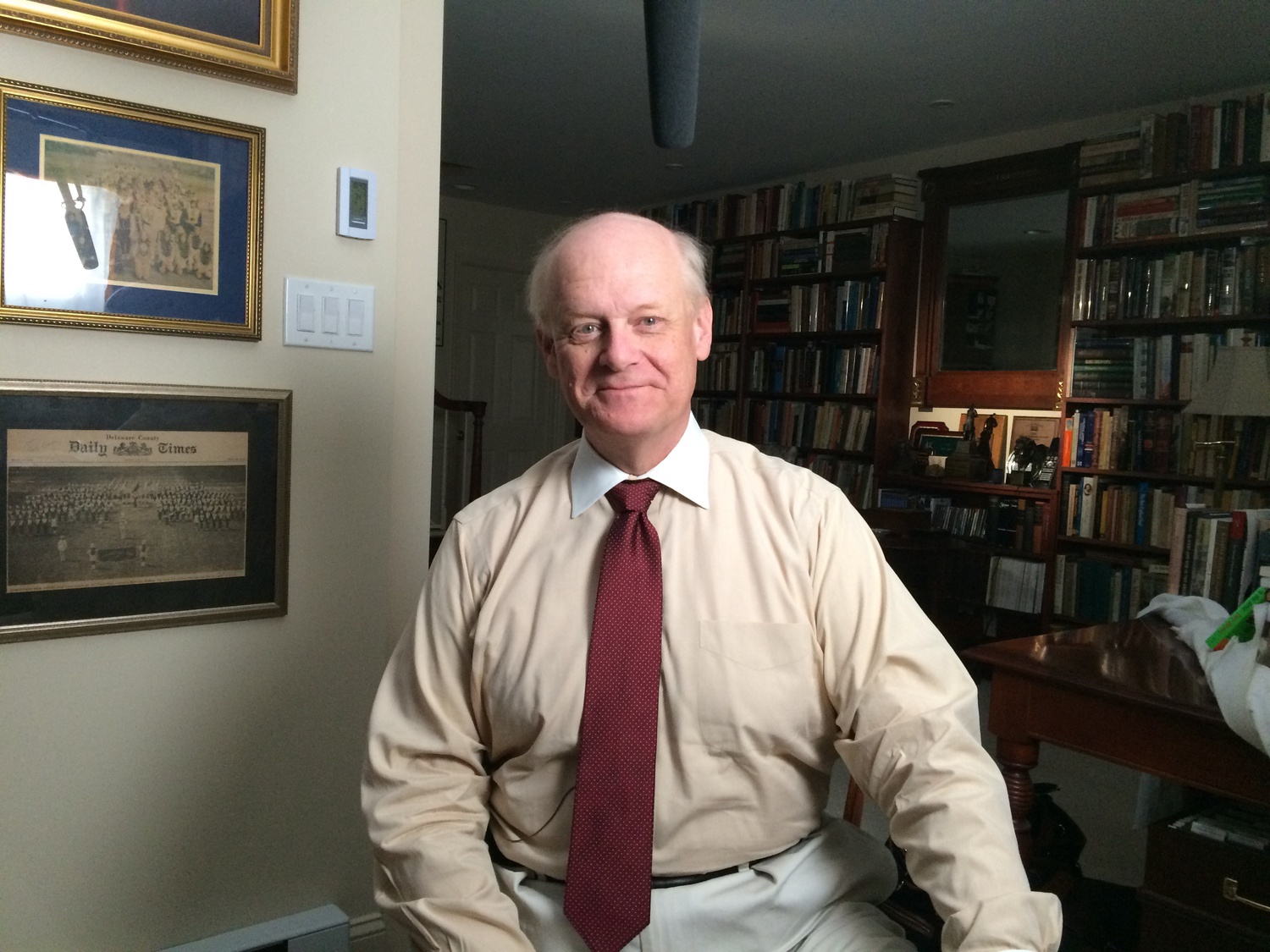
Allen C. Guelzo
American historian
11
APPEARANCES
9
PODCASTS
Oct 20, 2026


Allen GuelzoGUEST
Does a racist put weapons into the hands of black men, clothe them in the uniform of the United States, and send them out to kill genuine white supremacists in gray uniforms? Is that what you expect from a racist? Is a racist someone who, in the last speech that he gives in his life, talks about the importance of extending the vote to the newly freed slaves and extending public education to their offspring? A comment which draws from a member of the crowd the promise, I know what that means.
Allen GuelzoGUEST
That comment, of course, came from John Wilkes Booth, and we know what happened as a result of that.
Allen GuelzoGUEST
Is that what you would call the mark, if we're speaking of Lincoln, of a racist? When Frederick Douglass goes for the first time to meet Lincoln in 1863, Douglass, who has been frankly critical of Lincoln on many points up to that moment, he goes to meet Lincoln and says afterwards, I was treated by him as one gentleman would treat another.
Allen GuelzoGUEST
Is that the mark of a racist? So I put this question by way of response, and it suggests that there is more to this question than simply that one quote from the fourth of the Lincoln-Douglas debates at Charleston, Illinois, in 1858.
44 MINS LATER
Josh LewisHOST
To what degree would that be correct? And if it's not correct, is it a matter of the scale of what, say, Lincoln's political economy was less than, or is it a difference of kind, or how are these things similar or different?


John BatchelorHOST
I hope I've said this correctly and not taken away from your achievement, Alan.
Allen GuelzoGUEST
It illustrates for us what people are willing to wager on what they most profoundly believe to be true.
Allen GuelzoGUEST
There was a soldier, an officer in a Massachusetts regiment who was born in Denmark.
Allen GuelzoGUEST
His fellow soldiers of that Massachusetts regiment said to him, what do you have at stake in this battle? This is a battle between the northern and southern sections of the United States.
6 MINS LATER

Allen GuelzoGUEST
We could have, I suppose, have used as a title something from The Brothers Grimm with Hansel and Gretel and the breadcrumbs.
Allen GuelzoGUEST
But we decided that, you know, titling these books The Breadcrumbs, A History of the Western Tradition, just would not have the right impact.
Allen GuelzoGUEST
We decided to go back to the golden thread because, look, both of us had the same Latin teacher in high school.
18 MINS LATER


Allen GuelzoGUEST
And even those disciplines, even those pursuits, which don't think of themselves as being connected to history, nevertheless, they have one.
Allen GuelzoGUEST
And history is a way of shaping, understanding, clarifying, sometimes condemning, at other times exalting what has happened in events and with people that are no longer here to talk about them directly to us.
Allen GuelzoGUEST
There are many people who are very dubious about this exercise that we call history.
5 MINS LATER

Albert MohlerHOST
So when did that happen? When did that sense of civilizational doom or exhaustion arise?


Newt GingrichHOST
What is it about Lincoln that first captured your attention and then kept your attention?
Allen GuelzoGUEST
And although people like to say, almost routinely, that 16,000 books have been written about Abraham Lincoln, That's a bit of an exaggeration.
Allen GuelzoGUEST
The 16,000 books with Lincoln in the title doesn't mean they're really about him.
34 MINS LATER
Newt GingrichHOST
What's your feeling about at the 250th anniversary? What do you think Lincoln would say if he were wandering around today?

Allen GuelzoGUEST
He picks up the rhythm of speech, and he turns for a career to law, where he has to speak and speak in a persuasive and convincing fashion.
Allen GuelzoGUEST
So we're already starting to see some interesting pieces come together this way as he is in, you know, a mid-adult, let's say, in, he's in his forties.
Allen GuelzoGUEST
What he needs is a moral flame that will ignite all those pieces and weld them together, and that's what he gets in the 1850s when the Kansas-Nebraska Act looks like it's going to completely reverse all the direction of the American Republic on the subject of slavery.
Allen GuelzoGUEST
The direction that people understood up to that point had been slavery, well, right, we really can't do terribly much about it, but we're gonna contain it in the South.
Allen GuelzoGUEST
We're gonna let it asphyxiate on its own because it is, it's gonna die out on its own.
38 MINS LATER
Allen GuelzoGUEST
It's so much of a thought experiment that if you want to see Locke with flesh on the bones, you have to go to a novel in England, right? And that's Defoe's Robinson Crusoe.
Allen GuelzoGUEST
Ro-Robinson Crusoe is really, it's really Locke, uh, and the Two Treatises, and this, this is what it would look like.
Allen GuelzoGUEST
No, no one, no one woke up the next day after reading the Two Treatises and said, "Okay.
51 MINS LATER

Jonah GoldbergHOST
Is it just pure i- a pure ideological taste test, that they like the flavor of that kind of revolutionary stuff? Why is the American Revolution cast out into the old eighteenth century and not part of-The long nineteenth century and the, the, the revolutionary tradition that gets such fawning treatment by most historians.


Scot BertramHOST
Dr. Gelso, where do we see that the value of Western civilization? Why has it been resilient through crises? And where do we see redemption through time?
Allen C. GuelzoGUEST
And I bracket those together, and Jim brackets them together with me, because you can have government but it can be perfectly lawless and malevolent.
Allen C. GuelzoGUEST
What the West has done has been to find ways of linking, in important ways, government and law together.
13 MINS LATER
Scot BertramHOST
What keeps that golden thread intact? And what is the greatest danger to keeping it in place?


Allen GuelzoGUEST
We're dealing in 1924 with an era of tremendous disenchantment on the part of Americans.
Allen GuelzoGUEST
I mean, here, here this marvelous, uh, Y- European civilization has spent four years in the trenches blowing its brains out, and what do, what do we have as a result of it? Well, what we have is a deranged Europe, which is gonna get more deranged very quickly....
Allen GuelzoGUEST
So what are we trying to do? It's almost like we are trying to do a kind of disinfectant.
Allen GuelzoGUEST
We're trying to say, "We don't want to go in the direction that the Europeans have shown that they have gone." And there are gonna be some Europeans who are, in our minds, more dangerous than that, but it is a- it i- it is a moment of r- of real angst and disenchantment.
7 MINS LATER
Jonah GoldbergHOST
How much of this is, is that r- sort of, what's the phrase? Rights come from wrongs, that people, that we've learned the ideas of Western civilization inform how we learn, this resilience and adaptivity that you're talking about, but it's less the ideas driving things and more learning from events to find best practices?
Allen GuelzoGUEST
What makes things happen? Is it, is it some, uh, some inevitable cycle that human beings are condemned to follow? If that's the case, then Polybius was right in his histories when he talked about the three stages of every human society.
Allen GuelzoGUEST
Three stages, each of which has its, its own corruption stage, so you might wanna say that there are six stages.
Allen GuelzoGUEST
Uh, you can take the view of Polybius, and this is simply going to happen, and it's gonna happen inevitably.
Allen GuelzoGUEST
How do you stave off the negative aspects of it? Well, perhaps Polybius says, "You might wanna do like the Romans and you might wanna create a constitution which has one aspect to each of these three things." That might forestall the kind of corruption that undid previous regimes.
34 MINS LATER
speaker_11UNKNOWN
(laughs)


Allen GuelzoGUEST
People ask, "How long did it take you to write this?" And I say, "Well, actually we've been writing it for the last five decades." Uh, because every time we get together the kind of questions that are captured in The Golden Thread are the substance of our discussions and it just ram- it has just rambled over the years freely over the landscape.
Allen GuelzoGUEST
He covers the ground from, from ancient Greece up to the first inklings of the Renaissance.
Allen GuelzoGUEST
And between the two of us we have just had this ongoing dialogue for lo these many decades.
10 MINS LATER