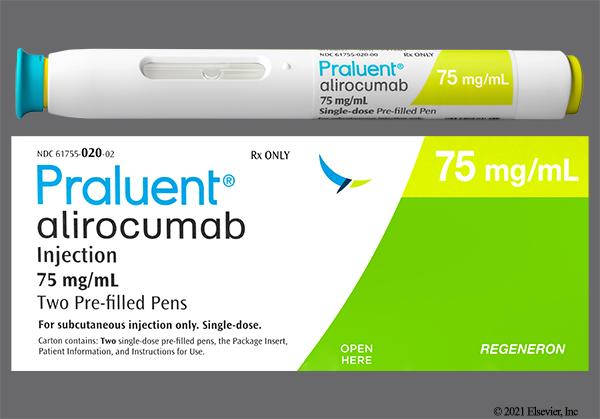
Alirocumab
MedicationWikipedia
16
MENTIONS
15
EPISODES
10
PODCASTS
Search complete. 16 mentions across 15 episodes found for "Alirocumab".
Oct 19, 2026

AloHOST
Now, before this new pill, every PCSK9 inhibitor on the market required a needle.
AloHOST
Evolocumab and Alirocumab, brand names Repatha and Praluent, are injectable antibodies you give yourself under the skin every two to four weeks.
AloHOST
There's also Inclisiran, brand name Lekvio, which uses a different technology, small interfering RNA, but it still has to be injected by a healthcare provider twice a year.
AloHOST
I want to be clear.

Ken BerryHOST
So...
Ken BerryHOST
Taking a statin or Repatha or Praluent, they're not going to lower your triglycerides or raise your HDL.
Ken BerryHOST
I want you to cut the carbs more.
Ken BerryHOST
Okay.

Ken BerryHOST
The hydrophilic statins, which didn't seem to show this same doubling of dementia risk, are Pravastatin, which is marketed as Pravacol, and Rosuvastatin, which is marketed as Crestor.
Ken BerryHOST
Important to note, that this study did not look at the PCSK9 inhibitors, which are Evalocumab, marketed as Repatha, and Alirocumab, which is marketed as Praluence.
Ken BerryHOST
This study did not consider these two drugs, so we don't know if these two currently double your risk of dementia or not.
Ken BerryHOST
That's yet to be determined by further research.
Ken BerryHOST
Uh, in my opinion, my educated opinion, a statin is not gonna slow that plaque progression down.
Ken BerryHOST
Uh, a Repatha, Praluent, a PCSK9 inhibitor's not gonna slow that progression down.
Ken BerryHOST
There is some limited research, and a lot of anecdotal research, that, uh, eating a very, very low carb diet strictly-
Amanda DeckerGUEST
Mm-hmm

Michael WilkinsonGUEST
But really where those guideline recommendations come from are post-hoc analyses of the PCSK9 inhibitor monoclonal antibody outcomes trials.
Michael WilkinsonGUEST
So Fourier with Evolocumab and the Odyssey outcomes trial with Alirocumab.
Michael WilkinsonGUEST
And in post-hoc analyses, looking at those participants with the highest LPA levels, Those individuals did significantly benefit from the use of PCSK9 inhibitors.
Michael WilkinsonGUEST
They experienced significant risk reduction for recurrent events, as was the takeaway from those trials.

Ken BerryHOST
Now, back to that topic of common sense that we were discussing earlier.
Ken BerryHOST
Doesn't it make common sense that a doctor should spend the majority of their time in counseling the patient, spend the majority of money testing the patient with blood tests and other diagnostic modalities, uh, and then the majority of the handouts should focus on the biggest parts of this pie? What's the biggest risk factor for developing heart disease and a, and a heart attack? But what we find when we, when we get feedback from patients, uh, kind of exit polls after they leave the doctor's office is, what did the doctor spend the most time talking about? And very often, what the doctor spent the most time talking about, ordered the, the most lab tests to check, and prescribed the most medications, uh, in a kinda simulacrum of pre- heart disease prevention was lipids, uh, specifically LDL cholesterol and statins, a class of drugs that doctors prescribe to patients to lower LDL cholesterol, or, uh, Repatha and Praluent, which is a new drug class that, that lowers your LDL cholesterol precipitously.
Ken BerryHOST
Now, so your, your question would be, well, n- shouldn't a doctor spend most of their time, most of the, the lab tests, and most of the prescriptions, and most of the handouts, shouldn't all that stuff focus on the biggest risk factor for heart attack? Yeah, I would agree.
Ken BerryHOST
Yes.
Ken BerryHOST
There must be a big slice of pie." No, it's not.
Ken BerryHOST
Uh, el- elevated LDL cholesterol actually comes in number thirteen or number fourteen on the list of risks for heart attack.
Ken BerryHOST
So it's not, it's not even in the top ten, yet the average doctor will spend the majority of the office visit time yelling at the patient about their high LDL cholesterol, prescribing them a statin or Praluent or Repatha to get their LDL cholesterol down.
Ken BerryHOST
And in, and in a, a s- a shockingly large pursu- per- proportion or percentage of the patient visits, they won't even test the patient to see if they have type two diabetes or early type two diabetes.
Ken BerryHOST
They ignore all that.
Ken BerryHOST
All they care about is getting you on that statin or on Repatha or Praluent.
Ken BerryHOST
It's inappropriate.
Ken BerryHOST
It's bad medical practice and it's not truly protecting you from having a heart attack.
Ken BerryHOST
Uh, indeed, all the statins and most of the other cholesterol-lowering medications are gonna deplete your store of CoQ10, or ubiquinone.
Ken BerryHOST
We're not sure yet if Repatha and Praluent, the newest PCSK9 inhibitors, if they lower your CoQ10 or not.
Ken BerryHOST
We need more research on that.
Ken BerryHOST
The next drug class is the acid blockers, whether you're talking about proton pump inhibitors or H2 blockers or even just over-the-counter antacids.

Michael J. WilkinsonGUEST
But really where those guideline recommendations come from are post-hoc analyses of the PCSK9 inhibitor monoclonal antibody outcomes trials.
Michael J. WilkinsonGUEST
So Fourier with Evolocumab and the Odyssey outcomes trial with Alirocumab.
Michael J. WilkinsonGUEST
And in post-hoc analyses, looking at those participants with the highest LPA levels, those individuals did significantly benefit from the use of PCSK9 inhibitors.
Michael J. WilkinsonGUEST
They experienced significant risk reduction for recurrent events, as was the takeaway from those trials.
Ken BerryHOST
And then if you still are adamant about trying to get my LDL cholesterol under seventy, I'm gonna find a new doctor, because my goal as a human being is to live a long damn time and to live a long, healthy life." So according to this study and according to the, the data that was used to calculate, uh, the, the, um, data that's in this chart, it's much, much healthier with regards to not dying to have an LDL cholesterol of two hundred and fifty versus having an LDL cholesterol less than seventy.
Ken BerryHOST
So please think about it before you take any of the high-dose statins like Lipitor, Zocor, Crestor, or definitely before you think about taking one of the aggressively LDL cholesterol lowering drugs like Praluent or Repatha.
Ken BerryHOST
You're increasing your risk of all-cause mortality, that means of dying from any reason, by taking those drugs.
Ken BerryHOST
So in addition to the inconvenience of having to sit in the doctor's office and then stand in the pharmacy line and pay all the co-pays associated with that, you're also gonna be at increased risk of dying.
5 more episodes mention Alirocumab.
Create an account to see the whole feed, search across every transcript, and follow the entities you care about.