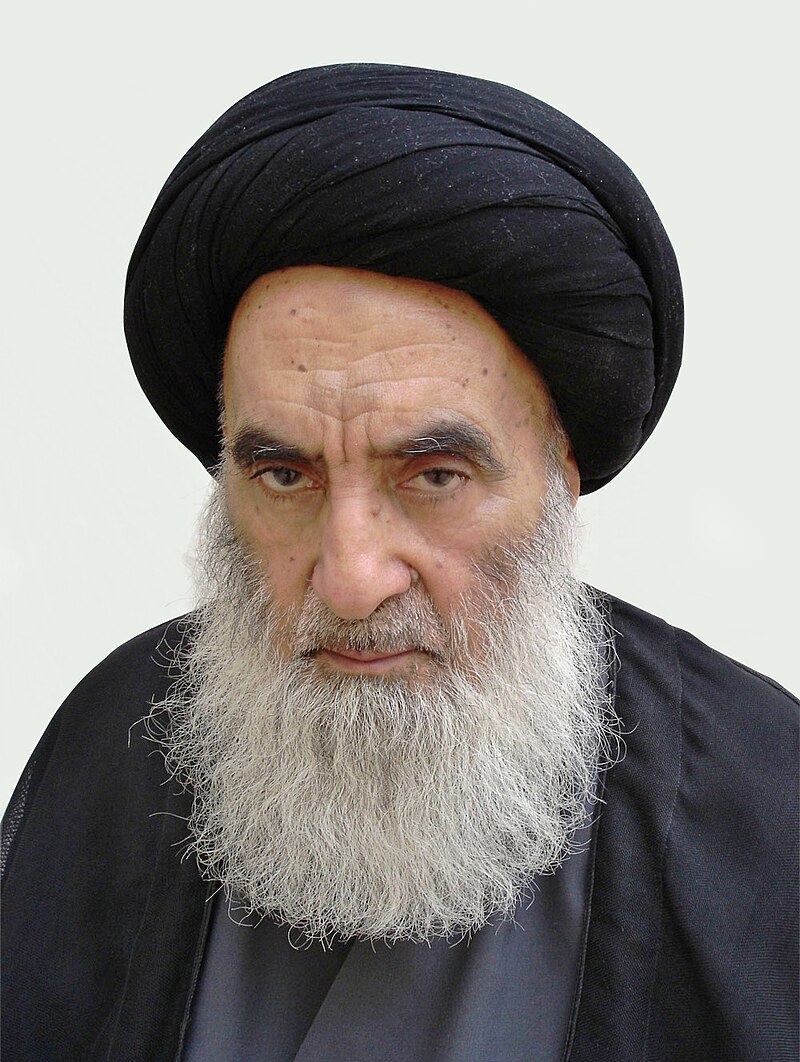
Ali al-Sistani
Religious leaderWikipedia
8
MENTIONS
6
EPISODES
5
PODCASTS
Search complete. 8 mentions across 6 episodes found for "Ali al-Sistani".
Oct 27, 2026

Ernest C. AudinoGUEST
Shortly after that, in... 2014, no, 2015, I believe.
Ernest C. AudinoGUEST
2014, Ayatollah Sistani signed a fatwa, issued a fatwa authorizing the expansion of the Hashd al-Shaabi, the Shia militias inside Iraq.
Ernest C. AudinoGUEST
2015, 16, somewhere in there, the Iraqi parliament formally incorporated the Hashd al-Shaabi into the Iraqi security forces.
Sarah Martinez AmirHOST
That reminds me, like you said, very much of the Lebanese model where we've got Hezbollah very much embedded within the Lebanese parliament, making decisions, being part of the government policy.

David HoldridgeGUEST
and have some responsibility along with my deputy, Paul Butler, and a couple of others, and the national staff.
David HoldridgeGUEST
We hooked on day one, not to the green zone, not to the donor, not to my headquarters, but to the Ayatollah Ali Sistani, who was basically in the holy cities, Karbala and Najaf, and was Probably one of the wisest people, I would say absolutely the wisest person in the Shia faith that existed.
David HoldridgeGUEST
These are the Shias that were slaughtered regularly by Saddam Hussein.
David HoldridgeGUEST
And we got a fatwa from him.
6 MINS LATER
David HoldridgeGUEST
And posted right there.
David HoldridgeGUEST
I mean, and our only antidote is, was more powerful.
David HoldridgeGUEST
And that was the Grand Ayatollah Ali Sistani and the principles and the faith of the Shia of Islam.
David HoldridgeGUEST
And I hear that stuff in the United States.

David IgnatiusGUEST
They've been, um, the sort of dueling, uh, centers of Shia power for centuries.
David IgnatiusGUEST
Um, with I- Iraq's problems and the, the eclipse o- of Ayatollah Sistani in Iraq, Iran has had the ascendancy.
David IgnatiusGUEST
But, um, Shiism, uh, except for its most militant phase, the IRGC, the Iranian Re- Revolutionary Guard Corps, Islamic Revolutionary Guard Corps, has seemed to many analysts to, to be in, in retreat.
David IgnatiusGUEST
The religious leadership in Iran is old, s- kind of sclerotic.
Richard PerleGUEST
Uh, if they existed in our society, we would move heaven and earth to destroy them.
Charlie RoseHOST
But isn't there a great risk in destroying them, which is what some people say, which is the reason they didn't go into Najaf and, and, and do as much damage as they could have, and the reason they haven't gone-- they pulled back from Fallujah, and the reason so far, uh, because of the, the warnings of Ayatollah Sistani and others, they haven't done more.
Richard PerleGUEST
Well, I believe that if the decision is made-
Charlie RoseHOST
It's a dilemma

Entifadh QanbarGUEST
He disappeared in Iraq.
Entifadh QanbarGUEST
Anyway, so basically what we have now is, but every major Shia scholar, or they call it Mujtahid, Sistani, Al-Khoi, Al-Ansari, said Walayat al-Faqih absolutely does not exist in Shia doctrine, in Shia ideology.
Entifadh QanbarGUEST
So if we can use this to completely undermine the whole legitimacy of .
Entifadh QanbarGUEST
Nobody did.
Dan PfeffermanHOST
There has to be, there has to be a very strong narrative effort.
Entifadh QanbarGUEST
I can bring you hundreds of Shia, even supporting Iran, not against Iran necessarily, but they will tell you as a Shia doctrine that doesn't exist.
Hayvi BouzoHOST
So the holiest site for Shia is in Iraq, right? The Sistani...
Dan PfeffermanHOST
Najaf, right?

Abdullah HashemHOST
So the commentaries of the scholars throughout history.
Abdullah HashemHOST
Just like the Shia right now, they compile and they hold to heart the answers of so-called ayatollahs like Sistani, Khamenei, et cetera.
Abdullah HashemHOST
The same thing takes place in Judaism.
Abdullah HashemHOST
The rabbis, uh, they play a very important part in Jewish law.