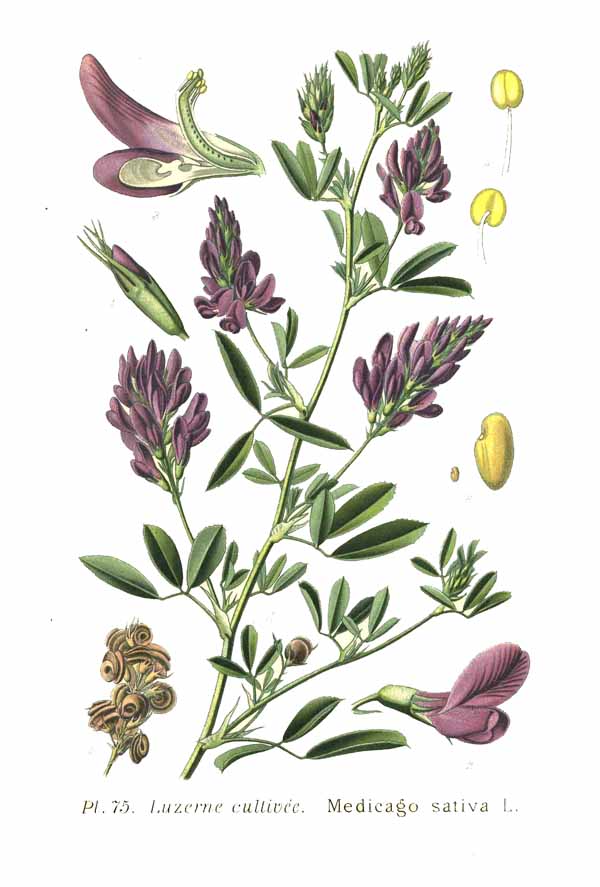
Alfalfa
PlantWikipedia
32
MENTIONS
17
EPISODES
17
PODCASTS
Search complete. 32 mentions across 17 episodes found for "Alfalfa".
Nov 2, 2026

IanHOST
it's taken quite a long time.
NigelHOST
Anyway, so one of the things that they love feeding on is Lucerne.
NigelHOST
What is lucerne, you ask? Yeah, I do ask what is lucerne.
NigelHOST
It is a silage crop which farmers put in their fields for several reasons.
NigelHOST
Tolland, because it's got deep tap roots.
NigelHOST
Wow.
NigelHOST
So, Lucerne.
NigelHOST
It reminds me of a character from Day of the Tentacle.

Shane SaterHOST
Thanks for joining me.
Shane SaterHOST
This story, which I share here in November 2026, is called Alfalfa to Oak Forest, Sounds of the Oaxacan Mixteca.
Shane SaterHOST
As you most likely know by now, I really enjoy recording bird songs and other sounds of nature and sharing them, and this podcast is going to be the first in a new series that I'm excited to share, focused on the sounds and stories of different natural areas on the landscape.
Shane SaterHOST
I'll be making a new page on my website to link specifically to these stories as well as older stories that fit in with this same theme.

Jesse AllenHOST
One quick news note before we get to the break.
Jesse AllenHOST
Alfalfa producers dealing with reduced yields after a dry growing season may be wondering whether those stands will make it through the winter or or if it's time to rotate fields.
Jesse AllenHOST
Randy Welch, Cropland National Alfalfa Agronomist, says drought stress alone isn't necessarily a reason to tear up an alfalfa stand.
Randy WelchSOUNDBITE_SPEAKER
So there's really no loss in winter hardiness of drought stressed alfalfa.
Randy WelchSOUNDBITE_SPEAKER
So the alfalfa plant is designed to take dry weather.

Christina Boucher ReynoldsGUEST
So I know it's true because it was always kind of something whenever anybody would bring it up, you know, the textbook response is like, no, that's not a thing.
Christina Boucher ReynoldsGUEST
Alfalfa doesn't make horses hot.
Christina Boucher ReynoldsGUEST
Like giving them more calories might make them hot or changing their diet might make them hot.
Christina Boucher ReynoldsGUEST
But I do have one who gets genuinely like kooky if she has alfalfa in her diet.

Brian HeftyHOST
Well, wait a second.
Brian HeftyHOST
Alfalfa or grass hay? I thought he was just alfalfa.
Brian HeftyHOST
Alfalfa question I think if you damage those plants they're not coming back and it's not going to fill in well and the reason why is the allelopathy that alfalfa creates so what happens with alfalfa the plant in the soil kicks out chemicals and don't don't lose your minds if you're in the word chemicals it's their own natural things to suppress other plants including their own species and This is why you can't interseed alfalfa into alfalfa.
Brian HeftyHOST
So no, there's zero chance I would want to do that in alfalfa.
Brian HeftyHOST
You can sure try it.

Lynne TrulioGUEST
oh dear so you know and unfortunately um they also don't do well in orchards or in vineyards So there's only certain types of agriculture.
Lynne TrulioGUEST
Alfalfa, a brain place.
Lynne TrulioGUEST
Okay.
Scott HarrisHOST
Now, backing up a little bit, we were talking about Florida and we'll call them West Coast burrowing owls.

Sajah PophamHOST
So it's interesting for me, you know, only really knowing alfalfa from my herbal perspective and thinking of it that way and then just feeding it to animals more and it's like oh it's just it's just interesting i could really see the
Sajah PophamHOST
nutrient
Sajah PophamHOST
dynamic with this herb based on how it is with the animals so anyways alfalfa rich in the following nutrients iron magnesium calcium potassium you'll see those three a lot vitamins a b c d e k and folate biotin it's a very rich vitamin profile now the vitamin d piece i think is interesting and that's you know and that might be yeah that part's interesting i feel like i'd like to learn a little more about that one so i'm like d really um now how was alfalfa typically used well we use it for general malnutrition i tend to think of it if i see someone that's malnourished they're very skinny thin weak emaciated they're tired they as i yawn um maybe they have blood deficiency right maybe they um if it's a woman if they uh bleed really heavily around menses maybe they're a vegan or vegetarian and they're just they're anemic uh that's these are some indications i think of um Alfalfa is incredibly antioxidant, slightly astringent, a bit vulnerary.
Sajah PophamHOST
So you could use it a little topically, but it's very antioxidant.
Sajah PophamHOST
So protecting the body from inflammatory damage, oxidative damage.
Sajah PophamHOST
Usually herbs that are indicated for neurasthenia are nervines.
Sajah PophamHOST
You see herbs like St. John's wort and milky oats and skullcap and things like that.
Sajah PophamHOST
Alfalfa is not really a nervine.

speaker_2HOST
Gross revenue is an illusion if the expenses eat it all.
speaker_2HOST
Alfalfa is traditionally more expensive to grow, harvest, and feed than corn silage.
speaker_2HOST
Corn silage gives you massive tonnage per acre.
speaker_2HOST
Alfalfa gives you high protein but lower yield, and it requires multiple cuttings.
speaker_1HOST
So if adding more alfalfa to hit that 30-70 ratio bumps your daily ration cost by 20 cents per cow, you only keep 4 cents of that milkshake premium.
speaker_2HOST
Right.
11 MINS LATER
speaker_1HOST
That's standard public funding expected for this kind of work.
speaker_1HOST
Sure.

Liliane SilvaGUEST
Yeah.
Liliane SilvaGUEST
Alfalfa always have your schedule for spring that you're required to every year, right? But one thing that based on the weather.
Liliane SilvaGUEST
So how did that impact when you're choosing the varieties that you're using now? Are you using reduced lignin varieties?
Josh BeesonGUEST
I do have some hardback extra varieties.

Mark SmithNARRATOR
Wild strawberry developed into large table variety by Johann Schwerdkopf, German, who came to Long Island before Revolutionary War.
Mark SmithNARRATOR
Alfalfa seed, known as lucerne, brought to Minnesota and developed by Wendelin Grimm, German, in 1858.
Mark SmithNARRATOR
Hearty alfalfa for prairies of Northwest, brought from Siberia and Turkestan by Niels Hansen, Dane.
Mark SmithNARRATOR
Mower and reaper invented by Cyrus McCormick, Scotch-Irish.
7 more episodes mention Alfalfa.
Create an account to see the whole feed, search across every transcript, and follow the entities you care about.