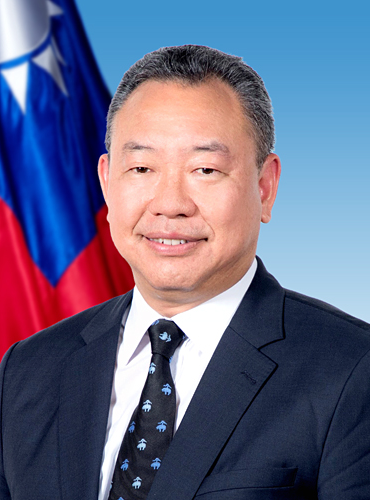
Alexander Tah-ray Yui
Taiwan’s Representative to the United States
14
APPEARANCES
11
PODCASTS
Oct 29, 2026


Alexander YuiGUEST
always been, so there's always been, no, there's always been this grudge between those who were already in Taiwan before 49 and those who came with Chiang Kai-shek after 49.
Alexander YuiGUEST
And the party politics in Taiwan has also alignments with local and after 49ers.
Alexander YuiGUEST
And then KMT, which is a party that came with Chiang Kai-shek from mainland China to Taiwan, imposed martial law and all that.
Fletcher KanebHOST
With President Peña saying recently Paraguay would support Taiwan independent of the U.S., what do you think continues to sustain this enduring relationship which commenced almost 70 years ago?

11:52
Well, I, I made an a- analogy, uh, at, at another interview about somebody's trying to get into your house, a thief, and you notice, and so you ask the, the, you know- ADT, the, the security company to beef up your security system.
12:10
You know, I want to add a camera here, the de- detector here, whatever.
12:15
And then the thief complains that you're making his job more difficult, and that's what, exactly what's happening.


Alexander YuiGUEST
Well, it was foundational, but there was no reaction from the US side, which I think, again, during May, President or General Secretary Xi gave an earful of Taiwan to President Trump when he was in Beijing.
Alexander YuiGUEST
But during this trip, The United States made it very clear that no change in position towards Taiwan.
Alexander YuiGUEST
Right before the visit, Secretary Rubio met with the foreign ministers of Japan and Korea and UNGA.
Alexander YuiGUEST
in New York, and they made it very clear they supported peace, stability of the Taiwan Straits, no coercion, no status quo, and even supported Taiwan's meaningful participation in the international organizations, as well as many other countries during the UNGA.
Alexander YuiGUEST
But so, Taiwan is, there's no change in Taiwan's position for the United States.
6 MINS LATER

Alexander YuiGUEST
Like for example, I had my company manager, back when I had, um, knee pains, uh, my company manager would drive me to the clinic nearby, personally drive me every, every week to, you know, see what's wrong or try to help out the situation.
Alexander YuiGUEST
But, uh, going back to, like, where they're coming from, if you've watched the Unbroken documentary, you've seen that quite a few of these people who are used by New York Times to file lawsuits and make these accusations towards us, a lot of them have connections to the Beijing Dance Academy.
Alexander YuiGUEST
Like, they were really friendly towards, you know, sometimes they left the, the, the ca- the campus and contact the teachers like, "Oh, thank you for, you know, all the years you've taught me." And then they go off to China, enroll in Beijing Dance Academy, and they flip suddenly.
5 MINS LATER

Alexander YuiGUEST
No, this obviously is ample support from, as I mentioned, Congress, bipartisan, but camera roll.
Alexander YuiGUEST
I think they can voice to their representatives, to their senators, that Taiwan is important to him or her as a citizen, that they support Taiwan as a democracy and But also the linkages between U.S. and Taiwanese companies and investments and students.
Alexander YuiGUEST
Actually, we're doing a lot of work with students because there's an alliance between Taiwanese and U.S. universities, state universities, private universities.
Alexander YuiGUEST
to generate as much STEM and semiconductor talents as possible, because there's not enough engineers in either side, in the US or Taiwan.
Alexander YuiGUEST
Yes, I've been getting a lot of, you know, suggestions from friends here in the United States, in D.C., in the capital, saying that, you know, we support Taiwan, we're friends and we'll do anything.
Alexander YuiGUEST
But their concern for Taiwan cannot be more than the concern that we ourselves have on our defense and our well-being of being attacked or aggression from outside.
Alexander YuiGUEST
And actually, we are doing what we can and we're strengthening our defense capabilities.
Alexander YuiGUEST
And as many people know, President Lai also late last year proposed an additional $40 billion worth of defense budget.
Alexander YuiGUEST
uh to increase our um asymmetric uh defense capabilities and by buying more arms and having better um communications and self-defense and civil defense capabilities etc etc so so uh and our defense will be 3% of our GDP by this year and 5% by the year 2030.
speaker_2HOST
Yeah.


Alexander YuiGUEST
So discussions about, uh, how to beef up Taiwan security is also in the constant communications.
Alexander YuiGUEST
So it's not that it's o- one set and it, it stays, you know, because we're constantly also to update our strategies, our, uh, you know, how to defend the island w- uh, with asymmetric warfare.
Alexander YuiGUEST
Uh, how, for example, how does a small country defend against a s- big one such as Ukraine? So we're all constantly taking different, uh, approaches and, and recommendations.
Alexander YuiGUEST
Uh, I think he, he, if he has time, would love to tell him our, our side of the story, the Taiwan story, which is one that, um, of resiliency, of, uh, stay- staying up against the Chinese aggression.
Alexander YuiGUEST
This is not something that just happened when the DPP, their current ruling party in Taiwan, came to power.
Alexander YuiGUEST
And it, it means that Taiwan is independent from the Chinese aggression, from the PRC actually.
Alexander YuiGUEST
The formal name of my country is Republic of China, and we're not subordinate to the People Republic of China in any way at all, and that's maintaining our sovereignty, our way of life, our democracy, our s- our vibrant economy, our high-tech production.


Jack PosobiecHOST
But it's really because of of the miracle of the semiconductor industry, this has given Taiwan a specific strategic advantage, I believe, in the world market, even beyond all of this pressure coming from PRC.
Alexander YuiGUEST
You mentioned about the isolation that Taiwan is facing international organizations.
Alexander YuiGUEST
Well, the British monarchs were visiting the United States a couple of weeks ago, not long ago, but when they were visiting, I was thinking of my president, President Lai Ching-tung, was also planning to visit our diplomatic ally in Africa, the Kingdom of Eswatini, but he was prevented from doing so at the last moment when his charter plane overflight rights through three African countries, mainly Seychelles, Mauritius and Madagascar, they revoked the overflight rights to the FIR, which is flight information region of these three countries, making his charter plane impossible to fly to reach Africa.
22 MINS LATER
Jack PosobiecHOST
I just wanted to give you a chance to conclude your remarks and to thank you for joining us today here on Human Events.

Jack PosobiecHOST
When it comes to the role economically, this has been a huge issue for Taiwan because China has worked through so many of the international organizations to really try to block Taiwan from having access to trade and even access to foreign direct investment through these international organizations, but it's really because of the miracle of the semiconductor industry, this has given Taiwan a specific strategic advantage, I believe, in the world market, even beyond all of this pressure coming from PRC.
Alexander YuiGUEST
Uh, you mentioned about the isolation that Taiwan is facing international organizations.
Alexander YuiGUEST
Well, uh, uh, the, the British monarchs were, uh, visiting United States a couple weeks ago, not long ago.
Alexander YuiGUEST
Uh, but when they were visiting, I was thinking of my president, President Lai Ching-te, was also planning to visit our diplomatic ally in Africa, the Kingdom of Eswatini.
Alexander YuiGUEST
But he was prevented from doing so at the last moment when his charter plane, uh, over flight rights through three African countries, mainly Seychelles, Mauritius, and Madagascar.
Alexander YuiGUEST
They revoked the, the, the overflight rights to the, uh, FIR, which is, uh, flight information region of these three countries, ma- making his charter plane impossible to fly to reach Africa.
21 MINS LATER
Jack PosobiecHOST
I just wanted to give you a chance to, uh, to conclude your remarks and to thank you for joining us today here on Human Events.


Jan JekielekHOST
... you know, when we feel like it." How much do you think that might actually contribute to this kind of robustness around democracy, about econo- economy, all these areas?
Alexander YuiGUEST
Since I was born in Taiwan, mm, you know, many, many decades ago, we were already c- being confronting this situation, which is, uh, a menace from the other side, mainland China, towards the survival of, of, of the people in Taiwan.
Alexander YuiGUEST
And, uh, so, uh, facing this threat, we've learned to be, you know, self-reliant and as, you know, as, uh, we had to, uh, leave...
Alexander YuiGUEST
We were founding members of United Nations, you know, mind you, but you know, then things changed and we eventually w- had to, been forced to leave United Nations.
Alexander YuiGUEST
So at, at one point, uh, there was a very, fairly sad situation, you know, g- grim and dim situation Taiwan, you know, feeling like, you know, the world was leaving Taiwan, uh, you know, we're being cast aside, we're being orphans, uh, of the world.
Jan JekielekHOST
What can America learn about those United Front tactics and how they affect Taiwan?

19:59

So what can this audience do to, so we can understand, have a deeper bond with Taiwan, or what can we do today to assist the great patriots there?
Alexander YuiGUEST
Uh, for example, the, uh, strengthening of our coordination with United States in terms of security issues in, in Taiwan, uh, and procurement of, of more, um, forces, helping Taiwan to be more resilient.
Alexander YuiGUEST
And again, I want to stress, there's also a doubt from some people here in the United States whether Taiwan is doing enough to he- to help itself to defend its- itself against the Chinese aggression.
Alexander YuiGUEST
If we count NATO standards, in terms of how they procure their, their, uh, defense, uh, uh, budget, we actually already around 5% of our, our budget, including, including, uh, resilient, uh, infrastructure, all that.


Alexander YuiGUEST
physically as far as trade goes? When the announcement was made on April 2nd, obviously Taiwan and many countries were were shocked by this high number of percentage applied to Taiwan in particular.
Alexander YuiGUEST
But actually, what the United States wants to accomplish, which is to re-energize, reinvigorate United States manufacturing, actually, it confirms to Taiwan's strategy itself.
Alexander YuiGUEST
So you've heard about President Trump's announcement in April about I'm sorry, March about TSMC's added investment of $100 billion added to the 65 that they already are doing in Arizona.
Alexander YuiGUEST
And also recently there were announcements of NVIDIA working with three Taiwanese companies, Foxconn, TSMC and Winstrom to manufacture AI computers in Texas, an order of $500 billion, and et cetera.
Alexander YuiGUEST
So we already positioned ourselves in the United States, and this U.S. goal conforms with Taiwan's also.

Channing LeeHOST
Can you share your career story, how you became the number one representative from Taiwan in the United States and also how Taiwan's story kind of changed as well during that time?
Alexander YuiGUEST
Thank you, Channing and Libby, for giving me this opportunity to be on your initial podcast.
Alexander YuiGUEST
Taiwan, for the longest of times, we were quite isolated since 1949 when the split between PRC and ROC happened.
16 MINS LATER