Alexander Litvinenko
British-Russian criticWikipedia
49
MENTIONS
29
EPISODES
26
PODCASTS
Search complete. 49 mentions across 29 episodes found for "Alexander Litvinenko".
Nov 2, 2026

Jonathan FinkHOST
After 32 years of service, more than two decades of them in counter terrorism and national security.
Jonathan FinkHOST
Dominic worked on the investigation into the murder of Alexander Litvinenko and later held a senior investigative leadership role into the 2018 Sulzburg-Novichuk investigation.
Jonathan FinkHOST
You're going to be covering various aspects here, but my key question to you is really how investigators move from suspicion to attribution to admissible evidence.
Jonathan FinkHOST
I think there's a whole range of problems in that process, but over to you.
Dominic MurphyGUEST
If I could just take a step back because I think before we look to what I think the threat is likely to manifest, how it's going to manifest itself in the future, I think it's really important to reflect on how we got to where we are today and certainly what that impact is operationally in the United Kingdom.
Dominic MurphyGUEST
Because if I were to look back at the start of my CT career, I served 22 years in counter-terrorism and national security.
Dominic MurphyGUEST
Alexander Litvinenko was one of those first investigations.
Dominic MurphyGUEST
I was a junior individual within counter-terrorism policing at the time.

Julia RaesideHOST
yeah.
Jon Dryden TaylorHOST
And the world of James Bond came to the UK in an extraordinary way with the death by poisoning of Alexander Litvinenko.
Jon Dryden TaylorHOST
Oh.
Jon Dryden TaylorHOST
So he, on November the 1st, 2006, went to the...
Jon Dryden TaylorHOST
He eventually died in hospital on the 23rd of November.
Jon Dryden TaylorHOST
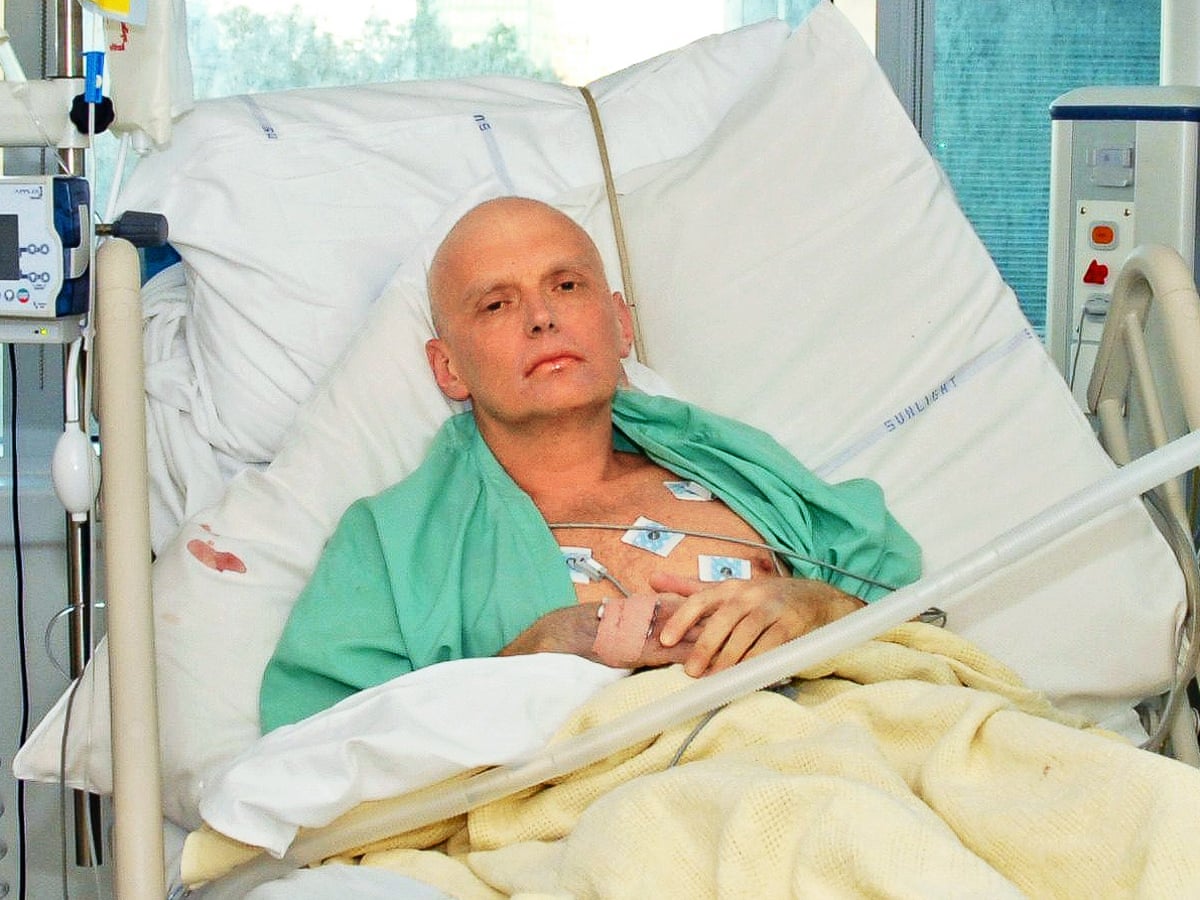
And there are just occasionally photographs in the news which take on a life all of their own that everybody has seen.
Jon Dryden TaylorHOST
I would say for this era, not many people remember the Litvinenko case now, but everyone remembers that photograph of him in the hospital bed, in the green hospital gown, looking as he was on the verge of death.
Julia RaesideHOST
Yeah, absolutely.

John BruniHOST
attacks against people in the UK, which would also fall under the threshold.
John BruniHOST
We had the Litvinenko poisoning.
John BruniHOST
You had the Skripal poisoning.
John BruniHOST
I mean, these things were significant in and of themselves.

speaker_16SOUNDBITE_SPEAKER
So
Marcy WheelerHOST
Christopher Steele, former MI6 guy, he was known for being Litvinenko's handler.
speaker_17NARRATOR
Alexander Litvinenko had been working as a spy for MI6 when he was poisoned with the radioactive substance polonium-210.
speaker_17NARRATOR
And Mr Litvinenko had been a well-known critic of the Russian regime.
speaker_17NARRATOR
The coroner was told that the British government had evidence that the Russians had Mr Litvinenko killed and that it amounted to state-sponsored terrorism on the streets of London.
speaker_17NARRATOR
It's likely that
Marcy WheelerHOST
the Russians were trying to take him out from very early on because he was tied to Litvinenko, and Litvinenko was trying to expose the corruption in the Putin system.
Marcy WheelerHOST
But Steele had then gone into private consulting.

Anna FunderGUEST
It looked like Nazi agents, looked to me certainly, as if Nazi agents had poisoned these activists.
Anna FunderGUEST
But as I was beginning the research on that in 2006, I was in London when a dissident former SFB agent called Alexander Litvinenko was poisoned by FSB, most likely agents sent by Putin or doing Putin's bidding in London in a tea shop with a polonium isotope in his green tea.
Anna FunderGUEST
And it took him three weeks to die as I was there beginning my research.
Anna FunderGUEST
And I actually thought, I mean, I'm not...

Matt FreiHOST
But they were clearly getting vexed by something.
Matt FreiHOST
So when Litvinenko was killed, poisoned in a London hotel in 2006, Blair immediately announced a kind of an inquiry into what was happening, But he told his cabinet very clearly, let's not upset relations with Moscow.
Matt FreiHOST
And I think even after the Georgia invasion of 2008, when finally any kind of dreams of working very closely with the Russians vanished, they were still treading very, very softly.
Mark UrbanHOST
Yeah, let me just jump in briefly on Litvinenko, because I did a fair bit of reporting and digging on that.
Mark UrbanHOST
And what was absolutely fascinating was, as you say, Blair's desire to limit the damage.
Mark UrbanHOST
Now, as far as the professionals were concerned, There was a difference of opinion between the security service, MI5, that said this is a murder on British soil.
Mark UrbanHOST
And the Theresa May.
Mark UrbanHOST
It was 23 were expelled.

Alex WoodHOST
I think, Sarah, you'd probably say that the most successful adaptation from book to stage comes in the form of Lucy Preble's A Very Expensive Poison.
Sarah CromptonHOST
Yes, and it's probably the loosest in some ways, in the sense that it was based on Luke Harding, the Guardian journalist's book about the killing of Alexander Litvinenko.
Sarah CromptonHOST
It also oddly featured puppets.
Sarah CromptonHOST
There was an extraordinary moment in John Crowley's production where... puppets of Soviet leaders appeared on stage and bashed one another.
Sarah CromptonHOST
I think the thing I loved about A Very Expensive Poison is that it took a very, very big subject, i.e. the operations of the Russian state against Litvinenko and all the actions that led up to that and the rise of Vladimir Putin and really the background to where we are today and turned it into an incredibly effective piece of drama.
Sarah CromptonHOST
Lucy Prebble did a bit what she'd done in Enron of finding visual and theatrical ways of embodying different, difficult and naughty political subjects.
Sarah CromptonHOST
And it was a huge play and I thought a hugely successful one.

Jay DyerHOST
But that makes one question because that was in the context of the Skripal affair.
Jay DyerHOST
And this French intelligence guy was saying, well, one thing that's very possible is that rather than it being Putin operatives that were poisoning Litvinenko and Skripal or whatever, which the Skripal thing was probably fake in total, probably more likely that there's these French squads that do this if it's real.
Jay DyerHOST
And then they say, oh, look, Putin did it again.
Jay DyerHOST
He's killing people.

Tom TugendhatGUEST
Look, I think Wes said it out pretty well, actually, to be fair.
Tom TugendhatGUEST
I don't think we're at war, but a lot of the actions that we've seen, and you'll remember a few years ago the attack on the Skripals in Salisbury, you'll remember the attack on Litvinenko.
Tom TugendhatGUEST
They're not acts of war, but they are warlike acts, right? Had those...
Tom TugendhatGUEST
Had that Novichok got into the water supply, it would have killed thousands of people.
Tom TugendhatGUEST
The polonium nuclear chemical that the Russians used to poison Litvinenko, you know, that's...
Tom TugendhatGUEST
It led to buildings having to be stripped out right back to the concrete and an aeroplane to be scrapped because it had so contaminated with nuclear poison the environment in which it was.
Tom TugendhatGUEST
So we're seeing, as Wes correctly says, state-sponsored terrorism.

Jacek SiewieraGUEST
Envelope, which was sent to military police, to gendarmerie, and the acute poisoning of three soldiers and two civilian employees of armed forces.
Jacek SiewieraGUEST
It's very similar to what we have seen on the Great Britain theater with highly precise targeted attacks with the use of polonium as a radionuclide for Litvinenko or Novichok inhibitor of phosphodiesterase towards Skripal or later Navalny case.
Jacek SiewieraGUEST
These are not scenarios which are identical.
Jacek SiewieraGUEST
They are similar and they are changing the modus operandi.
8 MINS LATER
Jacek SiewieraGUEST
Now I can unfortunately imagine, and Ukrainians, BND from Germany or Dutch intelligence is reporting 13,000 cases of the usage of chemical weapons in Ukraine, normalization of the chemical weapon in Ukraine.
Jacek SiewieraGUEST
I call it a hybridization of the weapon of mass destruction in between the...
Jacek SiewieraGUEST
Soviet era weapon of mass destruction as we understood it those days that entire cities may evaporate through the highly precise and highly targeted attacks like Navalny Skripal or Litvinenko we have some middle zone in which unfortunately I can imagine drones hitting cities with a chemical payload and this will create an unbelievable strategical dilemma if you want to shoot it down, if you want to intercept it over your cities, or you allow these drones to strike and hit your energetic infrastructure with all the consequences.
Jacek SiewieraGUEST
This will unfortunately affect the spirit of fight, and simultaneously I can imagine that your own people will oppose your armed forces from intercepting the drones.
19 more episodes mention Alexander Litvinenko.
Create an account to see the whole feed, search across every transcript, and follow the entities you care about.