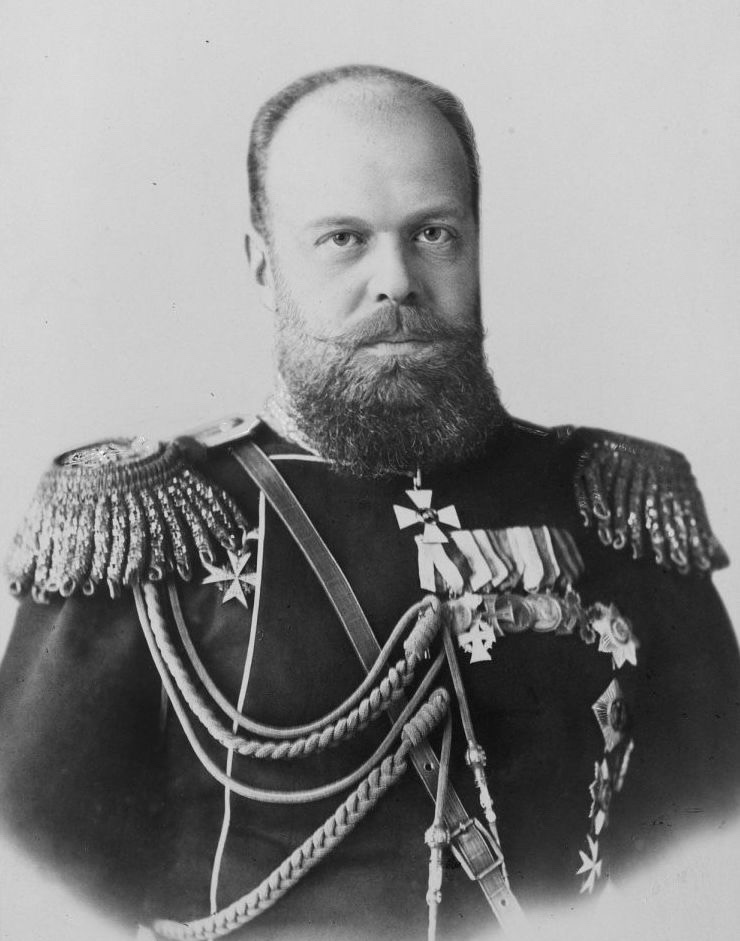
Alexander III of Russia
Former emperor of RussiaWikipedia
168
MENTIONS
5
EPISODES
5
PODCASTS
Search complete. 168 mentions across 5 episodes found for "Alexander III of Russia".
Oct 2, 2026

speaker_4NARRATOR
All prominent men of the sixties, even such moderates as Count Nicholas Muraviev and Nicholas Milutin, were treated as suspects.
speaker_4NARRATOR
Only Dmitri Milutin, the Minister of War, was kept by Alexander II at his post, because the reform which he had to accomplish in the army required many years for its realization.
speaker_4NARRATOR
All other active men of the reform period had been brushed aside.
speaker_4NARRATOR
I spoke once with a high dignitary of the Ministry for Foreign Affairs.
speaker_1ADVERTISER
Void where prohibited.
speaker_1ADVERTISER
Visit spinquest.com for more details.
speaker_4NARRATOR
Alexander II was their executive, their tool, and they ruled by fear.
speaker_4NARRATOR
Trepov had so frightened Alexander by the specter of a revolution which was going to break out at St. Petersburg that if the omnipotent chief of the police was a few minutes late in appearing with his daily report at the palace, the emperor would ask, Is everything quiet at St. Petersburg? Shortly after Alexander II had given an entire dismissal to Princess X, he conceived a warm friendship for General Fleury, the aide-de-camp of Napoleon III, that sinister man who was the soul of the coup d'état of December 2, 1852.

Herman PoppleberryHOST
It builds the Church of Mary Magdalene at Gethsemane in 1888.
Herman PoppleberryHOST
Seven gilded onion domes, commissioned by Tsar Alexander III for his mother, designed by David Grimm.
Herman PoppleberryHOST
There's the Mount of Olives Convent and Ascension Church, the Gourney Convent in Ein Karim, a hospice and asylum in the Muristan, schools and properties in Bethany, Hebron, Jericho, Jaffa, Haifa, and Tiberias.
Herman PoppleberryHOST
That's not a compound.

Matthew Raphael JohnsonGUEST
You know, that one of the toughest jobs of the Russian monarch was to control his own house, was to control his own, you know, the courtiers around him.
Matthew Raphael JohnsonGUEST
Alexander III did a great job, but you had to be made of iron to do that.
Matthew Raphael JohnsonGUEST
And it was very hard for a normal guy to do it.
Matthew Raphael JohnsonGUEST
And Nicholas II, of course, sacrificed himself.

speaker_4NARRATOR
All prominent men of the sixties, even such moderates as Count Nicholas Muraviev and Nicholas Milutin, were treated as suspects.
speaker_4NARRATOR
Only Dmitri Milutin, the Minister of War, was kept by Alexander II at his post, because the reform which he had to accomplish in the army required many years for its realization.
speaker_4NARRATOR
All other active men of the reform period had been brushed aside.
speaker_4NARRATOR
I spoke once with a high dignitary of the Ministry for Foreign Affairs.
speaker_2ADVERTISER
Clear choice.
speaker_2ADVERTISER
Hassle-free all the way to your driveway.
speaker_4NARRATOR
Alexander II was their executive, their tool, and they ruled by fear.
speaker_4NARRATOR
Trepov had so frightened Alexander by the specter of a revolution which was going to break out at St. Petersburg that if the omnipotent chief of the police was a few minutes late in appearing with his daily report at the palace, the emperor would ask, Is everything quiet at St. Petersburg? Shortly after Alexander II had given an entire dismissal to Princess X, he conceived a warm friendship for General Fleury, the aide-de-camp of Napoleon III, that sinister man who was the soul of the coup d'état of December 2nd, 1852.

speaker_0NARRATOR
All prominent men of the sixties, even such moderates as Count Nicholas Muraviev and Nicholas Milutin, were treated as suspects.
speaker_0NARRATOR
Only Dmitri Milutin, the Minister of War, was kept by Alexander II at his post, because the reform which he had to accomplish in the army required many years for its realization.
speaker_0NARRATOR
All other active men of the reform period had been brushed aside.
speaker_0NARRATOR
I spoke once with a high dignitary of the Ministry for Foreign Affairs.
speaker_0NARRATOR
And now he is in service under the reign of Shuvalov and Trepov, was the reply, which so correctly described the situation that I could say nothing more.
speaker_0NARRATOR
General Shuvalov, the chief of the state police, and General Trepov, the chief of the St. Petersburg police, were indeed the real rulers of Russia.
speaker_0NARRATOR
Alexander II was their executive, their tool, and they ruled by fear.
speaker_0NARRATOR
Trepov had so frightened Alexander by the specter of a revolution which was going to break out at St. Petersburg, that if the omnipotent chief of the police was a few minutes late in appearing with his daily report at the palace, the emperor would ask, Is everything quiet at St. Petersburg? Shortly after Alexander II had given an entire dismissal to Princess X, he conceived a warm friendship for General Fleury, the aide-de-camp of Napoleon III, that sinister man who was the soul of the coup d'état of December 2, 1852.