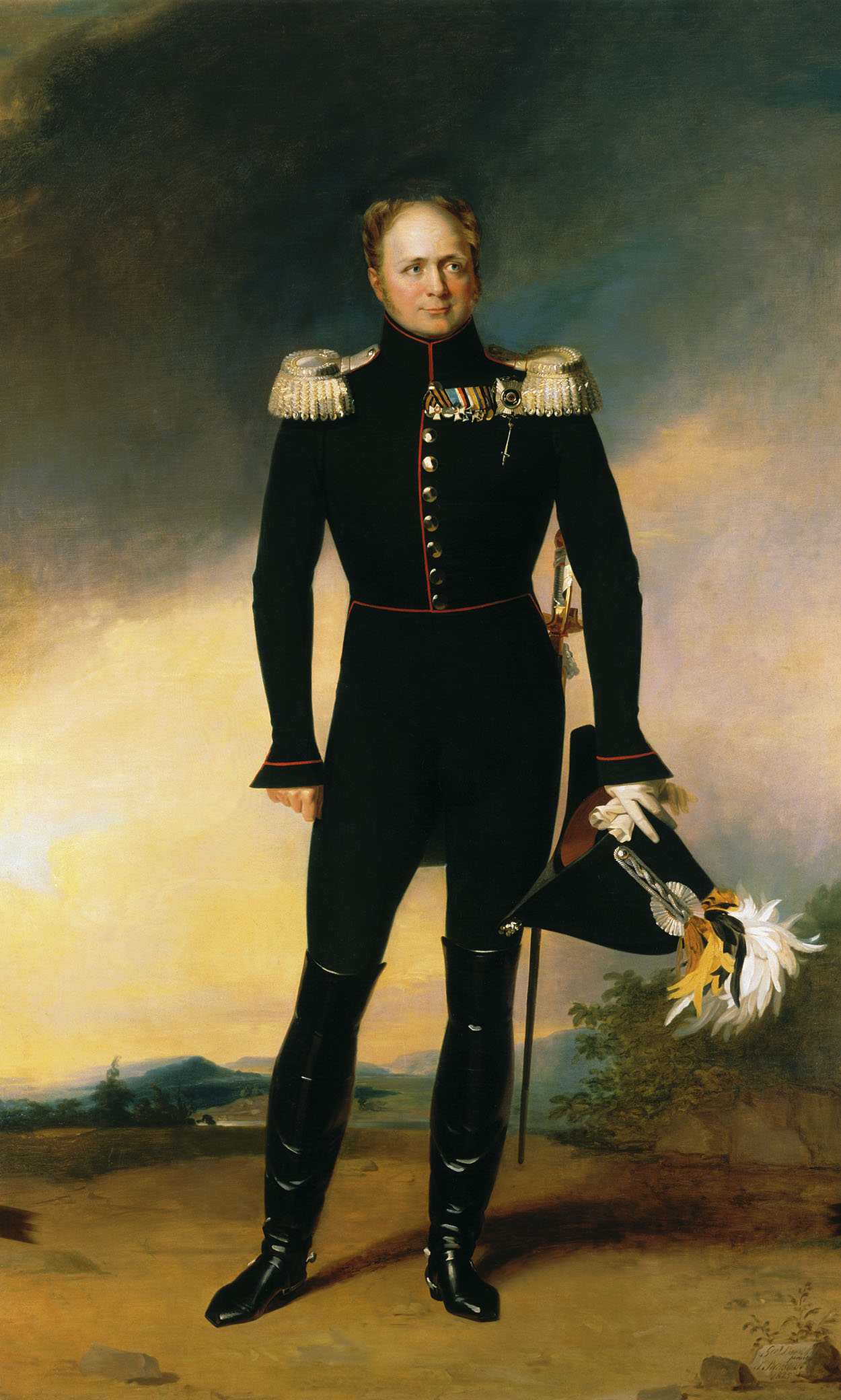
Alexander I of Russia
Former emperor of RussiaWikipedia
372
MENTIONS
44
EPISODES
35
PODCASTS
Search complete. 372 mentions across 44 episodes found for "Alexander I of Russia".
Oct 22, 2026

speaker_0NARRATOR
By 1807, having fought the Russians to a bloody stalemate at Ilo and crushed them at Friedland, he had reached the zenith of his power.
speaker_0NARRATOR
At the treaties of Tilsit, signed with theatrical pomp on a raft moored in the middle of the Neman River, he and the charismatic young Tsar Alexander I of Russia met as equals and effectively divided Europe between their two empires.
speaker_0NARRATOR
it was a moment of supreme triumph but one that contained the seeds of his downfall for in his quest to defeat his last remaining enemy great britain he had decreed the continental system a europe-wide economic blockade This attempt to wage economic war by strangling British trade would prove a colossal strategic error, fostering widespread resentment, encouraging massive smuggling operations, and ultimately leading him into the two fatal quagmires of Spain and Russia.
speaker_0NARRATOR
At the height of his power, Napoleon's empire began to unravel from its peripheries, bled white by two self-inflicted wounds.

Pamela NagamiNARRATOR
But it was clear that no transfer of possessions could be devised which would be equally acceptable to all states, and the Allies recognized that if the order created at Vienna were to be maintained, there must be some guarantee that infraction of the treaties would be punished.
Pamela NagamiNARRATOR
The mystical temperament of Alexander I led him to hope that this guarantee might be found in the basing of international relations on the precepts of the gospel, the observance of which should be ensured by the tender solicitude and arm strength of the great powers.
Pamela NagamiNARRATOR
The Holy Alliance, which almost all rulers were invited to join except the Pope as being too Christian and the Sultan as not being Christian enough, aimed at the substitution of fraternal love for the international rivalry of the past.
Pamela NagamiNARRATOR
But the very expansiveness of the alliance was sufficient to defeat its object, and a more real security was found in the renewal of the Treaty of Chaumont, which had been originally concluded between Great Britain, Austria, Russia, and Prussia to effect the overthrow of Napoleon.
6 MINS LATER
Pamela NagamiNARRATOR
Her ministers, with the ever-present fear of the House of Commons before their eyes, could not lightly agree to suppress across the Channel those free institutions upon which the prosperity of England was alleged to rest.
Pamela NagamiNARRATOR
On the other hand, partial geographical isolation and the hesitancy of Castlereagh, who was unwilling openly to break with the Allies, combined to minimize for a time the effect of British policy.
Pamela NagamiNARRATOR
It was far otherwise in the case of Alexander I, ruler of a great autocratic empire, master of a supposedly invincible army.
Pamela NagamiNARRATOR
His opinions and conduct were bound to affect deeply the course of continental affairs, the more so as he enjoyed a complete ascendancy over the soul of Frederick William III.

speaker_0HOST
While the Tsar worked with the nobility of Poland, peasants generally filled the ranks and endured what they must.
speaker_0HOST
Tsar Alexander was 27 at the time, and even though he was left crying under a tree, utterly defeated at Austerlitz, Alexander would rule for two more decades and was very fortunate in 1806.
speaker_0HOST
The population was forgiving, quite pliant, or ignorant.
speaker_0HOST
There was no movement towards revolution then.
speaker_0HOST
After Austerlitz, Prussia was somewhat isolated in their northern corner of Europe, and it took the better part of the calendar year for Napoleon to get in a position to now challenge them.
speaker_0HOST
In Napoleon's view, the Prussians refused to sign a treaty or capitulate.
speaker_0HOST
And he knew how Tsar Alexander was aligning with the Prussians.
speaker_0HOST
Frederick knew he was targeted and that his state would have to take a stand and fight.

Lindsay HolidayHOST
He became the first Tsar of all Russia, by terrorizing his people and his own family.
Lindsay HolidayHOST
He had several of his 6-8 wives murdered and beat his own son to death.
Lindsay HolidayHOST
The Tsar died at 53, possibly strangled by one of his many, many enemies.
Lindsay HolidayHOST
One might hope this would ring in happier days, but it actually resulted in an even worse era known as the Time of Troubles.
Lindsay HolidayHOST
Ivan's next son, Fyodor, became Tsar, but he was intellectually disabled.
Lindsay HolidayHOST
Nobles called boyars overran the government.
Lindsay HolidayHOST
His younger brother, Dimitri, was a glimmering hope for the future, but he died at the age of 9.
Lindsay HolidayHOST
The official story was that he stabbed himself in the throat during an epileptic seizure.

DamonHOST
The Russian soldiers, who'd enjoyed Paris so much, were starting to drift back home.
DamonHOST
And Alexander had visited London and had been difficult.
DamonHOST
The situation in Scandinavia had been sorted out to everyone's satisfaction, unless of course you happen to be either Danish or Norwegian.
DamonHOST
The Iberian Peninsula War had ended, as had the War of 1812 in the USA.
DamonHOST
So today we'll be covering four main items and mentioning one other thing that would have a delayed but significant impact in certain parts of the world.
DamonHOST
So those four main events or themes are Napoleon's time on Elba and what he eventually decided to do and how that all went.
DamonHOST
how the coalition powers reacted to that, Tsar Alexander's spiritual health, and how things finally concluded in North America.
DamonHOST
The other event that we'll get a mention occurred thousands of miles away, more or less in my backyard, i.e. Southeast Asia.

Martin SiloffNARRATOR
Oh, what a splendid reign! he repeated several times, then paused, drew from his pocket a gold snuff-box, lifted it to his nose, and greedily sniffed at it.
Martin SiloffNARRATOR
What a splendid reign the Emperor Alexanders might have been! He looked compassionately at Belishol, and as soon as the latter tried to make some rejoinder, hastily interrupted him.
Martin SiloffNARRATOR
what could he wish or look for that he would not have obtained
Martin SiloffNARRATOR
through my friendship demanded napoleon shrugging his shoulders in perplexity but no he has preferred to surround

speaker_1NARRATOR
The tawny Indian may hold out the hand of fellowship to him across the great Pacific.
speaker_1NARRATOR
We believe that the Empress Catherine corresponded with him, and we know that the Emperor Alexander called upon him and presented him with his miniature in a gold snuff box, which the philosopher, to his eternal honor, returned.
speaker_1NARRATOR
Mr. Hobhouse is a greater man at the Hustings, Lord Brawley at Plymouth Dark, but Mr. Bentham would carry it hollow on the score of popularity at Paris or Pegu.
speaker_1NARRATOR
The reason is that our author's influence is purely intellectual.
5 HRS 30 MINS LATER
Garfield DeSousaNARRATOR
He admits of nothing below, scarcely of anything above himself.
Garfield DeSousaNARRATOR
It is fine to hear him talk of the way in which certain subjects should have been treated by eminent poets, according to his notions of the art.
Garfield DeSousaNARRATOR
Thus he finds fault with Dryden's description of Bacchus in the Alexander's Feast, as if he were a mere good-looking youth or boon companion, flushed with a purple grace.
Garfield DeSousaNARRATOR
He shews his honest face, instead of representing the god returning from the conquest of India, crowned with vine leaves and drawn by panthers and followed by troops of satyrs, of wild men and animals that he had tamed.

speaker_3NARRATOR
Each new reign formed, at least in its beginning, a contrast to the one which had preceded it.
speaker_3NARRATOR
The reigns of Alexander I and Alexander II marked the departure in the direction of liberalism.
speaker_3NARRATOR
Those of Nicholas I and Alexander III were returned to the ideas of reaction.
speaker_3NARRATOR
In accordance with this historic schedule, Alexander III should have been followed by a sovereign of liberal tendencies.
speaker_3NARRATOR
But in this case, the optimistic expectations with which the new ruler was welcomed both by his Russian and his Jewish subjects were doomed to disappointment.
speaker_3NARRATOR
The reign of Nicholas II proved the most gloomy and the most reactionary of all.
speaker_3NARRATOR
It was universally felt that the autocratic regime was still firmly entrenched and that the old constitution of enforced safety, this charter of privileges bestowed upon the police to the disadvantage of the people, was still unshaken.
speaker_3NARRATOR
The hope of seeing Russia transformed from a state based upon brute force into a body politic resting upon law and order was dashed to the ground.

Stephen DaltonHOST
Napoleon faces the armies of Austria and Russia and wins one of the most famous victories of his career.
Stephen DaltonHOST
The battle later becomes known as the Battle of the Three Emperors because Napoleon, the Austrian Emperor Francis, and the Russian Emperor Alexander are all involved.
Stephen DaltonHOST
That is an unusually senior meeting.
Stephen DaltonHOST
Most international conferences end with a photograph.
10 MINS LATER
Stephen DaltonHOST
And Britain still refuses to cooperate.
Stephen DaltonHOST
Then another major problem emerges: Russia.
Stephen DaltonHOST
Tsar Alexander I becomes increasingly unwilling to follow the Continental System strictly.
Stephen DaltonHOST
Russian economic interests are suffering.

Matthew Raphael JohnsonGUEST
And that occurred especially during the Moscow period.
Matthew Raphael JohnsonGUEST
There is a theory, one that I accept, that Alexander I did not die in Crimea, but in fact became a monk and became an ascetic under a different name, Fyodor.
Matthew Raphael JohnsonGUEST
I have a lecture on that too.
Matthew Raphael JohnsonGUEST
I think I have a paper on that.
34 more episodes mention Alexander I of Russia.
Create an account to see the whole feed, search across every transcript, and follow the entities you care about.