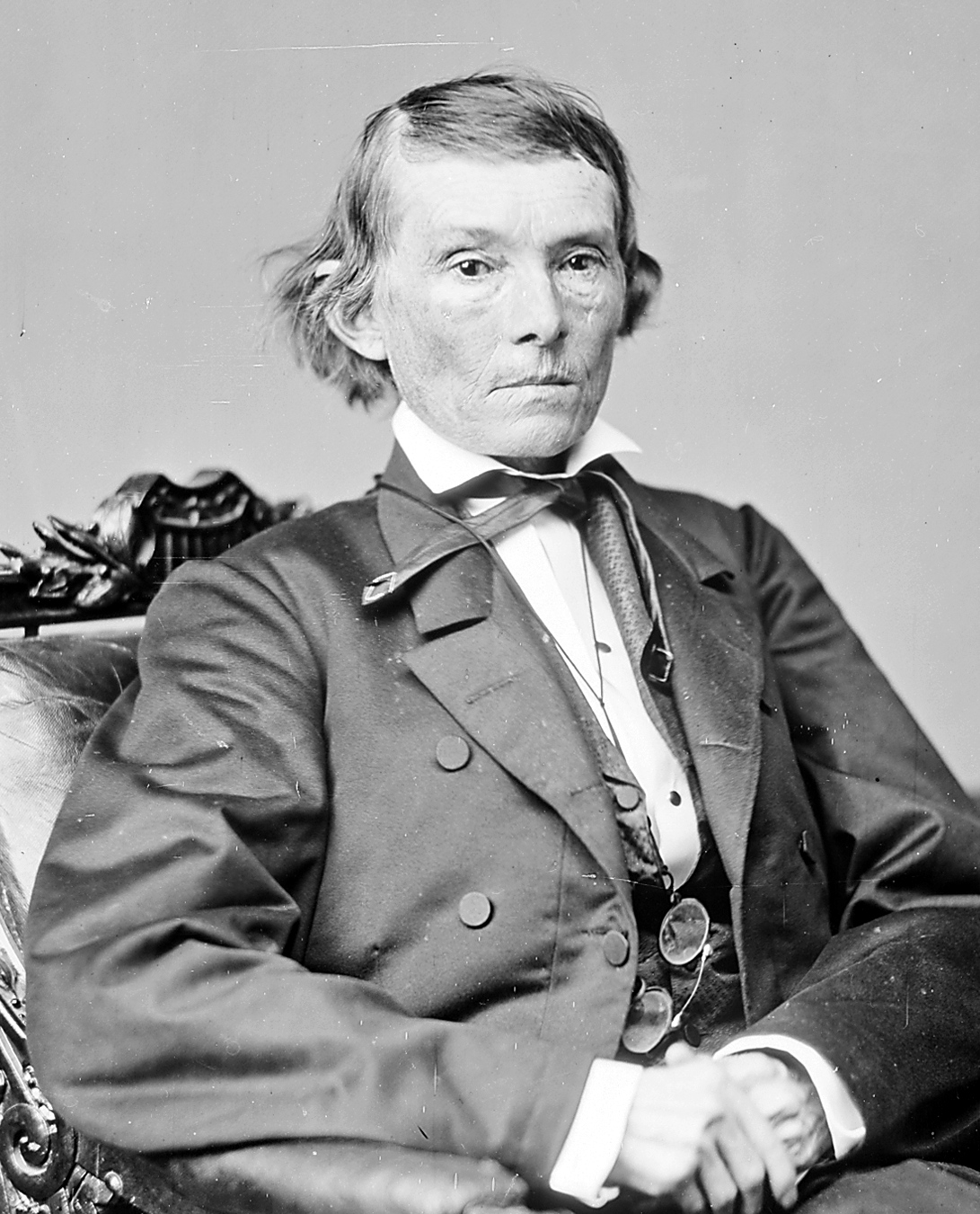
Alexander H. Stephens
Former Vice President of the Confederate States of AmericaWikipedia
16
MENTIONS
14
EPISODES
14
PODCASTS
Search complete. 16 mentions across 14 episodes found for "Alexander H. Stephens".
Oct 24, 2026

speaker_4NARRATOR
His deep musings on the ways of God, on the souls of men, on the principles of justice and the laws of liberty, bore fruit in exalted character and exact insight.
speaker_4NARRATOR
hence a style of speech remarkable for its lucidity direction and forthright power with no waste of words tinged always by a temperament at once elusive and alluring which bryce compares to the weighty eloquence of cromwell without its haziness going into the silence during an important criminal trial m c mcwilliams said lincoln will pitch in heavy now for he has hid one who knew him declared he seemed never alone i have frequently seen him in the midst of a court in session with his mind completely withdrawn from the busy scene before his eyes was completely abstracted as if he were in absolute solitude judge whitney wrote in religion lincoln was in essence a mystic and all his adoration was in accordance with the tenets of that order a judgment which agrees with that of alexander h stephens vice president of the southern confederacy with lincoln the union rose to the sublimity of a religious mysticism the mystical mood cannot be likened to any other mood people in a hurry never experience such a mental state personal ambition forbids it and the feeling of vainglory renders such a condition impossible what renders the life of lincoln so instructive is the fact that with him everything was so natural he did not experiment he did not practise special hours and seasons he had no fixed times for this or that he professed no subtle methods of inducing moods and took no stimulants nature and a mystical providence arranged and provided his moods were between himself and his god no one ever dared approach him as to the why or the wherefore of his silence and it is proper here to comment on the instinctive good sense of the american people in whose midst lincoln passed his whole life they instinctively knew too much to presume upon the privacy of his mystical moods in this their attitude was wholly admirable The American people were at the time practical democratic seers, without whom the greatest practical mystic could not have existed.
speaker_4NARRATOR
That Lincoln possessed intuition and illumination without resorting to human aid is clear and irrefutable.
speaker_4NARRATOR
His words were simple and his actions were simple, like those of the Hebrew seers.

Carl JonesGUEST
So that was the second attempt, uh, regarding the Emancipation Proclamation of Lincoln trying to lure the South back in with perpetual slavery.
Carl JonesGUEST
And in, uh, the early months of 1865, they had a meeting between Lincoln and, uh, some emissaries, including the vice president, Alexander Stephens, from the Confederacy.
Carl JonesGUEST
They met, uh, in, in Hampton Roads, and there Lincoln told them once again, "Look, if you rejoin the Union, you'll have the votes to defeat the 13th Amendment, and you'll be able to keep your slaves." So three times during the war he offered them perpetual, irrevocable slavery, and three times they declined to rejoin the Union and accept his offer.
Carl JonesGUEST
W- that's really all we need to know [laughs].

Novella SerenaNARRATOR
There was the chairman, Honorable Robert Toombs of Georgia.
Novella SerenaNARRATOR
There was John C. Breckinridge of Kentucky, Stephen A. Douglas, Alexander H. Stephens, and Jefferson Davis.
Novella SerenaNARRATOR
Silence was the cry as Honorable Robert Toombs, the chairman, arose.
Novella SerenaNARRATOR
Fellow delegates and fellow citizens, I find myself in a most remarkable situation, and I feel that every Southern gentleman sympathizes with me.

Bob CescaHOST
Mm-hmm.
Tara DevlinGUEST
The Alexander Stephens, the Cornerstone Speech.
Bob CescaHOST
Oh, yes.
Tara DevlinGUEST
It says it right in the first line.

Novella SerenaNARRATOR
There was the chairman, Honorable Robert Toombs of Georgia.
Novella SerenaNARRATOR
There was John C. Breckinridge of Kentucky, Stephen A. Douglas, Alexander H. Stephens, and Jefferson Davis.
Novella SerenaNARRATOR
"Silence," was the cry, as Honorable Robert Toombs, the chairman, arose.
Novella SerenaNARRATOR
"Fellow delegates and fellow citizens, I find myself in a most remarkable situation, and I feel that every Southern gentleman sympathizes with me."

John BatchelorHOST
The Confederacy at this point is extremely confident in making bold statements that are contemptible.
John BatchelorHOST
And when we come back, Alexander Stephens, the vice president of the Confederacy.
John BatchelorHOST
I'm speaking to Richard Carwardine.
John BatchelorHOST
He is the author of the new book, Religious Strife.
John BatchelorHOST
I'm John Batchelor with Professor Richard Carwardine.
John BatchelorHOST
The book is Righteous Strife: The Pulpit's Battle.
John BatchelorHOST
Alexander Stephens is not a preacher.
John BatchelorHOST
He does use a speech, though.

Tim RoeNARRATOR
I have frequently seen him in the midst of a court in session with his mind completely withdrawn from the busy scene before his eyes, as completely abstracted as if he were in absolute solitude.
Tim RoeNARRATOR
Judge Whitney wrote, "In religion, Lincoln was in essence a mystic, and all his adoration was in accordance with the tenets of that order," a judgment which agrees with that of Alexander H. Stephens, vice president of the Southern Confederacy.
Tim RoeNARRATOR
With Lincoln, the Union rose to the sublimity of a religious mysticism.
Tim RoeNARRATOR
The mystical mood cannot be likened to any other mood.

Novella SerenaNARRATOR
There was the chairman, Honorable Robert Toombs of Georgia.
Novella SerenaNARRATOR
There was John C. Breckinridge of Kentucky, Stephen A. Douglas, Alexander H. Stephens, and Jefferson Davis.
Novella SerenaNARRATOR
Silence was the cry as Honorable Robert Toombs, the chairman, arose.
Novella SerenaNARRATOR
Fellow delegates and fellow citizens, I find myself in a most remarkable situation, and I feel that every Southern gentleman sympathizes with me.
4 more episodes mention Alexander H. Stephens.
Create an account to see the whole feed, search across every transcript, and follow the entities you care about.