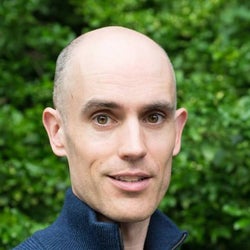
Alex Hutchinson
Journalist
30
MENTIONS
15
EPISODES
15
PODCASTS
Search complete. 30 mentions across 15 episodes found for "Alex Hutchinson".
Sep 17, 2026

Dean BuonomanoGUEST
I agree.
EvanHOST
I c- I can give the explanation that Alex Hutchinson gave in his Neuroscience of Endurance book.
EvanHOST
Um, great book.
EvanHOST
If anyone hasn't read it, I'll put it on screen.
Dean BuonomanoGUEST
Yeah, I be- I believe those, those anecdotes, yeah.
Dean BuonomanoGUEST
Um, and that, you know, we all say time flies when you're having fun, and time goes very, very slowly when you're, when you're suffering.
Dean BuonomanoGUEST
Now, and I think that when you're running a marathon, so much of that is mental, and I agree with your point that apparently Alex Hutchinson made in that some of the, that fatigue is, is mental, right? And why would that be? Well, maybe because in nature you don't only have to run something for the next hour or two, but you need to be in good enough shape to protect yourself if a predator shows up in the next hour or two.
Dean BuonomanoGUEST
So you have to...

Christopher DringHOST
And it found its audience.
Christopher DringHOST
It's interesting, um, I know that, uh, we had Alex Hutchinson on, um, talking about, um, Revenge of the Savage Planet, and he talked about how loads of people discovered the game because of Game Pass.
Christopher DringHOST
But what he found is Game Pass customers don't necessarily spend money.
Christopher DringHOST
[laughs] So he was hoping for-

Simon RichardsonHOST
... as well as with my mates.
Simon RichardsonHOST
But, uh, it was when I was reading the ever brilliant Alex Hutchinson in Outside Magazine recently, and he made me question whether riding in a group is actually better for, well, me, you, everyone.
Alex PatonHOST
Anyone.
Alex PatonHOST
Now his column was about how the benefits of group exercise are hardwired into our brains, talking about how there's a growing body of evidence to show how exercising with others allows us essentially to try harder without it feeling harder.
5 MINS LATER
Alex PatonHOST
Yeah.
Simon RichardsonHOST
But equally, I still like, you know, still like riding on my own, basically.
Alex PatonHOST
Something that just springs to mind, actually, of a example, like, a most recent thing in pro cycling was at the Tour de France with Alex Swift.
Alex PatonHOST
Was it the...

Kyla ChannellHOST
Another brain thing.
Kyla ChannellHOST
Have you read the book Endure by Alex Hutchinson? No, but I've heard of it.
Kyla ChannellHOST
Yeah.
Kyla ChannellHOST
I think he covers the swish and spit method in there, but the whole like kind of emphasis of the book is around like the power of the brain in sport and in athletes and like, It's really cool.

Xand van TullekenGUEST
"This is gonna be a great chapter about all these brilliant, amazing things that work." And I assumed they would be very high tech things.
Xand van TullekenGUEST
I got a fantastic journalist called Alex Hutchinson, um, who's, who's my favorite kind of sports journalist.
Xand van TullekenGUEST
He's also got a PhD in maths from Cambridge, so he's, I think it's, maybe it's physics.
Xand van TullekenGUEST
But anyway, he's a super bright guy.

Marie-Philippe JeanHOST
Ouais, tout à fait.
Marie-Philippe JeanHOST
Et, euh, bon pour celles qui demandaient là, t'sais, comme des fois : « Est-ce que quand je suis fatiguée, faut-tu que j'aille m'entraîner ou pas ? » Bon, on y reviendra plus tard, mais, euh, y avait une étude qui, ben en fait, y a plusieurs études, mais je suis tombée sur un article de l'auteur que j'aime bien, qui est Alex Hutchinson, qui parlait dans le fond de l'effet de la fatigue mentale sur la fatigue physique.
Marie-Philippe JeanHOST
Puis lui, il est allé faire des recherches parce que il disait : « Là, je comprends pas mon, mes, mes courses tempo du samedi matin, euh, ma vitesse, elle drop à une-- t'sais comme je comprends pas pourquoi, mais je vais vraiment moins vite.
Marie-Philippe JeanHOST
Puis pourtant, t'sais, physiquement, je me sens comme vraiment bien.

StuartGUEST
But there is something in there as well around being able to use, we talked about confidence, to be able to get through the session and, you know, juggling the loud and quiet voice so that you don't lose to the loud voice and pull back from your effort.
StuartGUEST
'Cause the whole reason we train at a certain intensity, whether or not you're a cyclist and you're on the bike and you do some bike work, whether you're a runner doing a 20-minute hard block or a 10-minute or a six-minute or whatever it might be, one of the core elements of endurance, and this is the basis of what Alex Hutchinson wrote in the book Endure, was he defined endurance as the ability to overcome the urge to slow down or quit.
StuartGUEST
If you can do that in training and consistently show yourself that you can do that, then it comes to the race, you've locked in all that training into your body, and fingers crossed, you just, you know, get your mind out the way, run the race.
StuartGUEST
And yeah, you'll have some hard times, but you've got the ability to do that marathon, do that ultra, and trust yourself that you'll finish and stay on pace as much as you can.

JT AyersHOST
I mean, I'm a coach, and I'm excited about my guest.
JT AyersHOST
Alex Hutchinson's a national magazine award-winning science journalist.
JT AyersHOST
He's a former Canadian national team distance runner, a very good runner too.
JT AyersHOST
He still writes for the magazine Outside, and, but he's on the podcast because I'd read one of his books, The New York Times bestseller Endure: Mind, Body, and the, the Elastic Limits of the Human Performance.

Lauren FeinerHOST
As a much slower marathoner, I've always had a huge fascination with the technology that's helped advance the sport.
Lauren FeinerHOST
To understand how this happened, I'm talking to Alex Hutchinson, a journalist and author of books like Endure, about the science behind human performance limits.
Lauren FeinerHOST
He's chronicled the research and technology that's advanced the sport, and gone inside the lab where Nike designed its iconic SuperShoes.
Lauren FeinerHOST
But first, here's what's happening on The Verge today.
34 MINS LATER
Alex HutchinsonGUEST
If you're buying that, you wanna think really carefully about, um, wheth-whether that's what running is about for you.
Lauren FeinerHOST
Well, I think that's a great place to leave it.
Lauren FeinerHOST
Alex Hutchinson, thank you so much for joining us.
Alex HutchinsonGUEST
Thanks, Lauren.

Jason SaltmarshHOST
And it surprised me.
Jason SaltmarshHOST
Alex Hutchinson went through every 5,000 to 10,000 meter world record of the modern era and found the same shape every single time.
Jason SaltmarshHOST
First kilometer, faster than the middle.
Jason SaltmarshHOST
Last kilometer, faster than the middle.
5 more episodes mention Alex Hutchinson.
Create an account to see the whole feed, search across every transcript, and follow the entities you care about.