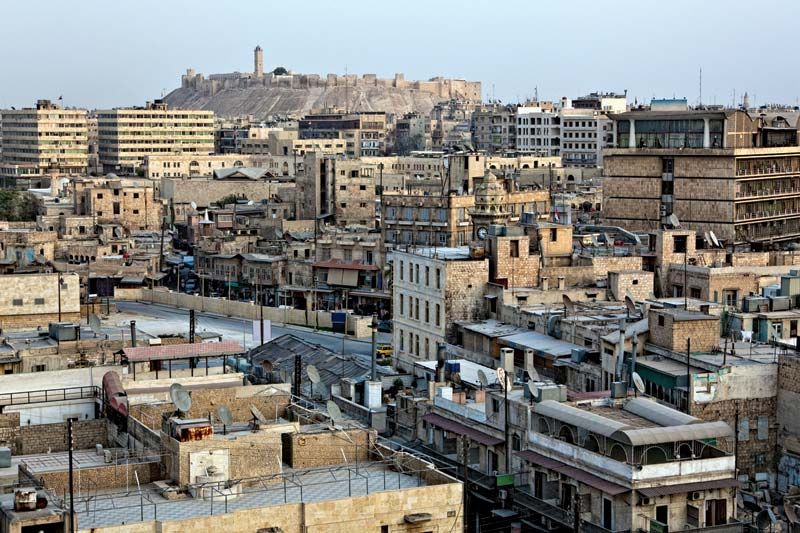
Aleppo
City in SyriaWikipedia
488
MENTIONS
165
EPISODES
130
PODCASTS
Search complete. 488 mentions across 165 episodes found for "Aleppo".
Oct 28, 2026

Bill CooperSOUNDBITE_SPEAKER
He was traveling under the guise of a missionary of the Caliph in Cairo.
Bill CooperSOUNDBITE_SPEAKER
From Aleppo he went to Baghdad seeking a headquarters where he should be safe from interference and where he yet could become powerful enough to expand.
Bill CooperSOUNDBITE_SPEAKER
Into persia the road led him traveling through the country making converts to his ideas Which were still apparently strongly based upon the secret doctrines of the egyptian ishmaelis Everywhere he created a really devoted disciple.
AndrewHOST
Have you guys noticed that everywhere we talk about regarding mystery babylon? Israel's like super involved in those places in like the current regional area modern today right like syria egypt all these places they're super either control it or what going to war with it so they could control it turkey all these places right so i think that's crazy you know because it really does kind of fulfill this idea that israel is kind of this mystery babylon culmination a little bit when you consider that this connects with all these mystery cults etc and they want to create this kind of one

Josh SchererHOST
So, like, literally that was what...
Josh SchererHOST
Got Hungarian paprika to be grown, Turkish, you know, peppers, Aleppo, Thai bird's eye chilies, scotch bonnets in Africa.
Josh SchererHOST
All of that was just brought over from the Americas.
Josh SchererHOST
And so every culture sort of figured out how to make… hot sauce but the way that we conceive of hot sauce in America as in like you go to a store and there's 50 little bottles of roughly the same viscosity that's like a very American thing but every culture figured out some sort of chili paste some sort of condiments some sort of whatever and I think that's really cool but a lot of them look very different Marie Sharp is from Belize.

Martha RaddatzMODERATOR
to move on.
Martha RaddatzMODERATOR
The heartbreaking video of a five-year-old Syrian boy named Amran sitting in an ambulance after being pulled from the rubble after an airstrike in Aleppo focused the world's attention on the horrors of the war in Syria, with 136 million views on Facebook alone.
Martha RaddatzMODERATOR
But there are much worse images coming out of Aleppo every day now, where in the past few weeks alone, 400 people have been killed, at least 100 of them children.
Martha RaddatzMODERATOR
Just days ago, the State Department called for a war crimes investigation of the Syrian regime of Bashar al-Assad and its ally, Russia.
Martha RaddatzMODERATOR
for their bombardment of Aleppo.
Martha RaddatzMODERATOR
So this next question comes from social media through Facebook.
Martha RaddatzMODERATOR
Diane from Pennsylvania asks, if you were president, what would you do about Syria and the humanitarian crisis in Aleppo? Isn't it a lot like the Holocaust when the US waited too long before we helped? Secretary Clinton, we will begin with your two minutes.
Hillary ClintonGUEST
Well, the situation in Syria is catastrophic.

Anand GopalGUEST
So the regime was basically facing uprisings everywhere and had to retrench its forces.
Anand GopalGUEST
And they'd focused on what it considered were its most economically and politically important cities, like Aleppo and Damascus and the areas surrounding those regions.
Anand GopalGUEST
So a place like Membesh... which is out of the way, they kind of ignored and ultimately just withdrew from so that they could focus on the other areas.
Anand GopalGUEST
And this kind of withdrawing meant that overnight, these protesters, who, by the way, were people from all walks of life, bricklayers and blacksmiths and gin teachers, et cetera, all of a sudden they found themselves in a city of 150,000 people, and they were the ones who had to figure out how to keep the street lights on, how to keep the schools open, how to keep the city running, essentially.
22 MINS LATER
Anand GopalGUEST
And the knowledge that they have the power to do so and the experience of having done so is something that's very hard to efface.
Anand GopalGUEST
And so even today, there are protests and demonstrations.
Anand GopalGUEST
And when there's attempts, especially like in Memesh or in Aleppo, for the new authorities to impose something, there's always a kind of resistance to it.
Anand GopalGUEST
And I think there's an understanding that for Syria to become a democracy, it's not going to be in one fell swoop.

Mike BurnardGUEST
There you have a church that is just filled with gratitude.
Mike BurnardGUEST
The one church in Aleppo, when we were there on a previous visit, completely destroyed.
Mike BurnardGUEST
I mean, the city is destroyed.
Mike BurnardGUEST
There's nothing left.

Luke WatersGUEST
Welcome to the Crusades.
Luke WatersGUEST
This is the second Crusade episode to Aleppo.
Luke WatersGUEST
And today we are talking about how the Muslim polities and their various armies and allies were arrayed.
Luke WatersGUEST
In the 50-ish years between the end of the First Crusade in 1099 and the fall of Edessa in late 1144.
7 MINS LATER
Derek DavisonHOST
We know about it through some fragmentary quoting and preservation.
Derek DavisonHOST
We don't know exactly what it is.
Derek DavisonHOST
It may have been a chronicle just of the city of Aleppo, but it does seem like there is And this was a first attempt at kind of putting down, chronicling what happened in the first crusade from the Islamic perspective.
Derek DavisonHOST
And this is something I think we'll talk about in the European side next time, the writing and some of the cultural things that went on.
Derek DavisonHOST
And lo and behold, when they're not fighting each other, They're actually pretty effective at fighting crusaders.
Derek DavisonHOST
And then the big figure who sort of encapsulates this is Imad ad-Din Zengi and his son Nur ad-Din, who are the rulers of Aleppo, also Mosul at various times, and really start to create a serious political entity, kingdom, uh, emperor.
Derek DavisonHOST
It's called, it's an Atabeg.
Derek DavisonHOST
I'll talk about that next episode, but, um, it's, it really starts to emerge as a major power in Syria until they make their fatal mistake of sending Saladin to Egypt to try and take over Egypt for them and he just takes over Egypt for himself but that's down the road but again this sort of emergence of serious Islamic powers to counter the crusaders is I think another thing that really comes out in this season
28 MINS LATER
Luke WatersGUEST
Once Zengi takes over and begins to consolidate, which we'll talk about next time, but once he consolidates everything, Odessa's right there.
Luke WatersGUEST
And if you're an expansionist state in the region, which they all are or would aspire to be...
Luke WatersGUEST
It's a very obvious point, especially when you either rule or have a puppet ruler in Aleppo.
Derek DavisonHOST
Right.

LukeHOST
Hey everyone, welcome to the Crusades.
LukeHOST
This is the second Crusade episode to Aleppo.
LukeHOST
And today we are talking about how the Muslim polities and their various armies and allies were arrayed.
LukeHOST
In the 50-ish years between the end of the First Crusade in 1099 and the fall of Edessa in late 1144.
7 MINS LATER
Derek DavidsonGUEST
We know about it through some, you know, fragmentary quoting and preservation.
Derek DavidsonGUEST
We don't know exactly what it is.
Derek DavidsonGUEST
It may have been a chronicle just of the city of Aleppo, but it does seem like there is, this was a first attempt at kind of putting down, chronicling what happened in the first crusade from the Islamic perspective.
Derek DavidsonGUEST
And this is something I think We'll talk about on the European side next time, the writing and some of the cultural things that went on.
Derek DavisonGUEST
We'll see this in Anatolia with the Seljuks who, you know, now realizing what they're dealing with with these, you know, weird, quirky Latin Christians coming in, will say, you know, we can't, we have to, like, work together, and they'll approach the other Turkic principalities of Anatolia, and eventually absorb them, so it's to the detriment of those other principalities, right? But part of the case they're making is we all, we need to work together against these guys, and lo and behold, when they're not fighting each other, They're actually pretty effective at fighting crusaders.
Derek DavisonGUEST
And then the big figure who sort of encapsulates this is Imad ad-Din Zengi and his son Nur ad-Din, who are the rulers of Aleppo, also Mosul at various times, and really start to create a serious political entity, kingdom emperor.
Derek DavisonGUEST
It's an Atabeg.
Derek DavisonGUEST
I'll talk about that next episode.
26 MINS LATER
LukeHOST
And Mosul is so powerful.
LukeHOST
Once Zinke takes over and begins to consolidate, which we'll talk about next time, but once he consolidates everything there, Odessa is right there.
LukeHOST
And if you're an expansionist state in the region, which they all are or would aspire to be, it's a very obvious point, especially when you either rule or have a puppet ruler in Aleppo.
LukeHOST
Yeah.

GHOST
Nothing is changed.
GHOST
And I guess the leader of the kingdom of, was it Riyadh, Saudi Arabia, where Crown Jewel's going to be at, Turkey, Aleppo, Salami, whatever his name is, he is still promoting tickets to get people to come out.
GHOST
to the show, which is, I believe, next weekend.
GHOST
Let me look at my calendar here.
155 more episodes mention Aleppo.
Create an account to see the whole feed, search across every transcript, and follow the entities you care about.