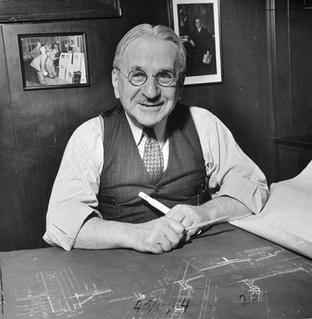
Albert Kahn
American architectWikipedia
28
MENTIONS
7
EPISODES
6
PODCASTS
Search complete. 28 mentions across 7 episodes found for "Albert Kahn".
Nov 1, 2026

Peter WaitzmanHOST
Concerts are played daily at noon, with the bells audible across campus.
Peter WaitzmanHOST
Hill Auditorium, designed by renowned architect Albert Kahn and completed in 1913, is known for its exceptional acoustics and has hosted countless performances by world-class musicians and speakers for over a century.
Peter WaitzmanHOST
The Frederick R. Weissman Art Museum represents Michigan's commitment to arts.
Peter WaitzmanHOST
Housing over 20,000 pieces, the museum's collection ranges from American modernism to Korean furniture, creating a cultural hub on campus.

speaker_41GUEST
At the outbreak of World War II, cans were out, torpedoes were in.
speaker_41GUEST
Albert Kahn, the Amatorp architect, he pioneered wide span open buildings that didn't have a lot of structural members.
speaker_33GUEST
Kahn started out building factories for the auto producers in Detroit.
speaker_33GUEST
He is the expert in building these production plants, especially for war.
speaker_41GUEST
The Chrysler Dodge plant on the south side, that one was the granddaddy of them all.
Dan SnowNARRATOR
And that's where they built sophisticated engines for the mighty B-29 Super Fortress.
Dan SnowNARRATOR
The Dodge Chicago plant, another Albert Kahn design, was the largest building in the world in 1944.
Dan SnowNARRATOR
82 acres under roof, 30 square city blocks.

Dan GelernterHOST
Um, he has already green-lighted the Willow Run bomber plant.
Dan GelernterHOST
Uh, whose great architect, uh, Albert Kahn, would die in 1942.
Dan GelernterHOST
This is sort of the end of the first generation, or the first and a half generation.
Dan GelernterHOST
Uh, of course, Edsel is really the second generation, but he was there more or less at the beginning.

speaker_2NARRATOR
At this point, he decided to invest in the mass production principles that would change the automotive industry, and all industry, forever.
speaker_2NARRATOR
Enlisting industrial architect Albert Kahn, the Ford Motor Company began construction of a new factory in the Detroit suburb of Highland Park.
speaker_2NARRATOR
This plant would be designed around key concepts of mass production, division of labor, and deskilled labor at that, an integrated supply chain, and most innovative of all, a metal conveyor belt that moved each Model T along, allowing his workers to remain stationary as they assembled the component parts of each vehicle.
speaker_2NARRATOR
Inspired by the continuous flow systems of American meatpacking plants, this assembly line system brought into existence a degree of scalability that had never before been possible.

Daven HiskeyHOST
This facility boasted six runways, a control tower, a cafe, a hotel, and three aircraft hangars, the largest of which could house 20 B-24s at once.
Daven HiskeyHOST
The Willow Run plant was designed by famed Detroit architect Albert Kahn, perhaps best known for his work on Ford's River Rouge plant.
Daven HiskeyHOST
At the time of its completion in 1942, Willow Run was the largest single-roof manufacturing facility ever built, the massive L-shaped building being nearly a mile long and almost 1,300 feet across and enclosing a whopping 330,000 square meters, or 3.5 million square feet, of factory space, the equivalent of around 70 American football fields.
Daven HiskeyHOST
This gargantuan footprint would only be exceeded two years later by the 489,000 square meter, or 5.3 million square kilometer, K-25 gaseous diffusion facility in Oak Ridge, Tennessee, built by the Manhattan Project to enrich uranium-235 for the first atomic bombs.
Dan GelernterHOST
Even the men who worked on his assembly line should be able to buy Fords.
Dan GelernterHOST
This story is extremely intertwined with the story of America's greatest industrial architect, who was a son of a rabbi named Albert Kahn, a German immigrant.
Dan GelernterHOST
And Ford, despite the fact that he was a notorious anti-Semite, Ford worked with Albert Kahn for his entire c- career.
Dan GelernterHOST
Uh, Albert Kahn invented the concept of the modern factory.
Dan GelernterHOST
And you might say, "What is the big deal? How hard is it to design a big, empty space where you can make things?" But that's exactly what Albert Kahn came up with, was a big, empty space that could be used to make things.
Dan GelernterHOST
Because if, if you think of it, picture buildings from the 19th century, which have to be supported by wood or stone columns every 15 or 20 feet.
Dan GelernterHOST
There are not a lot of long, open spaces that you can conveniently use for, say, an assembly line.
Dan GelernterHOST
Albert Kahn invented the modern factory when he built the Packard Model 10 building, which he built in, in 1905.

speaker_1NARRATOR
Ford began building the plant in 1941.
speaker_1NARRATOR
Architect Albert Kahn designed an enormous industrial building on Michigan farmland.
speaker_1NARRATOR
The ambition was to bring the methods of automobile manufacturing to the production of military aircraft.
speaker_1NARRATOR
There was a difficult catch.