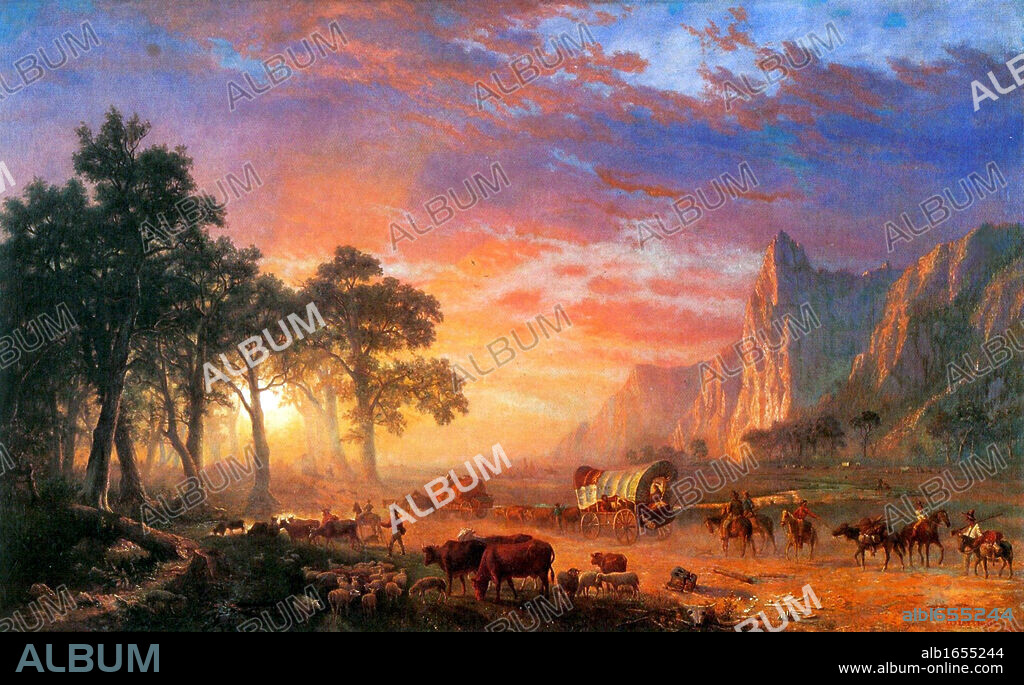
Albert Bierstadt
German-American artistWikipedia
23
MENTIONS
14
EPISODES
12
PODCASTS
Search complete. 23 mentions across 14 episodes found for "Albert Bierstadt".
Nov 27, 2026

Layla BermeoGUEST
And if you've had the chance to see our colleagues' Framing Nature exhibition, there's actually a whole discussion of images of the Garden of Eden because we see them persists really kind of throughout the world, right? And so this is the sort of colonial Mexican vision of that.
Layla BermeoGUEST
And the lush foliage of the Garden of Eden, here we can see as kind of part of that story of colonization still, that it is speaking to the fertility of the colonies, which is a topic that will persist again all the way, I mean, through now, but definitely something like this makes me think of like Albert Bierstadt or artists from the East Coast traveling to the West Coast and positioning that land as a kind of Eden.
Layla BermeoGUEST
countries in the Americas that have been colonized and then themselves become colonizers, not only through the taking of land, but also through this really specific vision of Eden.
Layla BermeoGUEST
And in this case, we see a kind of direct quote from the Bible, right, which would shift sort of later in the 18th century into more kind of imagined scenes.
William R. CrossGUEST
Twelve years Winslow's junior, Thomas Benedict Clark was a prosperous manufacturer of shirt collars, of which he's wearing one that's quite prominent, but his greatest passion was collecting art.
William R. CrossGUEST
His tastes were eclectic, from Innis and Bierstadt landscapes to Persian metalwork and Chinese porcelain to American still life and genre pictures.
William R. CrossGUEST
Ten years after starting his own dealership, he finally decided to focus on early American portraiture.
William R. CrossGUEST
In February 1899, he put up for auction, without reserve, almost his entire collection.
6 MINS LATER
William R. CrossGUEST
Another methodological mystery in Homer's life and work is the role of photography.
William R. CrossGUEST
Frank Goodyear remarked two weeks ago that an unusually large number of photographic portraits of Homer survive, although the artist does not seem to have encouraged many painted portraits.
William R. CrossGUEST
His neighbors at the 10th Street Studio building included the successful landscape painters Albert Bierstadt and Frederick Edwin Church.
William R. CrossGUEST
Church built a substantial collection of travel photographs that he used as source material for his work.

Sayre GomezGUEST
And
Tyler GreenHOST
then later, Albert Bierstadt uses sunsets completely differently, mostly to celebrate the imperial advance of Anglo-Saxonism, a key intellectual foundation of white supremacy across North America.
Tyler GreenHOST
I do not think you're doing church, and I definitely don't think you're doing Bierstadt.
Tyler GreenHOST
Why are you interested in sunsets?

Roland RamblerHOST
They offer very little of the unvarnished grit of a surviving ferret, the geological honesty of actual rock, or the objective truth of the wilderness they claim to preserve.
Roland RamblerHOST
Here at the Whitney, a collection of 36 original paintings by Albert Bierstadt reveals how he captured the operatic scale of the frontier instead of its mundane facts, using the glowing, theatrical light that taught a young nation how to look at its own wild interior.
Roland RamblerHOST
It requires very little effort to envision the artist as a young man in the spring of 1859, tagging along with Frederick W. Lander's Honey Road survey party.
Roland RamblerHOST
Born in Prussia and raised in New Bedford, Massachusetts, Bierstadt had returned to Germany to study the highly polished, meticulously detailed academic style of the Dusseldorf School.

Holly FreyHOST
After being a surveyor, a clerk, a sailor, a farmer, and a journalist, and with the books based on his Southern travels still being completed and published, he was encouraged to apply for a position of superintendent of Central Park in New York City.
Holly FreyHOST
He also circulated a petition supporting his efforts, and that petition got more than 200 signatures, including people like Washington Irving, Albert Bierstadt, and James Alexander Hamilton, son of Alexander Hamilton.
Holly FreyHOST
This combination of jobs did give Olmsted a unique set of skills that was well-suited to working on the park.
Holly FreyHOST
There was also a lot of political maneuvering by city officials that's outside the scope of this episode, but he was appointed to that position that September.

Mike AdamsGUEST
And then for the painting side of things, I really do a lot of landscapes that are kind of really inspired by the Hudson River School.
Mike AdamsGUEST
If you're familiar with them, Thomas Cole and Albert Bierstadt and stuff.
Mike AdamsGUEST
I haven't had a chance to do a lot of sporting art yet.
Mike AdamsGUEST
I do have my work in some galleries and I've had some, some solo shows for that.

Michael LibbieHOST
And so it was with the art lining the walls of Turner's sprawling Flying D Ranch in south-central Montana.
Michael LibbieHOST
Paintings by American masters Thomas Moran and Albert Bierstadt capture the grandeur and beauty of the early western landscape when it was still largely untouched by European settlers.
Michael LibbieHOST
Over Turner's imposing stone fireplace was a painting of Yosemite Valley.
Michael LibbieHOST
Elsewhere in his home were images of the Grand Canyon, Oregon's Mount Jefferson, and a Bierstadt work called Buffalo at Sunset, depicting a group of bison near a pool of water that reflects a glaring sun.
Cynthia DaignaultGUEST
I read a lot and look at a lot of other works that that piece brings to mind.
Cynthia DaignaultGUEST
When I was making this piece, I Revisited Bierstadt and the Hudson River School.
Cynthia DaignaultGUEST
I revisited Warhol's Shadows for a long time.
Cynthia DaignaultGUEST
You know, I reread a lot about Warhol's Shadows and I, you know, revisited that.

speaker_0HOST
My wife and I first encountered paintings from the Hudson River School of Art when touring the Broadmoor Hotel in Colorado Springs.
speaker_0HOST
Neither of us knew diddly squat about art history or the philosophy of art at the time, but we were spellbound by the landscapes depicted by painters like Albert Bierstadt, Thomas Moran, Frederic Edwin Church, and others.
speaker_0HOST
A picture might be worth a thousand words, but great art communicates beyond words.
speaker_0HOST
Étienne Gilson, a Thomistic philosopher, quotes the French painter Eugène Delacroix to make this point.
10 MINS LATER
speaker_0HOST
The Hudson River School played a major role in giving generations a visual language to communicate that value.
speaker_0HOST
The paintings continued to shape American ideas about wilderness and national identity.
speaker_0HOST
Roosevelt himself admired the Hudson River School and was likely acquainted with Albert Bierstadt, who himself was a member of the Boone and Crockett Club.
speaker_0HOST
Roosevelt went on to protect over 200 million acres of forests, wildlife refuges, and parks.

Leslie Greene BowmanGUEST
She had an amazing landscape sort of collection.
Leslie Greene BowmanGUEST
But one I really like to talk about is Bierstadt's monumental Rocky Mountain landscape.
Leslie Greene BowmanGUEST
That comes into the collection during the Reagan administration, but it's already been on loan there for a while, and it's a four-foot spectacular tableau of the Rocky Mountains.
Leslie Greene BowmanGUEST
And of course, before photography, Bierstadt was providing Americans with these glorious views of the Rockies in the West, and most Americans had never seen and had no way of understanding the um splendor of the american continent this painting is utterly arresting and it usually hangs in the um the red room and of course there was thomas moran who was sent out literally with a geological expedition to yellowstone to document it but it's his paintings of yellowstone that are used to persuade congress that they need to protect yellowstone as a national park and it's mrs johnson who um Recorded those landscapes the first landscapes of the Tetons and the Rockies are thanks to the Johnson administration so you could sort of see how Jackie got this major project rolling and got it over a tipping point and and then other administrations were really helping to amplify that work in large part because the maybe the third and maybe most important thing she did and I'm I think they're all equally important.
Leslie Greene BowmanGUEST
But she set up an organization that could continue to fund the work because money was always the problem, right? So she made sure there was expertise with a curator, but she established the White House Historical Association as a private nonprofit that would publish the collection, that would promote it with education, that would help protect it, and would raise funds to continue to acquire great American art.
Miranda MelcherHOST
And what I love is that all of these themes...
4 more episodes mention Albert Bierstadt.
Create an account to see the whole feed, search across every transcript, and follow the entities you care about.