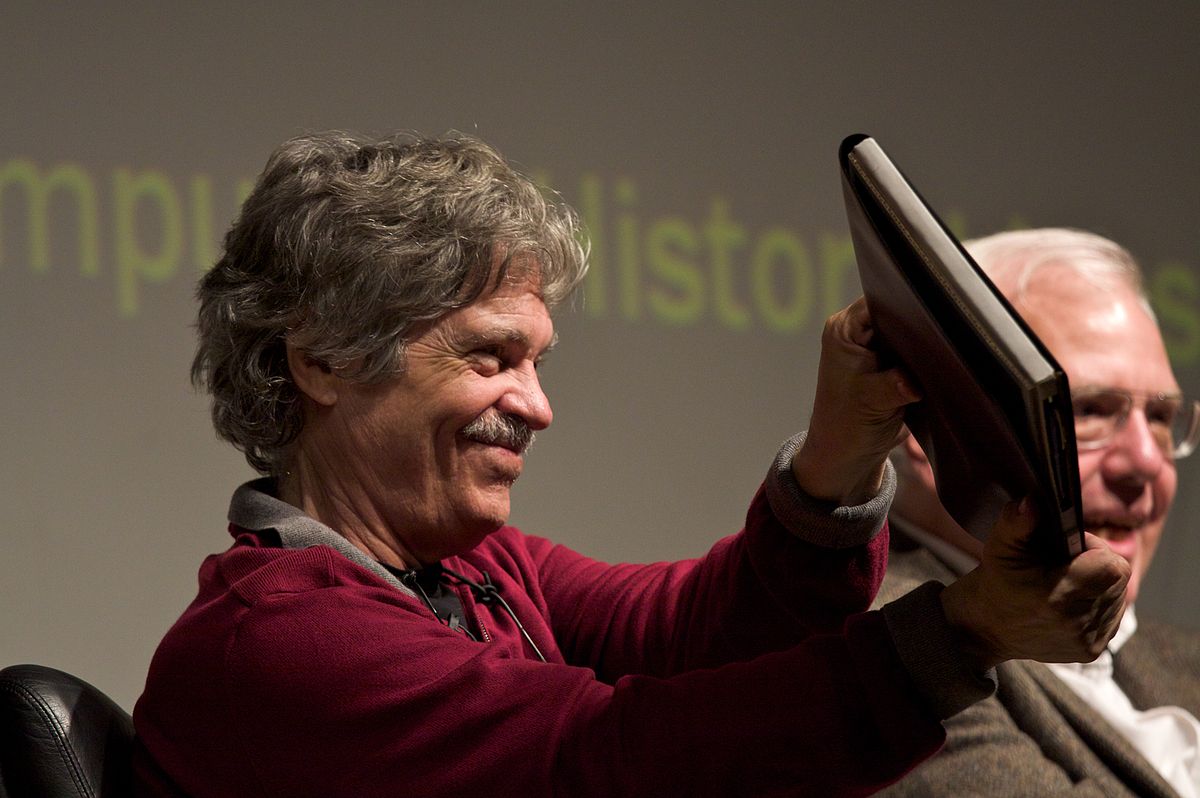
Alan Kay
American computer scientistWikipedia
24
MENTIONS
18
EPISODES
15
PODCASTS
Search complete. 24 mentions across 18 episodes found for "Alan Kay".
Oct 22, 2026

Saanvi PhaneendraHOST
The best way to predict the future is to invent it.
Saanvi PhaneendraHOST
Alan Kay.
Saanvi PhaneendraHOST
Hello and welcome to Express Yourself.
Saanvi PhaneendraHOST
We're a program by, for, and with creative young people.
Bill BurnettGUEST
And if they don't, a new competitor will probably emerge and take much of their market.
Bill BurnettGUEST
So I'll close with my favorite quote from Alan Kay, a computer scientist who was at Atari and Apple and IBM and other places.
Bill BurnettGUEST
He said, the best way to predict the future is to invent it.
Bill BurnettGUEST
I guess I'd turn this around and say, if you aren't inventing the future, somebody else is.

Peter ReinhardtGUEST
So growing quickly and hopefully I can shed some light on finding product market fit for you.
Peter ReinhardtGUEST
And I thought, just start by sort of looking back to Alan Kay's lecture last week.
Peter ReinhardtGUEST
I think he had some pretty incredible advice around how to do really amazing research by sort of looking into the future and imagining what that future might be like.
Peter ReinhardtGUEST
And in particular, he had this diagram of sort of exploring the pink plane and sort of testing out different ideas there.
32 MINS LATER
Peter ReinhardtGUEST
Traction, but if a marketer needed a new tool and you were using the open source version, the engineer still has to go compile it.
Peter ReinhardtGUEST
So in some ways we got lucky, right, that the open source version doesn't fully solve the problem.
Peter ReinhardtGUEST
Cool, so I'm gonna steal gratuitously from Alan Kay's slides again.
Peter ReinhardtGUEST
And I think finding product market fit feels a lot like finding the sort of blue plane when you're in the pink plane.

Crystal MurrayGUEST
I don't think it's essential, but I don't think it's necessarily optional because there's good stuff there.
John SpierkleHOST
Yeah, I thought it was really interesting how they integrated in Slack and, you know, the, you know, Harari, the author of Sapiens, talks about the fact, and also a good friend of mine, Bill Isaacs, who wrote a book called Dialogue, which is just fantastic, talks about thinking together in the process of dialogue.
John SpierkleHOST
Then the conversational interface, the fact that Slack, I mean, I think the AI folks are very fortunate that many organizations have adopted Slack because that's an organizational-wide conversation, right? And the ability-
Crystal MurrayGUEST
And Salesforce together, right? And
John SpierkleHOST
Salesforce too, right? Yeah.
John SpierkleHOST
And so and so that notion of having a having an intelligence sitting in the middle of the conversation of organizations, both with their customers, with each other and their suppliers, that's hugely powerful to inject that kind of intelligence in there.
John SpierkleHOST
Never mind the fact that, you know, Slack is basically a bulletin board on steroids and, you know, that's a really crappy way to organize information if you you know if it's it's um as my friend Alan Kay said it's like kudzu you know it's okay when it's small but when it when it's the main plant you get a problem and so it's a really crappy way to organize information um slack is uh but very easy to get started uh so the the bill the ability to inject intelligence in for value I think is interesting um where are you on this
AkashPANELIST
uh i was optional john on this one i'm not sure uh there's a lot to take away from this one uh yeah yeah seems more like a aws advertisement rather than a proper case study i would say

Elliot FelixHOST
At the institutional scale, having a sandbox or having a test bed or having this place where you can prototype the future is a key part of it.
Elliot FelixHOST
It comes back to Alan Kay.
Elliot FelixHOST
The best way to predict the future is to invent it.
Elliot FelixHOST
It seems like that you are living every day as a, as the sandbox, as you put it.

Walter IsaacsonGUEST
Um, Doug Engelbart, who figures out the mouse.
Walter IsaacsonGUEST
Alan Kay and the people at Xerox PARC, the graphical user interface.
Walter IsaacsonGUEST
It all comes together with Steve Jobs.
John CooganHOST
Yeah.
Jaron LanierGUEST
It used to sound totally normal.
Jaron LanierGUEST
Um, in the '70s when I was a teenager and I, I, uh, I would worshipfully visit Xerox PARC up the road and, and during the era when Alan Kay was there and building these amazing prototypes of the machines that we th-think of as normal today, uh, I remember seeing, uh, copying in the, in the Xerox PARC prototypes.
Jaron LanierGUEST
I was like, "Why are you copying files? You just invented Ethernet here.
Jaron LanierGUEST
You actually can connect your computers.
Bill BurnettGUEST
So this is an example of how moving from one paradigm to the other could radically change, um, this organization's business, and they are in process of putting in place all four of these initiatives, uh, worldwide across their organization.
Bill BurnettGUEST
Alan Kay, who's a computer scientist, the inventor of the Dynabook, the first notebook, and, uh, was an Apple fellow, said it probably better than anybody, "The best way to predict the future is to invent it." That's what we did at Apple when I was there for seven years.
Bill BurnettGUEST
They're still doing it.
Bill BurnettGUEST
I guess they're gonna have some new phone announcement tomorrow, but, um, I, I don't know.

Bonnie StachowiakHOST
Hmm.
Gardner CampbellGUEST
I was once in a room where Alan Kay, who helped to develop the, um, uh, interface for the Xerox Alto computer, one of the first, I guess you'd call it personal computers in a way, and he was challenged, "Why did you pick the metaphor of the desktop?" Which we all think about now without even thinking about it.
Gardner CampbellGUEST
What have you got on your computer or your screen? It's a desktop.
Gardner CampbellGUEST
What, what's on the desktop? Well, folders.
Gardner CampbellGUEST
So I got really interested in that, and along the way, I would just get jolted by certain things into bringing me once more into a state of kind of high alert to what are the metaphors.
Gardner CampbellGUEST
A dear friend and colleague named Chuck Dziuban recommended a book called Metaphors We Live By by two linguists, and it kind of maps all of these concerns in ways that are very interesting.
Gardner CampbellGUEST
W- of course, I had that i-instance where Alan Kay had to defend some of his choices, which he had a defense, but it was not a real convincing defense.
Gardner CampbellGUEST
I think he kind of knew, oh yeah, there's some truth there.

Walter IsaacsonGUEST
The main thing I would say about AI in this regard is throughout the personal computer revolution, which I wrote about, and I'm reissuing this book called The Innovators, which is about the people that...
Walter IsaacsonGUEST
The goal was to connect the individual as closely as possible to the machine, even in small ways like Steve Jobs and Alan Kay and Xerox PARC inventing the mouse and graphical user interfaces or Siri.
Walter IsaacsonGUEST
You were supposed to be connected to your machines, and your machines were like a bicycle for the mind, to use Steve's phrase.
Walter IsaacsonGUEST
Agentic AI is now throwing that out and saying these things will operate without you, and that goes against the fundamental philosophy of Locke, Franklin, and Jefferson.
8 more episodes mention Alan Kay.
Create an account to see the whole feed, search across every transcript, and follow the entities you care about.