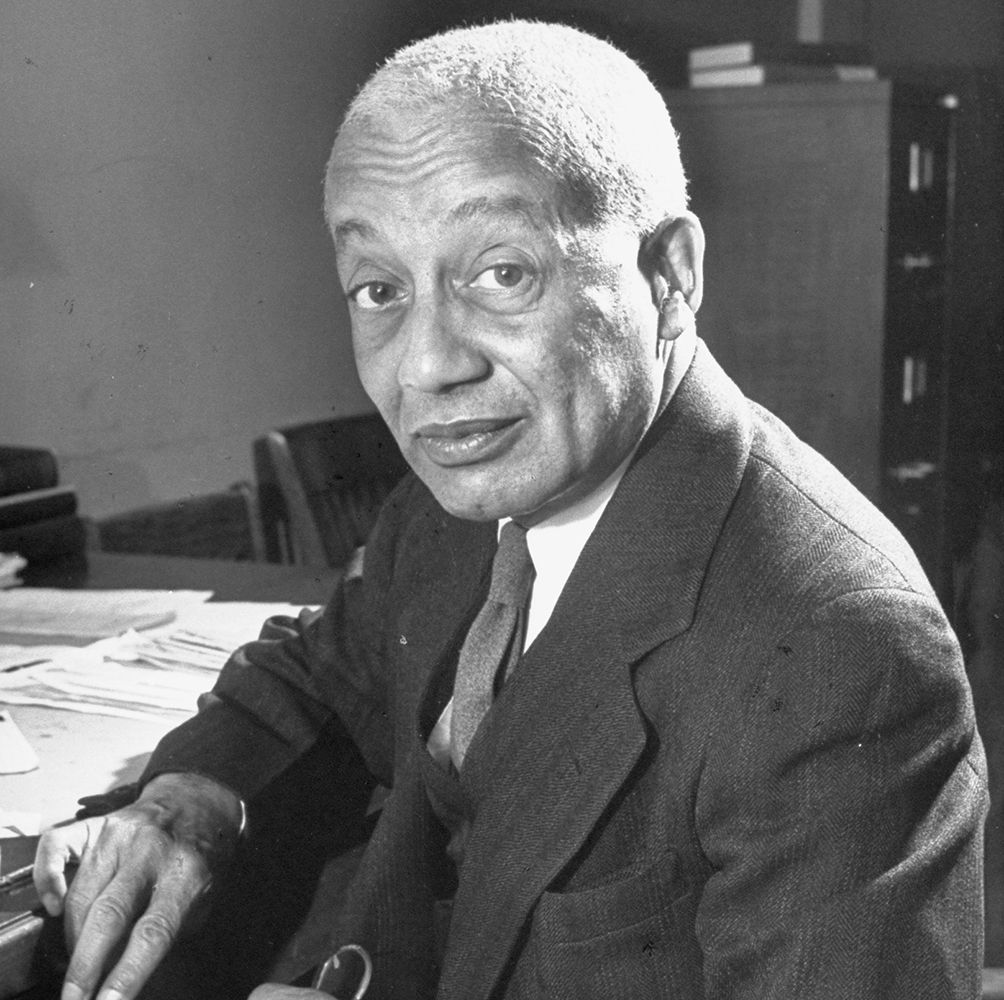
Alain LeRoy Locke
American writer and philosopherWikipedia
11
MENTIONS
5
EPISODES
5
PODCASTS
Search complete. 11 mentions across 5 episodes found for "Alain LeRoy Locke".
Oct 19, 2026

Rich MedinaGUEST
And his storied history with the Philadelphia art establishment, his collection of African art and how his first art show was panned.
Rich MedinaGUEST
by the establishment because of all the African elements in it, his relationship with Alain Locke and W.E.B. Du Bois and people who were wrapped around the Black education movement, whether you're a Booker T. Washington mindset or a Du Bois mindset, Albert Barnes sat in those spaces.
Rich MedinaGUEST
And he was a large part of the birth of the Harlem Renaissance.
Rich MedinaGUEST
And where's hip hop on paper in the Bronx? So there's this history of.

Alex EnglishHOST
[laughs]
Jeremy O. HarrisGUEST
Um, and basically, W.E.B. Dubois was the, and Alain Locke, were the two godfathers of the Harlem Renaissance.
Alex EnglishHOST
Mm-hmm.
Jeremy O. HarrisGUEST
They would find the boys, find the girls, and say, "Y'all are, y'all are it." Like, "Let's protect what you're doing.
Jeremy O. HarrisGUEST
Let's get you a..." Alain Locke, though, really fun thing about him.
Jeremy O. HarrisGUEST
He, because he was gay and was reading all these white gay writers that were out, and sort of like on their Walt Whitman, he was const- any time someone had a little bit of faggotry to them, he was like, "So you're gay."
Alex EnglishHOST
Mm-hmm.
Jeremy O. HarrisGUEST
"You need to be out.

William ParisHOST
He was asking a philosophical question, which is, what happens to a people when they begin to understand themselves as the authors of their own culture? It is this question that I think is the center of Locke's work.
William ParisHOST
It is also what makes Alain Locke particularly interesting if we approach him from the perspective of philosophy rather than literary history.
William ParisHOST
Locke was deeply concerned with questions about identity, recognition, democracy, pluralism, aesthetics, and the relationship between cultural and political emancipation.
William ParisHOST
His writings ask us to think about how racial groups become visible to themselves and to others, how cultural forms can challenge inherited stereotypes, and how art can participate in the reconstruction of a democratic society.
27 MINS LATER
William ParisHOST
And he thought race consciousness, like the poetry of Richard Wright, there's something creative and new that could possibly be
Lillian CicerchiaHOST
there.
William ParisHOST
I don't know if that's still possible now, but I think it's interesting to try to think through, well, how has the function of art changed for us? Is it possible for there to be another Alain Locke in this particular moment? Is it possible for him, for someone to produce an anthology of, here's the new, new Negro? They probably wouldn't say Negro.
William ParisHOST
But you know what I'm saying.

Clint SmithHOST
Then even the monsters we defy shall be constrained to honor us, though dead.
Clint SmithHOST
The editor of this historic issue of the Survey Graphic was Alain Locke.
Clint SmithHOST
Locke, the first Black American to earn a Rhodes Scholarship, received both his undergraduate degree and Ph.D. in philosophy from Harvard.
Clint SmithHOST
He would go on to teach at Howard University and publish a book called The New Negro, a manifesto and collection of essays that embodied the spirit of the movement and expounded upon the importance of the Harlem Renaissance.