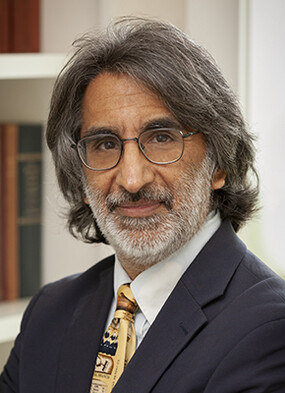
Akhil Reed Amar
American legal scholarWikipedia
58
MENTIONS
15
EPISODES
12
PODCASTS
Search complete. 58 mentions across 15 episodes found for "Akhil Reed Amar".
Sep 10, 2026

Brian McClanahanHOST
He's purposely misrepresenting some things.
Brian McClanahanHOST
Scholars such as Yale's Akhil Amar concede that the people of the several states ratified the Constitution.
Brian McClanahanHOST
Amar contends, though, contends, however, that the act of ratification was the world's largest corporate merger, which created a single indissoluble united people.
Brian McClanahanHOST
Amar is a distinguished scholar, but his merger theory would have been declared heretical by citizens living at the time of ratification.

Andy LipkaHOST
[upbeat piano music] Welcome to another episode of Amar's Constitution.
Andy LipkaHOST
I'm Andy Lipka, here with Professor Akhil Amar, now a year older.
Andy LipkaHOST
And once again, we have guests today.
Andy LipkaHOST
We have Professor Vik Amar returning to discuss yet another issue, and we'll have the second part of our interview with Professor Steven Smith on his new book on statesmanship and how that relates to constitutional matters, and so forth.
8 MINS LATER
Steven SmithGUEST
But I do think the statesman, one of the points I wanna make in the book is that the statesman is a rare phenomenon.
Steven SmithGUEST
We would be fortunate if we have one in our lifetime.
Andy LipkaHOST
So just to follow up on this though, I don't wanna leave it yet because I think that Akhil's point about, or at least his question, that is there a moral component? And you're saying there's a normative component, but they're not quite the same thing.
Andy LipkaHOST
And in terms of what you were saying with the Aristotelian trilogy or triad, as I'm listening to you, I'm thinking, okay, pathos.

Steven SolomonGUEST
I think also you go to the period of, uh, the debates over the, uh, the Constitution, the ratification period, um, just the freest possible debate.
Steven SolomonGUEST
Um, Akhil Amar has written a lot about this, uh, in, in, in several essays.
Steven SolomonGUEST
Um, there was no expectation or fear of, uh, seditious libel prosecutions or, or any other kind of punishment.
Steven SolomonGUEST
They were putting up, uh, liberty poles.

Elie HonigHOST
So two interesting events that I'm taking part in next week if you happen to be around.
Elie HonigHOST
September 15th, if you are in the New Jersey area, that's Tuesday night, I'm gonna be doing a one-on-one interview for Constitution Day with Professor Akhil Reed Amar, the famous Yale Law professor who is a constitutional historian, a brilliant guy, a really interesting guy.
Elie HonigHOST
That'll be on the campus of Rutgers University in New Brunswick, my alma mater, where I now teach.
Elie HonigHOST
So if you're in the central, north, even south Jersey area and wanna see Professor Amar, wanna see me one-on-one with him, sign up for that.

Edgar LinGUEST
I don't use it because that sounds like a shoe I'm not cool enough to wear.
Edgar LinGUEST
So the concept of it comes from Akhil Amar, who is one of the nation's leading constitutional scholar at Yale.
Edgar LinGUEST
He often says that he is great friends with Justice Thomas.
Edgar LinGUEST
It's been discussed very favorably by Judge Walker on the DC Circuit, one of the strongest Federalist Society credentials on the federal bench, and by Seth Waxman, former Solicitor General.
Andy LipkaHOST
Welcome to another episode of Amarica's Constitution.
Andy LipkaHOST
I'm Andy Lipka here with Professor Akhil Amar.
Andy LipkaHOST
Hello, Akhil.
Andy LipkaHOST
Hey, Andy.

Richard EpsteinGUEST
And why is that so important? Because it suggests there was no systematic gap between the two of them, that they were closely entwined.
Richard EpsteinGUEST
And so to give you an illustration of the mistake, my good friend, John, in a recent piece on Civitas Outlook, in which he starts talking about the context of the Constitution has to prevail over the natural law sentiment.
Richard EpsteinGUEST
The difficulty with that is a natural sentiment is what was embedded in the text.
Richard EpsteinGUEST
And everybody knew it, including Vattel.
Richard EpsteinGUEST
It's also in Kent when he quotes Vattel and so forth.
Richard EpsteinGUEST
But we are told a completely different thing, and then we have to figure out what we're supposed to do, and we don't know what the answer to that question.
Richard EpsteinGUEST
To make it worse, when you start saying it's a birthright citizenship stuff, the Supreme Court only applied this to essentially illegal aliens and transients, right? But my friend Akhil Amar, who always has a highly fevered intelligence, right? What he says is, look, I was born in the United States.
Richard EpsteinGUEST
My older brother Vic was born overseas.
Andy LipkaHOST
[upbeat piano music] Welcome to another episode of "America's Constitution." I'm Andy Lipka, here with Professor Akhil Amar and a guest that our audience is very familiar with, Professor Vic Amar.
Andy LipkaHOST
First of all, welcome back to your podcast, Akhil.
Akhil Reed AmarHOST
To ours.

Peter SagalGUEST
And the reasons make a little sense if you consider it from their perspective.
Peter SagalGUEST
The first thing you need to do is you need to remember, this is something that was impressed upon me by Akhil Reed Amar, a professor at Yale, a world-renowned expert in the U.S. Constitution who was our sort of in-house expert on our TV show Constitution USA for PBS.
Peter SagalGUEST
Yes.
Peter SagalGUEST
It's impossible for us now to comprehend how big America was, even just the 13 coastal colonies.

Jacob HuebertGUEST
It doesn't make too much sense that Congress could let courts appoint other people in the executive branch who have nothing to do with the courts.
Jacob HuebertGUEST
And so we cite a law review article by Akhil Amar where he takes this issue on directly
Mark ChenowethHOST
I was going to say, John, we don't always quote constitutional law professors here at NCLA, but when we do, we like to quote Akhil Amar.
Mark ChenowethHOST
No, it's not usually Akhil Amar, but go ahead, Jacob.
Mark ChenowethHOST
What does Professor Amar say?
Jacob HuebertGUEST
Yeah, and so he takes that view that if you read this in the context of the whole Constitution and how it treats – Inferiors relative to superiors.
John VecchioneHOST
They did it in the Defense of Marriage Act.
John VecchioneHOST
They did it for other acts where they have said, you're going to argue for the government because the government's dropped out.
5 more episodes mention Akhil Reed Amar.
Create an account to see the whole feed, search across every transcript, and follow the entities you care about.