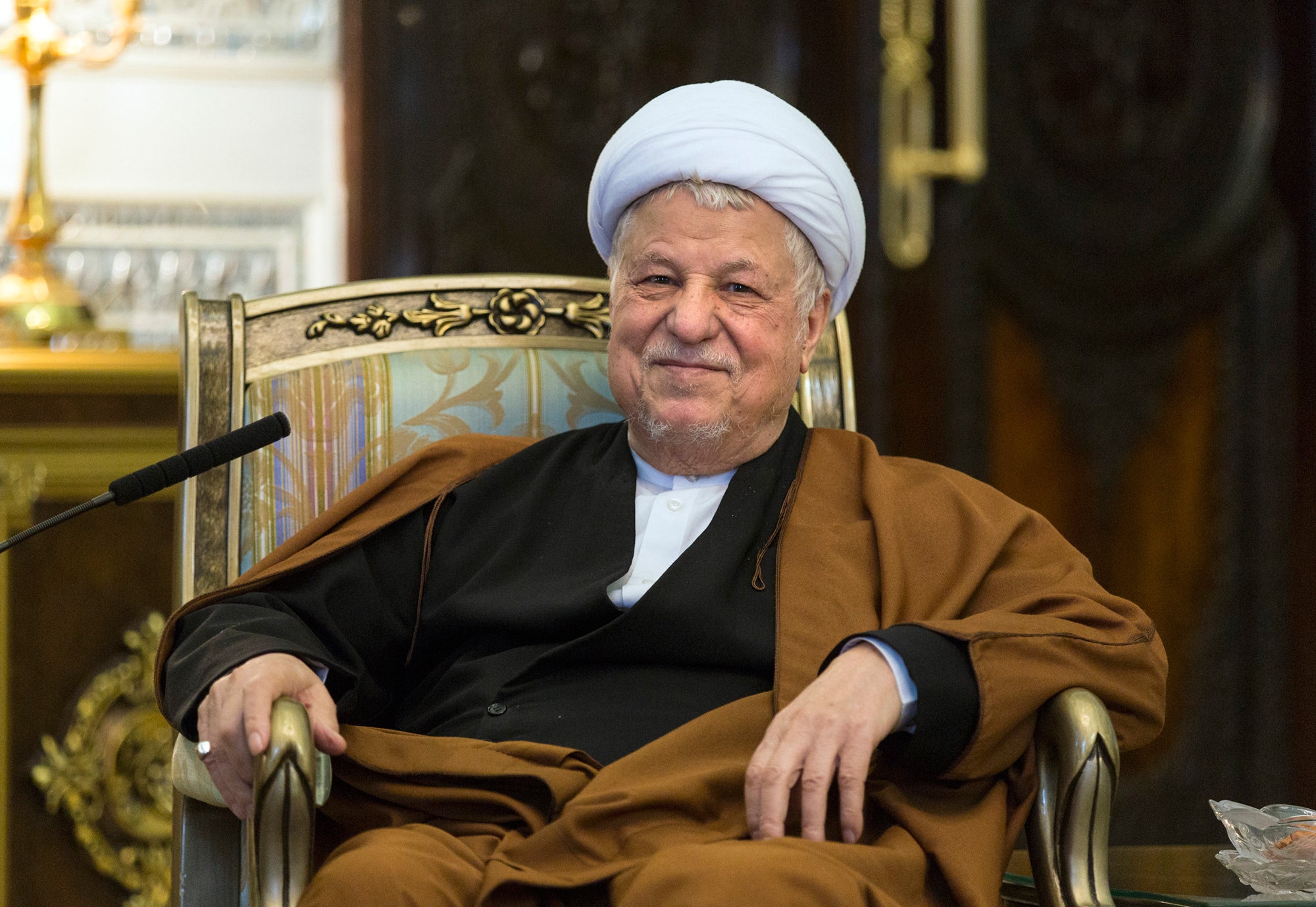
Akbar Hashemi Rafsanjani
Former President of IranWikipedia
40
MENTIONS
10
EPISODES
10
PODCASTS
Search complete. 40 mentions across 10 episodes found for "Akbar Hashemi Rafsanjani".
Oct 13, 2026

Borzou DaragahiHOST
But in any case...
Borzou DaragahiHOST
What can you tell me about that era, that era before 2003, when Iran's nuclear program kind of became a, started becoming a big period of attention? What did you learn in your research about that era, you know, under Rafsanjani, I guess, and other stalwarts of the Islamic revolution who launched this program? Sure.
Sina AzodiGUEST
So first of all, 1990s was a very important decade for Iran.
Sina AzodiGUEST
because the country emerges from the war relatively weakened by the war, it cannot rearm itself because of the U.S. arms embargo on the country.

Dennis RossGUEST
One of the things he learned was don't fight the United States directly because that could threaten the regime.
Dennis RossGUEST
He was president of Iran when Khomeini, the original leader, Ayatollah, original supreme leader, when he made the decision to end the Iran-Iraq war, something he said he would not do, and the reason he did it is because They then had a prime minister named Mousavi and Rafsanjani, who was a senior figure.
Dennis RossGUEST
They came to Homani and they said, look, we can't fight directly the U.S. That would threaten the survival of the regime.
Dennis RossGUEST
And Khamenei was present then.

Sina RahmaniHOST
And then you have another situation.
Sina RahmaniHOST
And these are, in a way, the kind of two main characters of your essay, which is the emergence of Hashemi Rafsanjani, as his main adversary in the plans around around.
Sina RahmaniHOST
Now, I want to sort of ask you a larger question.
Sina RahmaniHOST
If memory serves me right, I thought we did an episode about Rafsanjani.
Sina RahmaniHOST
Maybe not.
Sina RahmaniHOST
Maybe we didn't.
Sina RahmaniHOST
I think we did an episode about Ahmadinejad and Rafsanjani came up.
Sina RahmaniHOST
That's what it is.

Ali AlizadehGUEST
The country was under war, and it was difficult for anyone to dare to...
Ali AlizadehGUEST
There was some attempt, even in 86, by Rafsanjani to have a detente with the United States.
Ali AlizadehGUEST
You better than you possibly know about McFarlane traveling to Iran and the whole thing about Iran Contras and Reagan government reaching a hand of friendship with Iran, sending a bunch of olive and And said to Iran that we want to make peace.
Ali AlizadehGUEST
And then inside Iran, someone from Montazeri office, one of the important clergy, he basically disclosed that.
22 MINS LATER
Ali AlizadehGUEST
That's one point.
Ali AlizadehGUEST
And you can see from liberals are doing whatever they can.
Ali AlizadehGUEST
Last week, for example, Hossein Marashi, the godfather of the main neoliberal party in Iran, Kargo Zaransal Zandeghi, who was also brother-in-law of Hashemi Rafsanjani, the pillar of Iran's revolution, he said even Chinese don't want to work with Iran and Chinese have stipulated preconditions for buying Iran oil, including opening straight of Hormuz oil.
Ali AlizadehGUEST
and then de-escalating tension with the regional countries, with the Persian Gulf countries, etc.

Sharmine NarwaniHOST
How did this factualism actually begin? And I told you, Ali, earlier that I was privileged to watch a documentary in private by a journalist in Iran called Siavash Sarmadhi, which explained how this split began.
Sharmine NarwaniHOST
And it came about through the two personalities and two focuses of two men, Ali Khamenei and Akbar Hashemi Rafsanjani, right? Do you want to explain that a little bit or...
Sharmine NarwaniHOST
do you wanna explain like what happened? I mean, the quick background on these two men is after Ruhollah Khomeini, the first Supreme Leader of Iran passed away, there was a discussion within the Council of Guardian or Assembly of Experts to choose a successor.
Sharmine NarwaniHOST
And there was an idea that they would do like a council of experts, right? Like multiple personalities, including these two men.
Sharmine NarwaniHOST
And it is Rafsanjani, who pushed for Ali Khamenei to become the successor and that it would be a single man holding that position, correct? Which is kind of ironic because their worldviews and their views of what was good for Iran turned out to be very, very different.
Ali AlizadehGUEST
That's right.
Ali AlizadehGUEST
So very interesting because today, or at least in the Western media representation, we always had Khamenei as the top dictator who ran everything.
Ali AlizadehGUEST
So, but then in mid 80s, there is like Fischer and there is another faction, which is very quiet.

Ben MacIntyreGUEST
They didn't say thank you because that wasn't the way the Iranian Revolutionary Guard operates.
Ben MacIntyreGUEST
They just took it back to Tehran to show the authorities there, the Ayatollah, Rafsanjani, who was the Speaker of the Majlis, who was one of the most powerful figures in Iran.
Ben MacIntyreGUEST
And within two months of this intelligence being brought to the attention of the Iranians, something like 8,000 Iranian communists were arrested and rounded up, of whom it's not clear quite how many, but perhaps half were executed in the end.
Ben MacIntyreGUEST
I mean, it's an appalling bloodbath, and that is the moment when the Ayatollah's regime was solidified.

Shahab EsfandiaryGUEST
It seems that the
Omar GhazmiHOST
Islamic Republic lacks a revolutionary Islamic theory of political economy, which has allowed neoliberalism to take hold starting, of course, in the 1990s under Ali Akbar Hashemi Rafsanjani.
Omar GhazmiHOST
Why is there a lack of coherent political economic theory here in the Islamic Republic?
Shahab EsfandiaryGUEST
One of the reasons is again this colonial mentality that some of our economists have and they think that liberal economics or neoliberal economics is the... scientific method of doing economics anywhere in the world.

Noah RothmanGUEST
I don't want to be super conspiratorial, but you know, we've been, you've been talking about this.
Noah RothmanGUEST
We've been watching this, this big split in between the IRGC stuff and the, um, and the political class, right? So you have Pezeshkian, now, um, Khatami, and Rafsanjani, all of them very publicly saying, "Well, dude, this is killing us.
Noah RothmanGUEST
We, we need to find an honorable off-ramp here." These, all three have used the word honorable.
John PodhoretzHOST
Mm-hmm.

Ben MacintyreGUEST
They, they take it back.
Ben MacintyreGUEST
But that, the, the day they fly back, they contact, they get hold of, um, Rafsanjani, the speaker of the Iranian Parliament, and say, "We got a problem here." And the aftermath is brutal and spectacular.
David McCloskeyHOST
And bloody.
Ben MacintyreGUEST
And incredibly bloody.

Ben MacintyreGUEST
He gave them every stick of information that he had about the Iranian Communist Party, who they were, where the dead letter boxes were, where the safe houses were, the money chains, the arms dumps.
Ben MacintyreGUEST
And the Iranian... delegation returned to Tehran and informed the Ayatollah, informed Rafsanjani, the speaker of the Majlis, a very powerful figure in Iran.
Ben MacintyreGUEST
And within two months, something like 10,000 Iranian communists were rounded up, of whom probably 8,000 were executed.
Ben MacintyreGUEST
The Iranian Communist Party was smashed, absolutely destroyed.