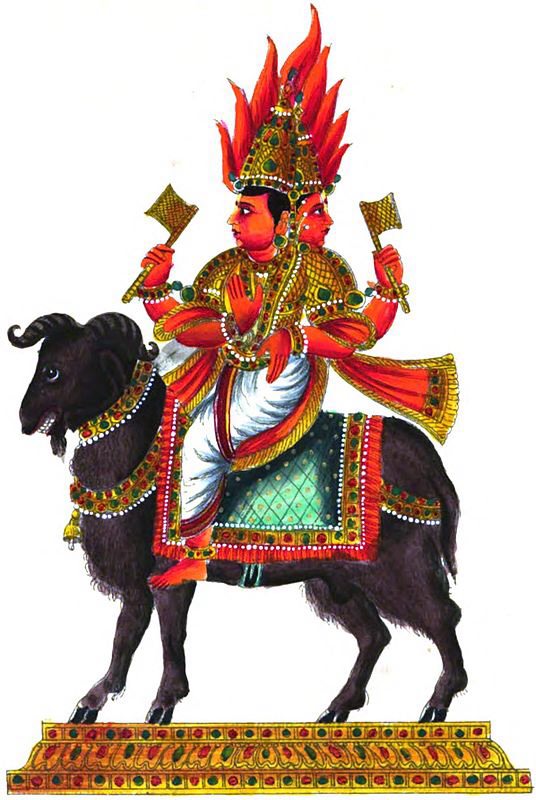
Agni
DeityWikipedia
290
MENTIONS
30
EPISODES
23
PODCASTS
Search complete. 290 mentions across 30 episodes found for "Agni".
Sep 20, 2026

Jyoti TharavanathNARRATOR
Verily the shining sun is the Aswamedha sacrifice, and his body is the ear.
Jyoti TharavanathNARRATOR
Agni is the sacrificial fire, Arka, and these worlds are his bodies.
Jyoti TharavanathNARRATOR
These two are the sacrificial fire and the Aswamedha sacrifice and they are again one deity, namely death.
Jyoti TharavanathNARRATOR
He who knows this overcomes another death.
5 MINS LATER
Jyoti TharavanathNARRATOR
Hence the Devas rose, the Asuras fell.
Jyoti TharavanathNARRATOR
He who knows this rises by his self, and the enemy who hates him falls.
Jyoti TharavanathNARRATOR
then they the devas said where was he then who thus stuck to us it was the breath within the mouth and therefore called ayasa he was the sap rasa of the limbs anga and therefore called that deity was called dur because death was far dhuran from it from him who knows this death is far off that deity after having taken away the evil of those deities namely death sent it to where the end of the quarters of the earth is there he deposited their sins therefore let no one go to a man let no one go to the end of the quarters of the earth that he may not meet there with evil with death that deity after having taken away the evil of those deities namely death carried them beyond death he carried speech across first when speech had become freed from death it became what it had been before agni fire That Agni, after having stepped beyond death, shines.
Jyoti TharavanathNARRATOR
Then he carried breath sent across.

Jyoti TharavanathNARRATOR
Now answer us a further question.
Jyoti TharavanathNARRATOR
Agni, Vayu, Aditya, Time, Kala, which is breath, Prana, food, Anna, Brahma, Rudra, Vishnu, thus do some meditate on one, some on another.
Jyoti TharavanathNARRATOR
Say, which of these is the best for us? He said to them, these are but the chief manifestations of the highest the immortal the incorporeal brahman he who is devoted to one rejoices here in his world presence thus he said brahman indeed is all this and a man may meditate on worship or discard also those which are its chief manifestations with these deities he proceeds to higher and higher worlds and when all things perish he becomes one with the Purusha.
Jyoti TharavanathNARRATOR
Yes, with the Purusha.
10 MINS LATER
Jyoti TharavanathNARRATOR
For thus it is said, The Udgita, called Pranava, the leader in the performance of sacrifices, the bright, the sleepless, free from old age and death, three-footed, consisting of three letters, A, U, M, and likewise to be known as fivefold, five pranas placed in the cave.
Jyoti TharavanathNARRATOR
And it is also said, the three-footed Brahman, has its root upward the branches are ether wind fire water earth c this one asvata by name the world is brahman and of it that is the light which is called the sun and it is also called the light of that syllable therefore let him forever worship that breath and sun as manifestations of brahman with the syllable om he alone enlightens us for thus it is said this alone is the pure syllable this alone is the highest syllable he who knows that syllable only whatever he desires is his and thus it has been said elsewhere this om is the sound endowed body of him This is his gender-endowed body, namely, feminine, masculine, neuter.
Jyoti TharavanathNARRATOR
This is his light-endowed body, namely, Agni, Vayu, Aditya.
Jyoti TharavanathNARRATOR
This is his Lord-endowed body, namely, Brahma, Rudra, Vishnu.

Alok PandeyHOST
Like in Vedas, we see Indra and other, they are taking the test.
Alok PandeyHOST
So then, soon after Pralambasur, there is a test taken by who else but Agni.
Alok PandeyHOST
the fire god.
Alok PandeyHOST
So it so happens that all the Gwal Bal and cows, there is a little aside to the story, it rains, so they have gone and then they find the cows who were in the cave and then they bring out.
36 MINS LATER
Alok PandeyHOST
And then, yes, there is suddenly this fire, because when you have decided to turn to the Lord, fire must come and test you.
Alok PandeyHOST
It's the test of fire.
Alok PandeyHOST
See, in Ramayana, it is described as Agni Pariksha.
Alok PandeyHOST
But here it is that immediately after this, there is fire.

Sai PrakashHOST
And they go back victorious back to the heaven.
Sai PrakashHOST
And Indra, Vayu and Agni, who are the main reason for winning this battle, are, you know, very proud and tending towards being very egoistic as well over the victory of this thing.
Sai PrakashHOST
Then the comment says, they believed that they were responsible for the victory.
Sai PrakashHOST
Hmm.
Sai PrakashHOST
And before they could go and catch him, he vanishes.
Sai PrakashHOST
Then now they said, we have to catch him somehow.
Sai PrakashHOST
Indra is very intrigued and he says, Agni, you go and catch him.
Sai PrakashHOST
Find out who is he, where he has come from and all that.
Alok PandeyHOST
Let's say.
Alok PandeyHOST
When you offer the power of the intellect into the Agni.
Alok PandeyHOST
So what will Agni do? What is the nature of Agni? First it will purify.
Alok PandeyHOST
Okay? Then Agni lifts everything apart.
Alok PandeyHOST
It's the nature of Agni.
Alok PandeyHOST
So when we put our mind, thoughts into the Yajna which is inside, it gets purified and uplifted.
Alok PandeyHOST
By purified, it's not about moral purity and all that.

Ami GanatraGUEST
That is another big difference between the worldviews.
Roshan CariappaHOST
I want to understand how did our gods evolve? What is the purpose of these gods and deities? And why do we not worship Indra or Agni or Varun like they were mentioned in the Rig Veda and so on? How did this evolution of gods happen to what we currently perceive as gods as well?
Ami GanatraGUEST
So I'll share how I think about this and that's how I started the book as well a little bit.
Ami GanatraGUEST
See, man initially lived in jungles.
5 MINS LATER
Ami GanatraGUEST
Some Devatas.
Ami GanatraGUEST
Who were...
Ami GanatraGUEST
Let me not say secondary, but who are not supremely prime, unlike Indra and Agni.
Ami GanatraGUEST
Indra and Agni have the most suptas in the Rig Veda.

Jyoti TharavanathNARRATOR
Verily the shining sun is the Aswamedha sacrifice, and his body is the ear.
Jyoti TharavanathNARRATOR
Agni is the sacrificial fire, Arka, and these worlds are his bodies.
Jyoti TharavanathNARRATOR
These two are the sacrificial fire and the asvamedha sacrifice and they are again one deity, namely death.
Jyoti TharavanathNARRATOR
He who knows this overcomes another death.
19 MINS LATER
Jyoti TharavanathNARRATOR
the one became a ewe the other a ram he embraced her and hence goats and sheep were born and thus he created everything that exists in pairs down to the ants he knew i indeed am this creation for i created all this hence he became the creation and he who knows this lives in this his creation next he thus produced fire by rubbing from the mouth as from the fire hole and from the hands he created fire therefore both the mouth and the hands are inside without hair for the fire hole is inside without hair and when they say sacrifice to this or sacrifice to that god each god is but his manifestation for he is all gods now whatever there is moist that he created from seed This is Soma.
Jyoti TharavanathNARRATOR
So far, verily, is this universe either food or eater.
Jyoti TharavanathNARRATOR
Soma, indeed, is food, Agni, eater.
Jyoti TharavanathNARRATOR
This is the highest creation of Brahman, when he created the gods from his better part, and when he who was then mortal created the immortals.

Jyoti TharavanathNARRATOR
The syllable iha, the self.
Jyoti TharavanathNARRATOR
The syllable ai is agni, fire.
Jyoti TharavanathNARRATOR
The syllable iu is the sun.
Jyoti TharavanathNARRATOR
The syllable ii is the nihava, or invocation.
19 MINS LATER
Jyoti TharavanathNARRATOR
He lives long, becomes great with children and cattle, great by fame.
Jyoti TharavanathNARRATOR
His rule is, do not speak evil of the Brahmanas.
Jyoti TharavanathNARRATOR
21st Kanda the hinkara is the threefold knowledge the prstava these three worlds the yudgita agni fire vayu air and aditya sun the pratihara the stars the birds under rays the nidhana the serpents gandharvas and fathers that is the saman as interwoven in everything he who thus knows this saman as interwoven in everything he becomes everything and thus it is said in the following verse there are the five-fold three the three kinds of sacrificial knowledge the three worlds etc in their five-fold form that is as identified with the hinkara the prastava etc and the other forms of the sermon greater than these there is nothing else besides he who knows this knows everything all regions offer him gifts his rule is let him meditate on the salmon knowing that he is everything yea that he is everything twenty second kanda the yudgita of which a poet said i choose the deep-sounding note of the salmon as good for cattle belongs to agni The indefinite note belongs to Prajapati, the definite note to Soma, the soft and smooth note to Vayu, the smooth and strong note to Indra, the heron-like note to Brihaspati, the dull note to Varuna.
Jyoti TharavanathNARRATOR
Let a man cultivate all of this, avoiding, however, that of Varuna.

SatyaPANELIST
So here, you know, again, Atma Swaroopam is further explained.
SatyaPANELIST
So we talk about the body is compared, you know, compared to the, as a city with 11 gates and it also talks about, you know, for example, the Agni, Agni Tattvam or a fire principle.
SatyaPANELIST
So when we see You know, an iron ball with which is red heart.
SatyaPANELIST
You know, we don't see the iron at all.
SatyaPANELIST
But the fire doesn't have a shape.
SatyaPANELIST
And it is the ones, you know, a formless gets associated with the form and the locus.
SatyaPANELIST
And that is what is talked through Agni Tattvam, Vayu Tattvam.
SatyaPANELIST
And there is also an example of how the sun or the light principle, which is all pervading, so even even when a sun falls on something impure you know it doesn't get affected by that so that's the uh it only reflects what is whatever comes on the way but it stays uh unattached so similarly con so so you know all these examples are mentioned to uh refer to the consciousness uh as an akarta and above um as well as something which is all-pervading a contact and illumines everything and unpolluted with uh what is associated with that so you know again the 13th chapter of uh gita also we we saw this actually and what is the sadhana here the sadhana is the uh continuously doing the vedanta vicharam so like you know swamiji says that like you do nitya karma doing Vedanta Vicharam also should become part of our daily routine.

Jyoti TharavanatNARRATOR
Verily, the shining sun is the Aswamedha sacrifice, and his body is the ear.
Jyoti TharavanatNARRATOR
Agni is the sacrificial fire, Arka, and these worlds are his bodies.
Jyoti TharavanatNARRATOR
These two are the sacrificial fire and the asvamedha sacrifice and they are again one deity, namely death.
Jyoti TharavanatNARRATOR
He who knows this overcomes another death.
7 MINS LATER
Jyoti TharavanatNARRATOR
That deity, after having taken away the evil of those deities, namely death, carried them beyond death.
Jyoti TharavanatNARRATOR
He carried speech across first.
Jyoti TharavanatNARRATOR
When speech had become freed from death, it became what it had been before, Agni, fire, That Agni, after having stepped beyond death, shines.
Jyoti TharavanatNARRATOR
Then he carried breath sent across.
20 more episodes mention Agni.
Create an account to see the whole feed, search across every transcript, and follow the entities you care about.