After-action review
21
MENTIONS
6
EPISODES
6
PODCASTS
Search complete. 21 mentions across 6 episodes found for "After-action review".
Sep 25, 2026

Frank RichHOST
Study it.
Frank RichHOST
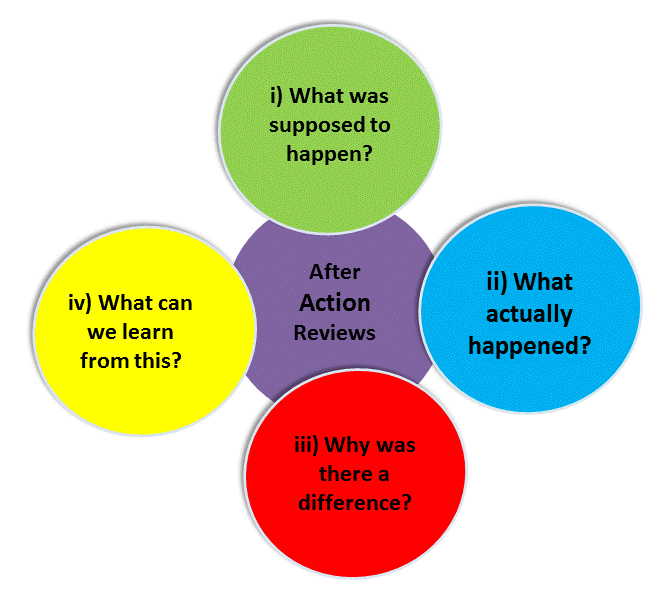
This is where something that we teach is to do an after action review.
Frank RichHOST
Ask what happened? What triggered me? What was I feeling? What was I thinking? What did I want to do? And what did I actually do? What was underneath the anger? And what did the urge to escape actually show up? And then what could I have done differently next time? We're not looking for perfection here.
Frank RichHOST
We're looking for the patterns.

Isaac AlkaideHOST
is a useful real-world example.
Isaac AlkaideHOST
Its guidance describes the AAR not simply as a critique delivered by the leader, but as a structured professional discussion where participants identify what happened, why it happened, what worked and what can be improved.
Isaac AlkaideHOST
The emphasis is on self-discovery and improving future performance rather than simply identifying who was wrong.
Isaac AlkaideHOST
The Army reinforced this approach with updated AAR guidance published in 2025.
Isaac AlkaideHOST
That distinction matters.
Isaac AlkaideHOST
The purpose is learning, no blame.

Yaakov LappinGUEST
So I think there are some very unique things happening in the IDF.
Yaakov LappinGUEST
And the first one of these principles is the After Action Review.
Yaakov LappinGUEST
And what's very unique about this culture, and it's first and foremost a culture, it's something that began in the Israeli Air Force, then spread out to the other two branches, to the ground forces and to the Navy.
Yaakov LappinGUEST
The Israeli Air Force is still really the laboratory of the After Action Review.
Yaakov LappinGUEST
The other two branches have looked to it to try and import this culture from them.
Yaakov LappinGUEST
And they have done that.
Yaakov LappinGUEST
But what's really fascinating about the way the Air Force does it is that it's all based on the idea that the most senior people in the room, after any significant event, training exercise, operational activity, when they sit down for their debrief, the most senior person in the room, whether it's a squadron commander or a wing commander, they will come up in front of the rest of the personnel, the subordinates, and say, here is where I went wrong.
Yaakov LappinGUEST
I should have banked left, I should have dropped my munition at this altitude, I ignored this sensor, and that's why I made a mistake.

Steve BlankHOST
IP used to be defensible.
Steve BlankHOST
Now, what is defensible IP? Leaving the after-action review, we thought we understood the problem.
Steve BlankHOST
The minimum viable product was no longer a useful artifact for learning and discovery about the value proposition and the product market fit.
Steve BlankHOST
I felt confident that we could make some simple fixes to the syllabus to deal with this.

Jennifer McLeodGUEST
When you tell
Greg CollinsHOST
them you're doing an AAR, they know exactly what you're talking about.
Greg CollinsHOST
Yeah,
Jennifer McLeodGUEST
exactly.

Guy HazutGUEST
And of course there were some days when uh, I went with my people directly into the combat zone to learn firsthand what was happening on the field.
Guy HazutGUEST
Information, in-information reach us in different ways, through a daily situation assessment with the learning officer in the division and the corps, through daily situation assessment with the division commanders at the Southern Command, through phone calls with unit commanders after success or unfortunately failures, through After Action Review, AAR that they were written and sent to us.
Guy HazutGUEST
Sometimes the information flowed to us, sometimes we took the initiative to pull it in.
Guy HazutGUEST
In some cases we went down to the field ourselves to conduct debrief and uh, learn.