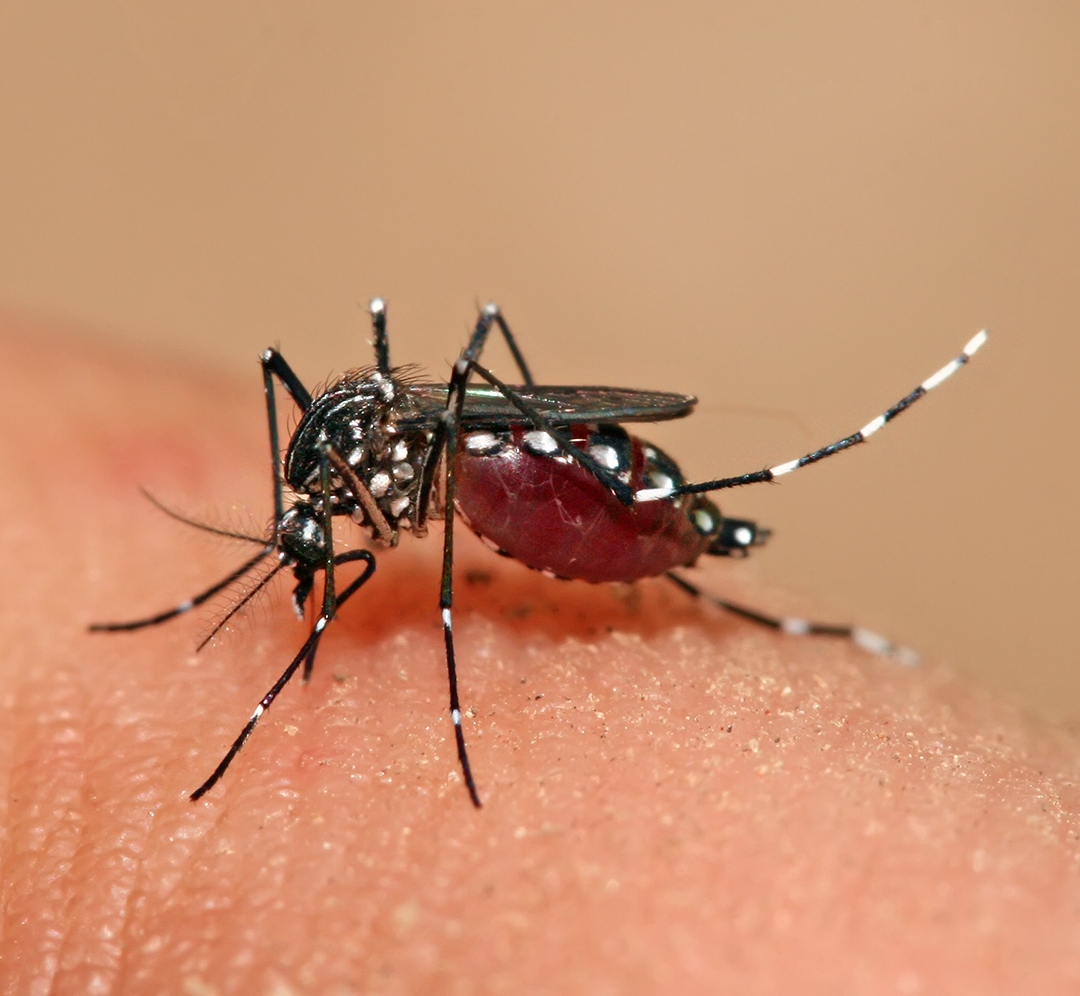
Aedes
InsectWikipedia
19
MENTIONS
9
EPISODES
8
PODCASTS
Search complete. 19 mentions across 9 episodes found for "Aedes".
Sep 23, 2026

speaker_0NARRATOR
Other countries have working systems.
speaker_0NARRATOR
Brazil approved the first unconstrained environmental release of an engineered insect, a variant of the Aedes aegypti mosquito, which carries diseases like dengue fever and Zika virus.
speaker_0NARRATOR
The modified males carry a gene that kills their offspring at the larval stage.
speaker_0NARRATOR
Adding them to the population means they compete with ordinary Aedes males for mating opportunities.
speaker_0NARRATOR
Since females mate only once, females who mate with them produce no surviving offspring.
speaker_0NARRATOR
In Brazilian cities where they've been released, wild populations have dropped 80 to 96%.

Heather McSherryHOST
The four serotypes are similar enough that we call all of them dengue, but they're immunologically different enough that infection with one doesn't make you permanently immune to the other three.
Heather McSherryHOST
The virus is transmitted primarily by Aedes aegypti mosquitoes, with Aedes albopictus also capable of transmission.
Heather McSherryHOST
Both of those occur in the U.S., and Aedes aegypti is especially comfortable living around humans.
Heather McSherryHOST
The virus may need to find its way to Florida, but the machinery capable of transmitting it is already there.
Heather McSherryHOST
Many dengue infections are asymptomatic or mild.
Heather McSherryHOST
They travel to Florida while virus is present in their blood.
Heather McSherryHOST
They may be pre-symptomatic, or mildly ill, or never noticeably sick.
Heather McSherryHOST
A female Aedes aegypti then bites them and takes in dengue virus with the blood meal.

Jeff WinkleHOST
He welcomes additional heroes onto the quest and secures the goodwill and aid of locals in various ports.
Jeff WinkleHOST
He even tries to negotiate with King Aedes for the fleece, offering the Argonauts his services in subduing Aedes' enemies.
Jeff WinkleHOST
Soft words are his instrument of choice, and Jason uses them on everyone.
speaker_2NARRATOR
Welcome to the Ad Nauseam Podcast, where classical gourmands everywhere can finally get their fill.

Michele I. MorrisGUEST
And finally, Toxoplasma gondii, There's been an increased density of the small mammal hosts, as well as improved oocyte survival and infectivity, leading to new geographic areas of involvement.
Michele I. MorrisGUEST
Onto dengue, a flavivirus that is transmitted through Aedes mosquito bites and is associated with a viremia that can spread the infection also through infected blood, organs, and tissues.
Michele I. MorrisGUEST
It's endemic throughout the tropics and subtropics, and the area of risk has increased significantly in the face of urbanization, human migration, and warming.
Michele I. MorrisGUEST
It's estimated that there are over 50 million asymptomatic cases a year, of symptomatic cases a year, but 40 to 80% of cases are actually asymptomatic.
Michele I. MorrisGUEST
We know that doubling of atmospheric carbon dioxide will increase transmission capacity of the mosquitoes 100-fold in temperate areas.
Michele I. MorrisGUEST
But actually, climate change and urbanization could favor dengue transmission over malaria in sub-Saharan Africa, which is really the epicenter of transmission.
Michele I. MorrisGUEST
The Anopheles gambiae mosquitoes transmit infection best at about 25 degrees centigrade, whereas the Aedes aegypti mosquitoes transmit best at about 29 degrees centigrade.
Michele I. MorrisGUEST
But this is not a sharp cutoff.

RobertHOST
And it's causing an increase in the mosquito population.
RobertHOST
In the state of Florida, we see two of the vectors for dengue fever, and that's Aedes aegypti and Aedes albopictus.
RobertHOST
They are both present in the state.
RobertHOST
And the other thing she said is the international travel issue.

Gary ArndtHOST
And within Culicidae, mosquitoes are divided into several subfamilies and many genera.
Gary ArndtHOST
The overwhelming majority of species that are important to human health belong to just three of these genera: Anopheles, Aedes, and Culex.
Gary ArndtHOST
Anopheles mosquitoes are best known for transmitting malaria.
Gary ArndtHOST
Aedes mosquitoes include species such as Aedes aegypti and Aedes albopictus, which can transmit yellow fever, dengue, and Zika.
Gary ArndtHOST
Culex mosquitoes are important vectors for West Nile virus and Japanese encephalitis.
Gary ArndtHOST
Despite their reputation as bloodsuckers, mosquitoes primarily survive on plant sugars.

Justin AngHOST
So...
Justin AngHOST
So in Singapore, it's the Aedes mosquito, right? We all know that.
Justin AngHOST
That spreads dengue.
Justin AngHOST
But apparently in Europe, it's a different species.

Shilpa ShadesHOST
Their visit comes as dengue cases in Europe surged 300% between 2015 and 2024.
Shilpa ShadesHOST
Project Wolbachia involves releasing lab-grown male Aedes mosquitoes infected with Wolbachia bacteria, which curbs their ability to reproduce.
Shilpa ShadesHOST
The approach has proven effective.
Shilpa ShadesHOST
Since 2016, populations at project sites have fallen by 80-90%, while dengue risk has dropped by more than 70%.
Shilpa ShadesHOST
Their visit comes as dengue cases in Europe surged 300% between 2015 and 2024.
Shilpa ShadesHOST
Project Wolbachia involves releasing lab-grown male Aedes mosquitoes infected with Wolbachia bacteria, which curves their ability to reproduce.
Shilpa ShadesHOST
The approach has proven effective.
Shilpa ShadesHOST
Since 2016, populations at project sites have fallen by 80 to 90 percent, while dengue risk has dropped by more than 70 percent.