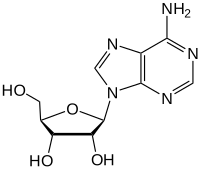
Adenosine
CompoundWikipedia
18
MENTIONS
8
EPISODES
8
PODCASTS
Search complete. 18 mentions across 8 episodes found for "Adenosine".
Sep 24, 2026

speaker_2HOST
Think about what happens when your cells are working all day, burning energy.
speaker_2HOST
They leave behind a chemical byproduct called adenosine.
speaker_1HOST
Adenosine, right.
speaker_2HOST
Yeah.
speaker_2HOST
And as the day goes on, adenosine builds up in your brain, docking into specific receptors, and that creates this intense biological pressure to shut down.

Vickie Petz KasperHOST
You may be wondering what all of this has to do with the sleep effort paradox, and I'm glad you asked.
Vickie Petz KasperHOST
Adenosine turns on the sleep switch, but what you need to understand is what turns it off.
Vickie Petz KasperHOST
I mean, that's the problem when you can't sleep.
Vickie Petz KasperHOST
I'll save some of this for more advanced mini-medical school, so don't even think about dropping this course just because I'm going to mention it.

speaker_1HOST
That's true.
speaker_0HOST
Adenosine, which is the chemical that builds up in the brain and causes sleep pressure, has been accumulating all day.
speaker_1HOST
Correct.
speaker_0HOST
So how can my biological clock possibly override 15 hours of physical and mental exhaustion to do deep work at midnight?

speaker_2HOST
Let's look at the top chambers, the atria first.
speaker_2HOST
One of caffeine's primary mechanisms is that it antagonizes or blocks adenosine receptors.
speaker_1HOST
Adenosine, which usually promotes drowsiness, right?
speaker_2HOST
Right, in the brain.
speaker_2HOST
But in the heart, it slows down the electrical impulses.

Herman PoppleberryHOST
Because caffeine works on the wrong system.
Herman PoppleberryHOST
Caffeine is an adenosine receptor antagonist.
Herman PoppleberryHOST
Adenosine is the molecule that builds up in your brain the longer you're awake, and it's the primary driver of sleep pressure.
Herman PoppleberryHOST
Caffeine works by blocking the receptors adenosine would normally bind to, so the sleepiness signal gets muffled.
Herman PoppleberryHOST
You feel more awake.

Michael BreusGUEST
So when a cell eats a piece of glucose, something comes out the back end.
Michael BreusGUEST
One of those things is adenosine.
Michael BreusGUEST
Adenosine works its way through your system and goes to a very specific receptor site in your brain, and as adenosine accumulates, you get sleepier and sleepier and sleepier.
Michael BreusGUEST
So that's what really we think is sleep drive.
Michael BreusGUEST
By the way, the technical term for that is the homeostatic drive for sleep.

speaker_3NARRATOR
But there's more than just molecule persistence.
speaker_3NARRATOR
Adenosine receptor sensitivity to caffeine blocking matters.
speaker_3NARRATOR
Some brains are more reactive to adenosine signaling disruption.
speaker_3NARRATOR
Caffeine depletes adenosine in brain tissue by blocking receptors, preventing adenosine reabsorption.
8 MINS LATER
speaker_3NARRATOR
The adenosine system represents one of your brain's most fundamental regulatory mechanisms.
speaker_3NARRATOR
a system so ancient it appears in organisms that have existed for hundreds of millions of years.
speaker_3NARRATOR
Adenosine is produced naturally throughout the day as a byproduct of neural activity.
speaker_3NARRATOR
Your neurons generate adenosine as they consume energy stored in molecules called ATP.

Michael BreusHOST
So when a cell eats a piece of glucose, something comes out the back end.
Michael BreusHOST
Uh, that's called adenosine.
Michael BreusHOST
Adenosine works its way through the system, goes to a very specific receptor area in your brain.
Michael BreusHOST
As adenosine accumulates, you get sleepier and sleepier and sleepier.
Michael BreusHOST
There's a second system though.