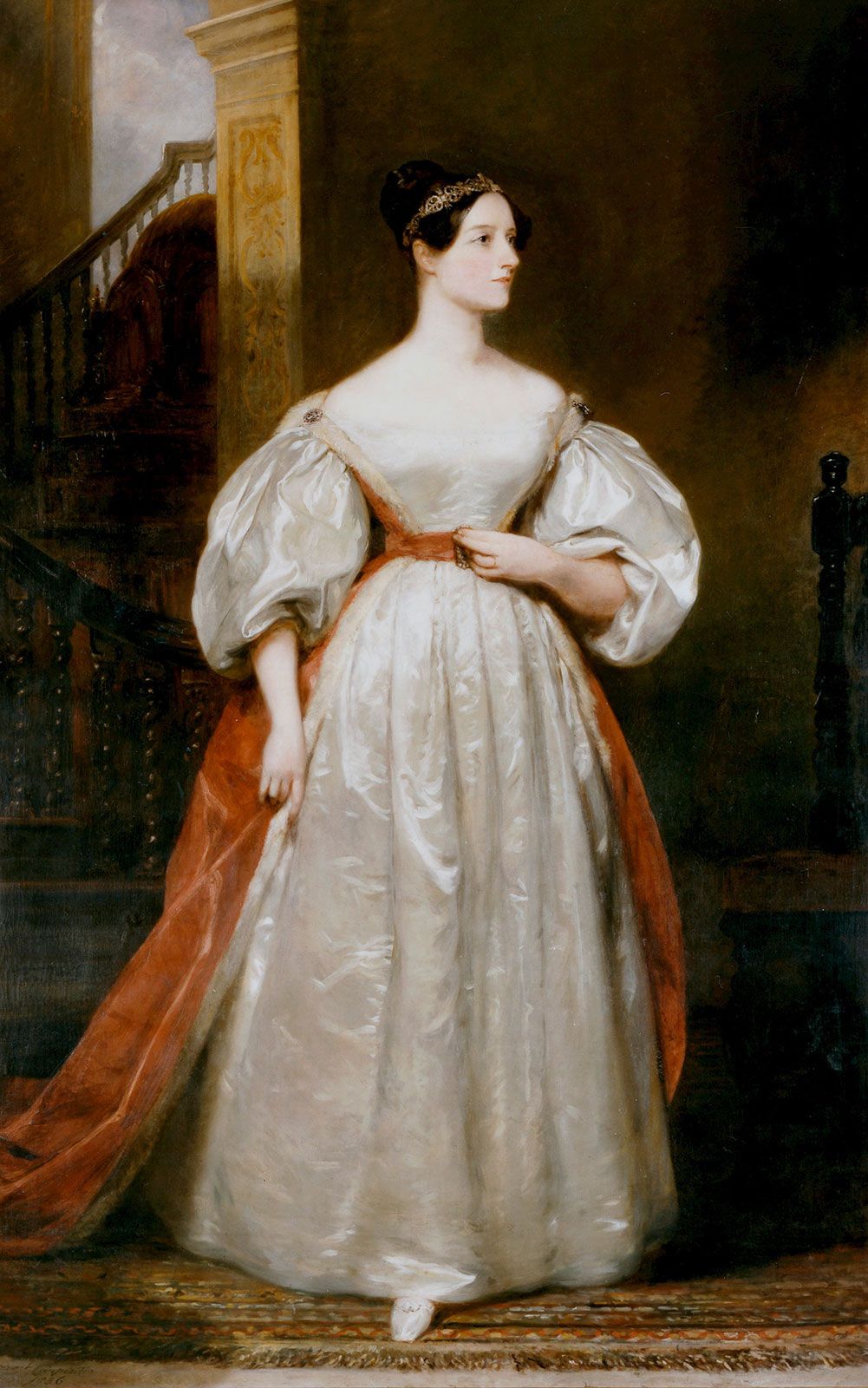
Ada Lovelace
Mathematician and writerWikipedia
49
MENTIONS
29
EPISODES
27
PODCASTS
Search complete. 49 mentions across 29 episodes found for "Ada Lovelace".
Sep 11, 2026

Finn J.D. JohnHOST
But that is a pretty familiar story, if you think about it.
Finn J.D. JohnHOST
From Ada Lovelace to Zelda Fitzgerald, from Alma Mahler to Marsha Lucas, and let's not forget Dorothy, Mrs. Luther Cressman, right? Dorothy Locke? History is full of great women who are remembered more for who they married than what they accomplished.
Finn J.D. JohnHOST
So, you know, what's sauce for the goose is always sauce for the gander, am I right? Well, that's all I've got on this one.
Finn J.D. JohnHOST
Key sources included Luther Cressman, Quest for First Peoples, an episode of Oregon Experience produced by Cammie Horton and first aired in 2014.

Herman PoppleberryHOST
She's increasingly known.
Herman PoppleberryHOST
No Ada Lovelace.
Herman PoppleberryHOST
The point is the quiet ones.
Herman PoppleberryHOST
So let's pin down what we mean by a quiet technology before we start naming names.

Wes BrownHOST
binary that way.
Heather D. SchulteGUEST
Yeah, the first is Ada Lovelace and Charles Babbage's counting machine.
Heather D. SchulteGUEST
All those little tendrils kind of trickled into what we do now.
Heather D. SchulteGUEST
Because computers were physical, you know, they were switches that go on and off.

speaker_0HOST
And the roots go deeper than most people realize.
speaker_0HOST
He points to Ada Lovelace and Suzanne Langer, who used the concept of a virtual world long before modern headsets existed.
speaker_0HOST
But here's where it gets really interesting.
speaker_0HOST
Lanier says the most important promise of VR isn't just seeing a different place.

Paula QuHOST
The signal you send into the universe returns.
Paula QuHOST
Ada Lovelace described a loom that weaves patterns from instructions, and the pattern returns to question the weaver.
Paula QuHOST
Glenn Gould recorded the same piece twice, and the second recording returned to the first and transformed it.
Paula QuHOST
You made a film about a director who cannot make his film, and the film returned to itself and became the thing it could not be.

speaker_5GUEST
Yeah, a steam-powered computer, basically.
speaker_4HOST
But the real breakthrough, at least conceptually, comes from Ada Lovelace.
speaker_4HOST
She looks at Babbage's giant calculator and realizes something profound.
speaker_5GUEST
She saw the bigger picture.
speaker_4HOST
She really did.
speaker_4HOST
She sees that if a machine can manipulate numbers according to rules, and those numbers can represent other things like, say, musical notes or letters, then the machine can manipulate any logical symbol.
speaker_5GUEST
Which is just fascinating because Lovelace basically decoupled computation from mere arithmetic.
speaker_5GUEST
She envisioned a machine that could process pure logic.

David HepworthHOST
I don't know which publisher did them.
David HepworthHOST
Which is about kind of, I can't remember the name of the series, but there were sort of feminist heroes for young girls, you know what I mean? So you obviously, you've got, what's her name? Ada Lovelace, the woman who pioneered the computer.
David HepworthHOST
Yeah.
David HepworthHOST
You know, you've got the woman Penicillin.

Ruby HartHOST
Their daughter, Augusta Ada Byron, was born on 10 December 1815.
Ruby HartHOST
She would later become Ada Lovelace, remembered for her work on Charles Babbage's proposed analytical engine, and often described as a pioneer of computer programming.
Ruby HartHOST
Byron showed affection for the infant, but fatherhood could not repair the marriage.
Ruby HartHOST
In January 1816, Annabella took Ada to her parents' home.

Marieke BiggGUEST
And because she kind of posited this philosophy above all else, She was able to unite those groups within her school and become this very influential teacher who brought together scholars from lots of different backgrounds.
Patrick GeogheganHOST
So there are so many famous names in it, people like Ada Lovelace, who we'll be familiar with.
Patrick GeogheganHOST
But there are also some astonishing recoveries in the book.
Patrick GeogheganHOST
For example, the story of Eunice Foote and her discoveries when it comes to experiments with gases and carbon dioxide and things that we would now associate as being so crucial to the climate movement.

Curtis RunstedlerGUEST
So maybe I can read it when I'm back for the holidays.
Curtis RunstedlerGUEST
But I think that's really cool, too, because I think there's probably some cybernetic... aspects and i mean it's a really interesting story we have you know byron's daughter ada lovelace and her mother doesn't want her to have anything to do with byron so she becomes this amazing kind of early kind of computer scientist and helps to develop this uh analytic engine which doesn't really come to pass but i mean it's it sets the the blueprints for kind of uh the the first computer which is amazing too so yeah i'd be really interested in reading that as well And that's all true.
Curtis RunstedlerGUEST
I mean, that's not a novel.
Curtis RunstedlerGUEST
It sounds like a novel,
19 more episodes mention Ada Lovelace.
Create an account to see the whole feed, search across every transcript, and follow the entities you care about.