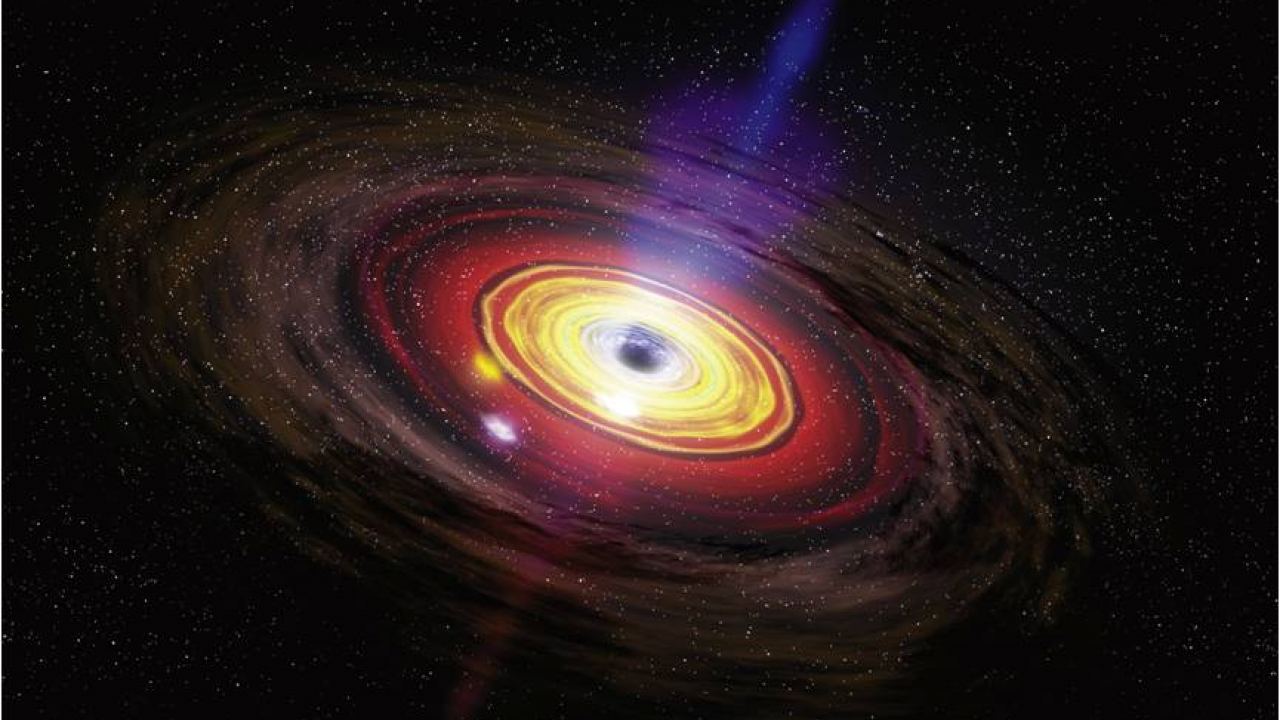
Active galactic nucleus
24
MENTIONS
9
EPISODES
4
PODCASTS
Search complete. 24 mentions across 9 episodes found for "Active galactic nucleus".
Sep 24, 2026
speaker_4HOST
It just turns off the star factory.
speaker_5HOST
Astrophysicists call this process active galactic nucleus feedback, or AGN feedback.
speaker_5HOST
It acts as a cosmic thermostat, regulating how large a galaxy can grow and how many stars it can produce.
speaker_4HOST
That's incredible.
speaker_3HOST
Exactly.
speaker_3HOST
But the narrative has almost universally defaulted to negative AGN feedback.
speaker_3HOST
We just assume these active galactic nuclei, or AGNs, operate purely as, like, cosmic quenchers.
speaker_4HOST
Yeah, the classic destroyer of worlds trope.
speaker_4HOST
Well, I mean, it's the dominant paradigm for a reason, you know?
speaker_3HOST
Sure.
speaker_4HOST
If you run a cosmological simulation without heavy-handed negative AGN feedback, your virtual universe just ends up overproducing these impossibly massive blue galaxies.
speaker_3HOST
Right.

speaker_5HOST
Right.
speaker_5HOST
The eighty-eight percent of sources that eROSITA is seeing in the extragalactic void are active galactic nuclei or AGN.
speaker_4HOST
Yeah.
speaker_5HOST
These are supermassive black holes that are actively gorging themselves on a massive, steady supply of galactic material.
speaker_4HOST
Let's dive into the physical mechanics of an AGN because when we casually say accreting black hole, I feel like it drastically undersells the violence of the mechanism.
speaker_5HOST
It really does.
speaker_4HOST
I mean, the black hole itself doesn't emit X-rays, right? Not even light can escape the event horizon.
8 MINS LATER
speaker_4HOST
Right.
speaker_2HOST
That interaction is arguably the most crucial aspect of this entire phenomenon.
speaker_2HOST
It's a process known in astrophysics as AGN feedback, active galactic nucleus feedback.
speaker_1HOST
Okay.
speaker_2HOST
See, we used to view galaxies as relatively simple systems.
speaker_1HOST
There seems to be a natural limit to how big a galaxy can actually get.
speaker_2HOST
Exactly.
speaker_2HOST
We observe a cutoff, and AGN feedback is the primary suspect for why that cutoff exists.
speaker_2HOST
The supermassive black hole basically acts as the galaxy's thermostat.

Cara BattersbyGUEST
Now it may have had in the past and lots of other ones do.
Cara BattersbyGUEST
So by observing what's happening, can we predict if it will have an AGN in the future, if it had an AGN in the past? And really, what are the physical processes that control that? And those are the questions that really drive me and keep me up at night in the most wonderful way.
Ethan SiegelHOST
You know, I don't blame you for asking those questions or for being kept up at night.
Ethan SiegelHOST
Because when I started learning about astronomy and astrophysics, I was mostly informed by what we can learn and see in visible light, right? What we can see in optical wavelength, the same type of light that our eyes can see.
Cara BattersbyGUEST
Can I add one thing to that, Ethan? I just want to just jump in for one second because the Chandra thing is super interesting.
Cara BattersbyGUEST
And the fact that we do see these like regular small flares from the, not from the Aegean, from the not Aegean, from the supermassive black hole that is not currently in Aegean.
Cara BattersbyGUEST
We see these small little flares, but actually one of the things that my group is working on now that's I find just so fascinating is that the molecular clouds so the gas the clouds of like gas and dust in the central molecular zone kind of surrounding the black hole those are showing signs of x-ray reflections with the idea being that in the past the supermassive black hole did have like a much larger accretion event like probably like an AGN like accretion event and it gave off these really powerful bursts of x-rays and those x-rays would have traveled outward in all directions they would have come to the earth where they saw that we didn't have an x-ray telescope and they just kept on going and then but they also travel and they interact with these molecular clouds and they actually cause those molecular clouds to fluoresce in the x-ray in this special iron k line and um and then we can actually observe with chandra we can see those molecular clouds one year they'll be nothing in the X-ray, then they'll have this X-ray reflection basically of that, that previous X-ray light from one of those flares coming through that cloud and then reflecting back and coming to the earth.
Cara BattersbyGUEST
And this time seeing that we do have an X-ray telescopes that we took pictures of that.

Alya Al NuaimiHOST
And here's the thing, this disk glows and it glows so brightly it can outshine every single star in its entire galaxy combined.
Alya Al NuaimiHOST
And we call this glowing active region an active galactic nucleus, or an AGN for short.
Alya Al NuaimiHOST
Now, most scientists would look at that environment and they will think it's so violent, so turbulent, so extreme, and then they say nothing could ever be born there because it's too chaotic, right? But, and it's a big but, a team of scientists decided to look more carefully.
Alya Al NuaimiHOST
They built a computer model, looked at the variators of these spinning disks, where things get a little calmer, we can say.
speaker_4HOST
Exactly.
speaker_4HOST
In modern galaxies, AGN feedback, which is the massive amount of energy pumped out by the accreting black hole, it regulates star formation.
speaker_3HOST
It pushes the gas out.
speaker_4HOST
Right.
11 MINS LATER
speaker_4HOST
Yeah.
speaker_3HOST
It's a complete outcast just sitting out there in the galactic suburbs.
speaker_4HOST
And the presence of this off-nucleus AGN arguably the most intriguing dynamic piece of the entire puzzle.
speaker_4HOST
Yes, because a two million solar mass object does not simply form in the low density outskirts of a galactic halo.
speaker_3HOST
To really understand how galaxies evolve, we have to look at what happens when these central black holes wake up and start eating.
speaker_3HOST
We have to look at active galactic nuclei, or AGN.
speaker_2HOST
AGN.
speaker_2HOST
Because when a super massive black hole feeds, it's not exactly a gentle process.

DrewHOST
So what could pack that much energy into such a small space? The first obvious suspect is a feeding black hole.
DrewHOST
Black holes themselves don't shine, of course, but gas falling toward one can become hot, creating an active galactic nucleus, or AGN.
DrewHOST
Quasars are the most spectacular members of that family.
DrewHOST
Many little red dots have broad hydrogen lines.