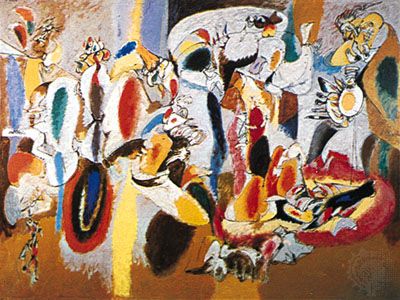
Abstract expressionism
Art movementWikipedia
26
MENTIONS
11
EPISODES
10
PODCASTS
Search complete. 26 mentions across 11 episodes found for "Abstract expressionism".
Sep 16, 2026

Leigh RobbHOST
I think this, you know, so while we have the Winter Masterpiece Series, the Extraordinary Monet to Matisse Defying Tradition Exhibition here at the Gallery from Toledo, it really presents a great opportunity for us to look at this particular period of incredible transition in the world and we're going to look at the art world.
Leigh RobbHOST
So today I'm going to It will be quite a whistle-stop tour through exploring the context of how and why the centre of the art world moved from Paris to New York, and we'll trace those developments, the trajectory of abstraction in Europe to the United States, from the 40s to the 60s and track a few major artists' diverse approach to materiality and to gesture, you know, from the fervent intensity of the action painters of the abstract expressionism to the pores and the planes of the colour field paintings.
Leigh RobbHOST
But first, just want to set the scene.
Leigh RobbHOST
We're in Midtown Manhattan on 30 West 57th Street, and it's October 1942.
10 MINS LATER
Leigh RobbHOST
And he taught there until 1949 and he had a huge impact on many American artists as well.
Leigh RobbHOST
And so did his wife, Annie Albers, amazing textile artist.
Leigh RobbHOST
But just thinking about The late 1930s to the early 1940s, you know, abstract expressionism comes after a period of, you know, an artistic period of social realism.
Leigh RobbHOST
And we're imagining that the impact of the economy, the Great Depression and the stock market crash was, you know, was phenomenal.

Andrea FranckeHOST
Yeah, and then the other thing that he point is the text that we read by Amy Sillman that we read on our first episode, ABEX and Disco Balls.
Andrea FranckeHOST
So it's talking about like these two texts kind of like bringing all these artists, feminist artists, queer artists that were doing abstract, were engaging with abstract expressionism were quite ignored the art history processes until that time.
Matthew de Kersaint GiraudeauHOST
So we read that article at AbEx, which is about in defense of abstract expressionism.
Matthew de Kersaint GiraudeauHOST
And Silman in that article is basically saying like, yeah, fine, dismiss the kind of high modernist version of abstract expressionism, but do not dismiss all the kind of queer painters, women painters who were like responding to that kind of bodily gestural use of paint in abstract expressionism and then he's talking about he says the museum and its collection is a very different environment to that of the art school with the latter far more engaged with those street discussions the fact that one could map the interrelationship between the painters included in whack which is this exhibition that molesworth is writing about or curates i can't actually remember and their connections through art schools and studios is important.
Matthew de Kersaint GiraudeauHOST
It's where one aspect of the culture of painting resides.

Vijay MasharaniGUEST
And I didn't realize that, but, like, Ross Feld's, but Ross Feld had lymphoma.
Vijay MasharaniGUEST
And he talks about him being more sympathetic to, you know, Guston, post-heretical Guston, you know, commits the heresy against the church, which he describes as the Protestant church of abstract expressionism in his book.
Vijay MasharaniGUEST
Yeah.
Vijay MasharaniGUEST
And his friendship with Ross Feld was struck up because Ross Feld liked the Mandarin pose, the show that got panned, the Marlboro show, where he debuted his new figurative.

Vanessa RichardsonHOST
For most of its history, the country had imported its culture from Europe, where the great painters and composers always seemed to live.
Vanessa RichardsonHOST
Abstract Expressionism was different.
Vanessa RichardsonHOST
It was loud, confident, and unmistakably American, arguably the first major art movement the country could ever claim as its own.
Vanessa RichardsonHOST
That made it a strange sort of national treasure, even to the many people who couldn't stand looking at it.
28 MINS LATER
Vanessa RichardsonHOST
And the Museum of Modern Art, with its deep ties to that very same world, helped carry American painting out into the Cold War as a glittering symbol of freedom.
Vanessa RichardsonHOST
But this is also where the story tends to get stretched beyond what the evidence actually supports.
Vanessa RichardsonHOST
You'll often hear this whole saga crushed down into one punchy claim that the CIA invented abstract expressionism, that the agency created the movement, made Jackson Pollock famous on purpose, and manufactured the entire thing from nothing.
Vanessa RichardsonHOST
But that's not quite true.

Vanessa RichardsonHOST
For most of its history, the country had imported its culture from Europe, where the great painters and composers always seemed to live.
Vanessa RichardsonHOST
Abstract Expressionism was different.
Vanessa RichardsonHOST
It was loud, confident, and unmistakably American, arguably the first major art movement the country could ever claim as its own.
Vanessa RichardsonHOST
That made it a strange sort of national treasure, even to the many people who couldn't stand looking at it.
28 MINS LATER
Vanessa RichardsonHOST
And the Museum of Modern Art, with its deep ties to that very same world, helped carry American painting out into the Cold War as a glittering symbol of freedom.
Vanessa RichardsonHOST
But this is also where the story tends to get stretched beyond what the evidence actually supports.
Vanessa RichardsonHOST
You'll often hear this whole saga crushed down into one punchy claim that the CIA invented abstract expressionism, that the agency created the movement, made Jackson Pollock famous on purpose, and manufactured the entire thing from nothing.
Vanessa RichardsonHOST
But that's not quite true.

Paul GreenhalghHOST
I would have thought so, in that he's quite often...
Paul GreenhalghHOST
I wouldn't say caricatured as being an abstract expressionist potter.
Paul GreenhalghHOST
We can all see why this extreme, very expressive giant scale works.
Paul GreenhalghHOST
But Your thoughts about the Japanese and the Japanese ethos that Hamada represented? Because, I mean, would it be an extreme to say, you know, Hamada's loose, beautiful expressionist painting style on the pots and his...
Stephanie RozeneHOST
I think in some ways he is because he's certainly not – he doesn't engage with Hamada and then go off and start making Japanese-style mingi pots, right? But I think he did take with him an improvisational energy.
Stephanie RozeneHOST
And I think that that is a key point, I would say.
Stephanie RozeneHOST
Volkos would go on the next year to teach at Black Mountain College, and there he met Robert Rauschenberg and John Cage and other avant-garde artists before traveling to New York City to meet the abstract expressionist painters.
Stephanie RozeneHOST
I think that Volkos went on to fuse Hamada's spontaneous kind of clay gestures with the massive scale of abstract expressionism and abandoning the vessel altogether.

Dan GelernterHOST
All right.
Dan GelernterHOST
So there are three great pillars of American abstract expressionism.
Dan GelernterHOST
Rothko, de Kooning, and Jackson Pollock.
Dan GelernterHOST
And they are all represented in the Met to varying degree.
6 MINS LATER
Dan GelernterHOST
It's a multi-stage process to prepare the canvas that involves first stretching the canvas and then priming it.
Dan GelernterHOST
The primer is a white gesso that goes over the canvas and sort of fills up the little microscopic pores in the canvas material so that the paint won't simply soak in.
Dan GelernterHOST
In abstract expressionism, a lot of artists began painting on unprimed canvas, which delivers a very different effect, which looks a little bit more like a tie-dyed T-shirt.
Dan GelernterHOST
And Morris Lewis, the Colorfield painter, who is also represented in the Met, has a nice canvas there, is like that.
Dan GelernterHOST
And if we cross the corridor, what I would do is we'd walk across a little hallway where you'll find a smaller secondary gift shop and also where some special exhibits are usually set up.
Dan GelernterHOST
And if you cross that, you're going to end up in 20th century abstract expressionism, which is a different subject, but that's where I would go next in the museum, and so that's where I think we should pick it up next time.
Dan GelernterHOST
All right, sounds good.
Dan GelernterHOST
It remains to say, thanks to everyone who's listened.

EricHOST
And in 1994, an obscure art dealer came in and had a proposal.
EricHOST
The proposal was to sell some unseen pieces of art from the abstract expressionist masters.
EricHOST
They were art collected by a very private owner.
EricHOST
And the owner claimed to have purchased them directly from the artists.
1 more episode mentions Abstract expressionism.
Create an account to see the whole feed, search across every transcript, and follow the entities you care about.