Abilene paradox
22
MENTIONS
14
EPISODES
8
PODCASTS
Search complete. 22 mentions across 14 episodes found for "Abilene paradox".
Oct 20, 2026

Konstantin KisinGUEST
Like Bjorn Lomborg said, during that oh my god heat wave we're all gonna die kept posting stuff about you know like actually the number of forest fires is the lowest it's ever been and the number of hurricanes in america is etc etc etc and i would love to know what's going on with that shit i would love to know you got any theories um Well, one thing that's interested me a lot is obviously people are familiar with the concept of groupthink.
Konstantin KisinGUEST
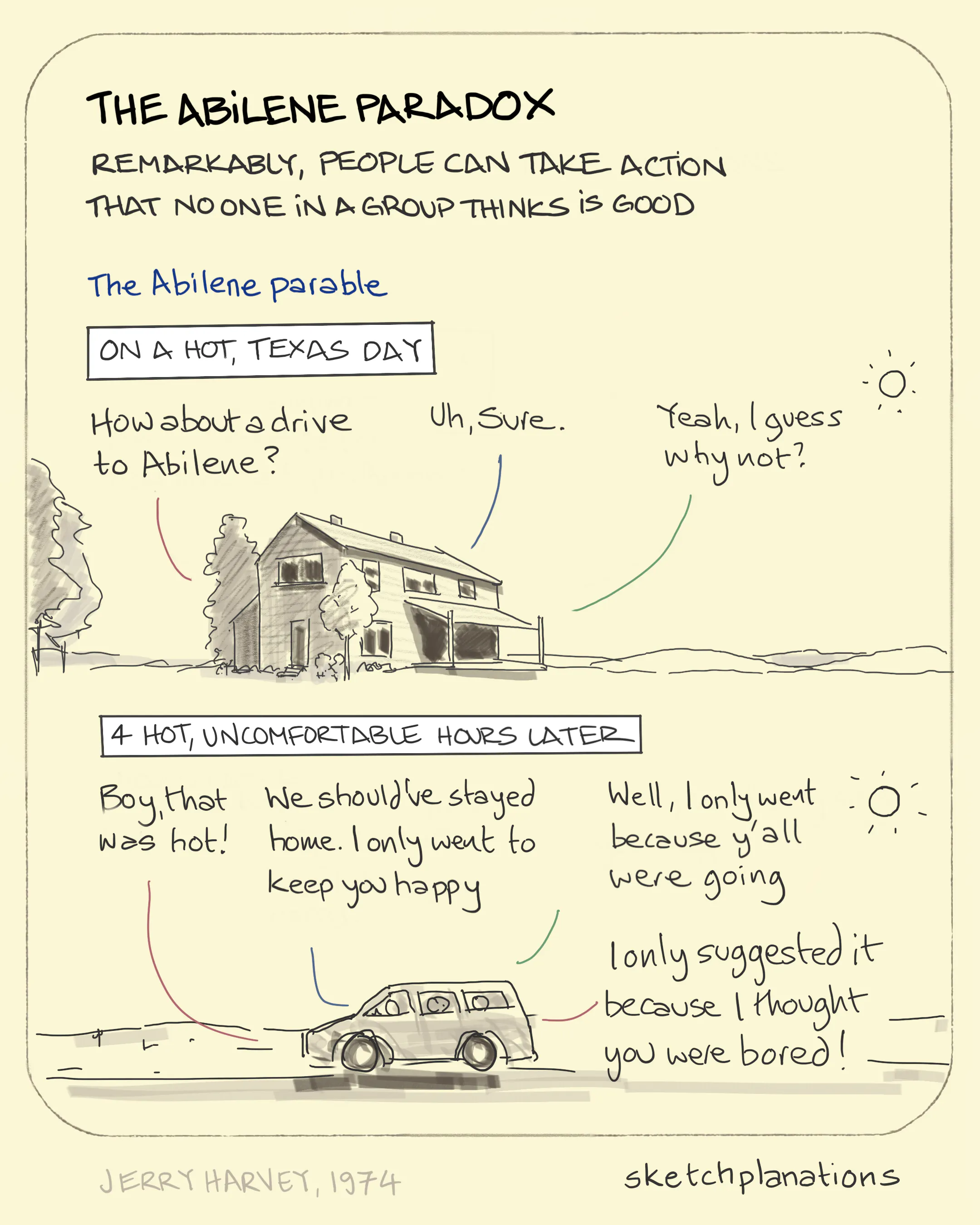
But there's another thing, which is the Abilene paradox.
Konstantin KisinGUEST
I don't know if you're familiar with it.
Konstantin KisinGUEST
It's basically the idea that people will often do things because they think other people want them done.
Chris WilliamsonHOST
And there's layers and layers to this that I've realized, especially maybe people that listen to podcasts like mine or yours, who are interested in psychology and human nature and can rationalize or explain away what they're feeling.
Chris WilliamsonHOST
Oh, that's the negativity bias, or that's the Abilene paradox, or that's, you know, I understand that this is because of my, it's the bystander effect or some other bullshit, right? Like they've got some mental model that allows them to explain what's going on inside of them.
Chris WilliamsonHOST
Yeah, James Clear talks about something similar in whatever, whatever.
Chris WilliamsonHOST
And I realized that for a good chunk of people, way more than might like to admit it, That's a protection mechanism.

Venki PadmanabhanHOST
Four people sat on a porch in Coleman, Texas, having just driven 106 miles through a dust storm to eat food none of them wanted in a direction none of them had chosen at nobody's request.
Venki PadmanabhanHOST
Harvey called it the Abilene Paradox.
Venki PadmanabhanHOST
And the argument he built on it is the reason it lasted.
Venki PadmanabhanHOST
Organizations, he said, don't fail because people disagree.
Venki PadmanabhanHOST
And I never asked.
Venki PadmanabhanHOST
I sat in those rooms and I nodded at the joke and I went back to work.
Venki PadmanabhanHOST
The Abilene Paradox has four people in a car and a moral architecture built entirely out of their unspoken preferences.
Venki PadmanabhanHOST
It's a masterpiece of self-criticism, and it trained two generations of executives to interrogate the silence of the passengers and never once the silence of the fence line.

Rick HeymanGUEST
The money we needed to spend on those bridges going way back decades wasn't done to the level that it should have been done and it put us in a tough spot.
Rick HeymanGUEST
But I also think that, and I talk about this a lot, I think When you look at solutions instead of outcomes, you can get on the bus to Abilene and you can't get off.
Rick HeymanGUEST
And do I suspect that that may have been what happened with the bridges? Yes.
Rick HeymanGUEST
Flip side of it is I don't think anybody on the commission or in city government was acting in bad faith.

speaker_1GUEST
It just makes them mask their opinions.
speaker_1GUEST
And when this happens at scale, it can lead to all kinds of absurd situations like the Abilene paradox.
speaker_1GUEST
I don't know if we've covered the Abilene paradox.
speaker_1GUEST
Run it back.
speaker_1GUEST
It's basically a situation where everyone professes a belief that no one actually believes purely because they think everybody else believes it.
speaker_1GUEST
So you can't keep track of these people anymore.
Chris WilliamsonHOST
This ties into your view about when people are their opinions, they feel like they have to have an opinion on anything and everything, and changing your opinion is tantamount to destruction of yourself.
Chris WilliamsonHOST
So because people value their opinions so much, in this situation, quite rightly, the performative nature of having the right opinion of the Abilene paradox is playing along with that has never been more important because opinions have never been more relevant to our status within the world.
Konstantin KisinGUEST
It just makes them mask their opinions.
Konstantin KisinGUEST
And when this happens at scale, it can lead to all kinds of absurd situations like the Abilene paradox.
Konstantin KisinGUEST
I don't know if we've covered the Abilene paradox.
Konstantin KisinGUEST
Run it back.
Konstantin KisinGUEST
It's basically a situation where everyone professes a belief that no one actually believes purely because they think everybody else believes it.
Konstantin KisinGUEST
So you can't keep track of these people anymore.
Chris WilliamsonHOST
This ties into your view about when people are their opinions, they feel like they have to have an opinion on anything and everything, and changing your opinion is tantamount to destruction of yourself.
Chris WilliamsonHOST
So because people value their opinions so much, in this situation, quite rightly, the performative nature of having the right opinion of the Abilene paradox is playing along with that has never been more important because opinions have never been more relevant to our status within the world.
Konstantin KisinGUEST
Um, well, one thing that's interested me a lot is obviously people are familiar with the concept of groupthink.
Konstantin KisinGUEST
But there's another thing, which is, um, the, the Abilene paradox.
Konstantin KisinGUEST
I don't know if you're familiar with it.
Konstantin KisinGUEST
Uh, it's basically the idea that people will often do things because they think other people want them done.
Chris WilliamsonHOST
And, uh, it, it-- there's layers and layers to this that I've realized, especially maybe people that listen to podcasts like mine or yours who are interested in psychology and human nature and can rationalize or explain away what they're feeling.
Chris WilliamsonHOST
"Oh, that's the negativity bias," or, "That's the Abilene paradox," or, "That's, you know, I, I understand that this is because of my-- the, it's the by-bystander effect," or some other bullshit, right? Like, they, they've got some mental model that allows them to explain what's going on inside of their...
Chris WilliamsonHOST
Yeah, James Clear talks about something similar and whatever, whatever, and I realized that for a good chunk of people, way more than might like to admit it, that's a protection mechanism.
Chris WilliamsonHOST
Their ability to rationalize and explain away what's happening inside of their minds gives them an excuse to not have to feel their feelings fully.
Konstantin KisinGUEST
Um, well, one thing that's interested me a lot is obviously people are familiar with the concept of groupthink.
Konstantin KisinGUEST
But there's another thing, which is, um, the, the Abilene paradox.
Konstantin KisinGUEST
I don't know if you're familiar with it.
Konstantin KisinGUEST
Uh, it's basically the idea that people will often do things because they think other people want them done.
Chris WilliamsonHOST
And there's layers and layers to this that I've realized, especially maybe people that listen to podcasts like mine or yours, who are interested in psychology and human nature and can rationalize or explain away what they're feeling.
Chris WilliamsonHOST
Oh, that's the negativity bias, or that's the Abilene paradox, or that's, you know, I understand that this is because of my, it's the bystander effect or some other bullshit, right? Like they've got some mental model that allows them to explain what's going on inside of them.
Chris WilliamsonHOST
Yeah, James Clear talks about something similar in whatever, whatever.
Chris WilliamsonHOST
And I realized that for a good chunk of people, way more than might like to admit it, That's a protection mechanism.
4 more episodes mention Abilene paradox.
Create an account to see the whole feed, search across every transcript, and follow the entities you care about.