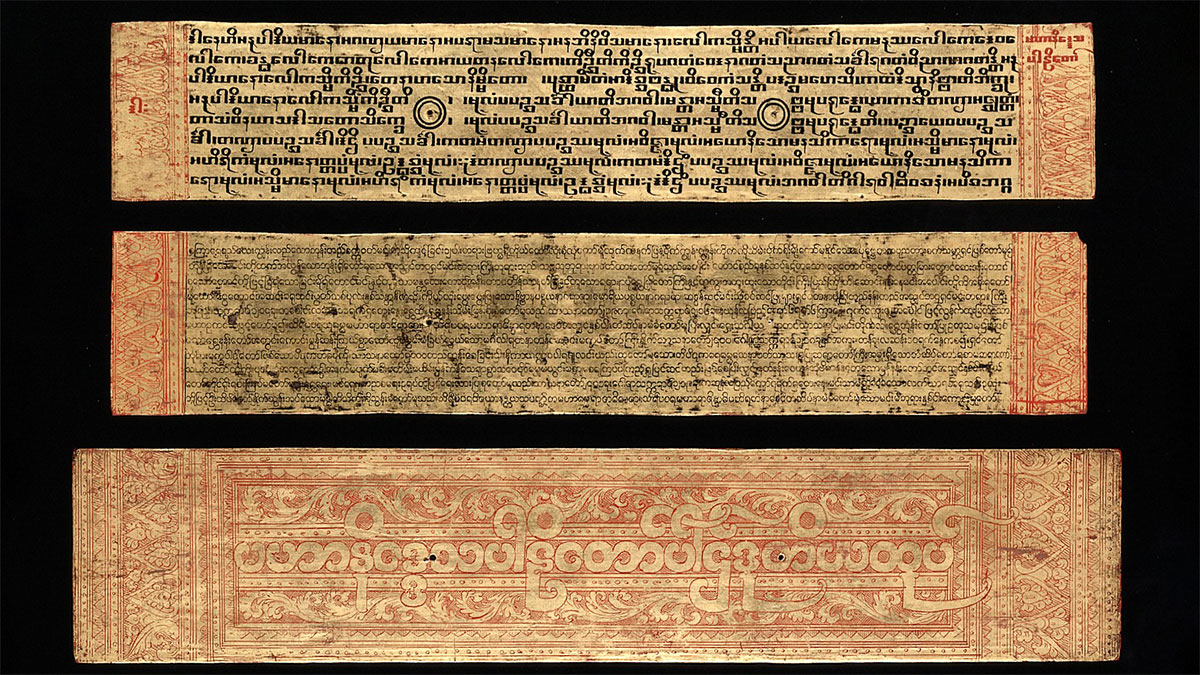
Abhidharma
CanonWikipedia
42
MENTIONS
26
EPISODES
22
PODCASTS
Search complete. 42 mentions across 26 episodes found for "Abhidharma".
Nov 22, 2026

Ajahn BrahmHOST
I've had a lot of fun, but not really sort of a best way of using your time.
Ajahn BrahmHOST
You never got wise by reading all the suttas and the Abhidhamma and all this sorts of stuff.
Ajahn BrahmHOST
That's just more ideas.
Ajahn BrahmHOST
It was Ajahn Chah this month.

Karen DonovanGUEST
So I mentioned during the interview that for some time I was going and reading the suttas, but interpretation is so helpful.
Karen DonovanGUEST
Like, we can't just read the Abhidhamma, for example.
Karen DonovanGUEST
The Abhidhamma is interpreted for us, interpreted by people who have walked the path to the end and who are fully enlightened.
Karen DonovanGUEST
So Goenkaji and Sayajubakin and Lady Sayadaw have interpreted the teachings of the Buddha and articulated them to us in a way that help us to understand them.
Karen DonovanGUEST
So from my point of view, I came to this... realization that I don't really need to go back to the suttas to understand the path.

Dionne GinesNARRATOR
Yes.
Dionne GinesNARRATOR
The first line embodies the whole spirit of the Vinaya Pitaka, the second that of the Sutta, the third that of the Abhidhamma.
Dionne GinesNARRATOR
They comprise only eight Pali words, yet, as the dewdrop reflects the stars, they sparkle with the spirit of all the Buddhadharma.
Dionne GinesNARRATOR
Question.
7 MINS LATER
Dionne GinesNARRATOR
The three collections of books called Tripitakas, or three baskets.
Dionne GinesNARRATOR
Question.
Dionne GinesNARRATOR
What are the names of the three Pitakas, or groups of books? the Vinaya Pitaka, the Sutta Pitaka and the Abhidhamma Pitaka.
Dionne GinesNARRATOR
What do they respectively contain? Answer.

speaker_0HOST
But as a physicist, I'm going to push back hard on this chariot analogy for a different reason.
speaker_0HOST
Isn't this just Abhidharma reductionism?
speaker_1HOST
Oh, OK, let's go there.
speaker_0HOST
Because in the scholastic period of Buddhism, centuries after the Buddha, these Abhidharma schools formalized the lists of aggregates.
speaker_0HOST
And they seem to imply that macro objects like chariots or persons are illusions, but the fundamental micro parts, the dharmas, the fleeting moments of consciousness are real.
speaker_1HOST
Yes, the Abhidharma scholars were essentially ultimate reductionists.
speaker_0HOST
But this rings huge alarm bells for me.
speaker_0HOST
In physics, we went down this exact reductionist rabbit hole.
speaker_1HOST
They were.
speaker_1HOST
And in fact, some early Buddhist schools, like the Abhidharma traditions, argue that, yes, there is a rock bottom.
speaker_1HOST
They call these irreducible elements dharmas.
speaker_0HOST
Dharmas.
Hamir GanlaGUEST
Then the fourth week the Buddha spent in this Ratanagraha small area.
Hamir GanlaGUEST
It seemed that it's in this area he sat and meditated on the Abhidhamma.
Hamir GanlaGUEST
And as he was meditating, those Five colours from his body came out and what today are designated in the Buddhist flag, the five colours.
Hamir GanlaGUEST
So it is what you call the Buddha contemplated and what you call on the document of the Abhidhamma.
Hamir GanlaGUEST
Just a little word about the Buddhist flag.
Hamir GanlaGUEST
It symbolises the universality of truth of the Buddha's teaching and the colors are the blue color symbolizes universal compassion, the yellow color symbolizes the middle way, the red color the blessings that the practice of the Buddha teaches, the white symbolizes purity, the orange unshakable wisdom and the combination on the right side that you get symbolizes the universality of the truth of the Buddha's teaching.

Rick HansonHOST
Pure mindfulness can feel very dry for many people.
Rick HansonHOST
Historically, you know, the movement of compassion and the bodhisattva, so forth, and the Mahayana developments were kind of a counter to the increasingly dry and sort of scholastic analytic aspects of the Abhidhamma and other developments in Buddhism after the Buddha himself died centuries, now centuries later.
Rick HansonHOST
So for your own sake, maybe bring in more heartfeltness.
Rick HansonHOST
Maybe meditate on some form of loving kindness.

Devon HaseGUEST
There's a whole range or spectrum of volition or chaitanya.
Devon HaseGUEST
In the Abhidhamma, the Buddhist psychology, chetana is a universal mental factor.
Devon HaseGUEST
So it's arising every moment and it's neutral.
Devon HaseGUEST
So this is that autonomic, like the body has chetana to breathe, to digest, to the nervous system is happening, right? Your respiratory system, all of this, your immune system.

speaker_0HOST
So this is a very interesting one.
speaker_0HOST
So why should we develop the liberation of the mind by loving kindness? Well, as we've just said, and this is also stated in Vibhanga, which is Abhidhamma, it says, it's the state of loving kindness that has mental freedom from ill will.
speaker_0HOST
So most of us are afflicted, like on a daily basis, we're afflicted because our bodies are aging or sick.
speaker_0HOST
That some kind of state that we don't find agreeable, the body becomes a disagreeable object.
Devon HaseGUEST
You know, bad karma, good karma.
Devon HaseGUEST
But here in the Abhidhamma, in the Buddhist psychology, cetana is connected to kama.
Devon HaseGUEST
So cetana is the intention that then drives action.
Devon HaseGUEST
And kama in Pali, it only means action.
16 more episodes mention Abhidharma.
Create an account to see the whole feed, search across every transcript, and follow the entities you care about.