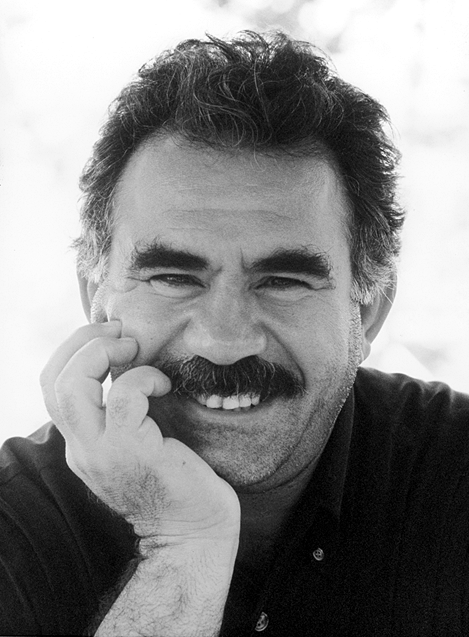
Abdullah Öcalan
11
MENTIONS
5
EPISODES
4
PODCASTS
Search complete. 11 mentions across 5 episodes found for "Abdullah Öcalan".
Oct 3, 2026

Heval MilitanGUEST
Um, and, you know, I, I think that's always been built in, in looking at, you know, history of Marxism, Leninism, um, in the, you know, latter 20th century.
Heval MilitanGUEST
Um, and you mentioned Murray Bookchin, who actually begins a correspondence directly with Abdullah Öcalan, who is currently, you know, serving a life sentence in, in prison in Turkey.
Heval MilitanGUEST
Um, and, uh, they start to, to engage, like, seriously with the ideas and looking at the, the area, and this is what also I think brings Abdullah Öcalan's, you know, grows his interest in what's happening in, in the new autonomous regions in, in Syria, is this kind of libertarian municipalism, you know, from a left, left libertarian municipalist, um, perspective is something that could actually potentially work, right? Something different, um, where, you know, the, the state or the, the goal of, of like, you know, as, as I think my, uh, Heval, who Mustay spoke earlier of just, like, replacing the state with a state, um, without addressing, you know, some of the core, core issues like, like feminism or, um, you know, uh, the ability to kind of dis- dismantle the re- like, certain repressive infrastructure and, and, and entities, um, wasn't, wasn't the, the path forward, right? I, I, I mean, just to give a, a quick anecdote, and this is more recent times, but, um, you know, there was a, a, a horrible kind of prison riot in, in, in Kobani, which is a very strategic and, and politically important city, um, where, uh, you know, a, a, a Kurdish, you know, fighter who had been integrated into the national army was, was killed by, um, some Arab tribesmen, uh, in what they claim was a revenge killing, sparked a lot of protests in Kobani.
Heval MilitanGUEST
The central state sent in police to kind of, you know, beat down the, the, uh, the protest, uh, jailed a bunch of people in the local prison, and the state immediately was like, "We're gonna transfer all of these Kurdish prisoners to, like, Assad's torture, you know, dungeons in Damascus," which they just still kept.
Heval MilitanGUEST
And it's been, like, it's not un- it is not controversial that torture and electrical torture still exists in Jilani, Syria.
8 MINS LATER
Heval MilitanGUEST
But they were able to make certain decisions without the blessing of the organization.
Heval MilitanGUEST
So it's a little bit of a, of a messy situation where I wouldn't say it was outright controlled by, by PKK.
Heval MilitanGUEST
Um, but the, i- if the question is more about the differences, I think for, for better or worse, look, I think this is more of a democratic grassroots organization and movement than what we saw develop in, in Northern Iraq, you know? Um, somebody like Abdullah Öcalan or the, or, or Muslim Abdi is the head of the YPG or the, uh, leaders of the SDF or the leaders of the autonomous administration, you know, really don't come from, like, the same pedigree as, like, a Barzani, right? They're, it's, they, that, that infrastructure that the Barzanis and the Talebanis had set up over long generations, right, in Northern Iraq with their own, um, you know, infrastructure, armies, you know, autonomy, wealth, you know, that, that's very different.

Mahtab MahboubGUEST
The idea was that Kurdish liberation and women's liberation were deeply connected, and it was symbolized in the word Azadi, freedom, liberation.
Mahtab MahboubGUEST
So PKK leader Abdullah Ocalan was also influenced by these discussions with women in the movement, including leaders like Sakina Jansis, and began to see the role of women's freedom as essential part of social and political liberation.
Mahtab MahboubGUEST
And this is where it actually was engraved in this movement, that women's liberation and struggle for freedom liberation of Kurdistan were interlinked.
Mahtab MahboubGUEST
The slogan spread across the region.

Eray ÇaylıNARRATOR
In the 1990s, extrajudicial killings, mass detentions and the destruction of villages were a common occurrence.
Eray ÇaylıNARRATOR
In the 2000s, after the PKK's leader Abdullah Öcalan was captured and called for ceasefire, waves of peace talks and reforms led to the re-establishment of official pro-Kurdish party politics with important implications for members of the communities trying to survive state oppression along the banks of the Tigris.
Eray ÇaylıNARRATOR
the party started to run for and win municipal elections, working towards local democratic autonomy instead of a full-blown nation-state.
Eray ÇaylıNARRATOR
And the municipalities they governed became havens for improved rights for women, multilingual public services, environmental welfare and improved infrastructure.
9 MINS LATER
Eray ÇaylıNARRATOR
The lead up to the genocide was a time when Kurdistan was still relatively hard for the central administration to control.
Eray ÇaylıNARRATOR
Kurdish tribes continued to enjoy a fair amount of autonomy.
Eray ÇaylıNARRATOR
To carry out the genocide, the Ottoman administration enlisted those tribal leaders they could convince.
Eray ÇaylıNARRATOR
They were rewarded with lands and property confiscated from the Armenians.
Rojin MukriyanGUEST
And, uh, many call that PJAK is an extended branch of the Kurdistan Workers' Party, PKK Ideologically, they share the same political vision with the Kurdistan Workers' Party.
Rojin MukriyanGUEST
They consider Abdullah Öcalan as their leader and advocate for the establishment of democratic and federalism for Rojava.
Rojin MukriyanGUEST
They call for democracy, but democracy for them, uh, is a direct democracy.
Rojin MukriyanGUEST
The people needs to rule themself.
18 MINS LATER
Rojin MukriyanGUEST
So it's the same.
Rojin MukriyanGUEST
The s- the strategy is the same.
Rojin MukriyanGUEST
Their political language or vision is the same, and they, as I said before, they consider Abdullah Öcalan as their political leader.
Rojin MukriyanGUEST
However, strategic and ideological similarity within the PKK make PJAK to be, uh, the same as the PKK or to be as the dominant, uh, narrative says that they are the same as the PKK or they are, uh, associated with the PKK or they are offshoot of the PKK or, uh, some, uh, people even go further and say that PJAK is not independent organization or party.

Amberin ZamanHOST
what's peculiar is you now see some Turkish commentators saying, oh, well, he was involved in such and such attack on Turkish forces.
Amberin ZamanHOST
But at the date, you know, during the dates that that commentator presents us with, In fact, the Turkish government was holding secret talks with him to convey messages to Abdullah Öcalan, who was still free at the time, and when he, Mazlumabdi, was in charge of the PKK's affairs in Europe.
Amberin ZamanHOST
So there are so many contradictions.
Amberin ZamanHOST
But, you know, you said...
24 MINS LATER
Banu GüvenGUEST
There will be more pressure in Syria.
Banu GüvenGUEST
It will be an issue in Syria.
Banu GüvenGUEST
I'm sure that Abdullah Öcalan also... got some written form of these interviews, what had been told there, etc.
Banu GüvenGUEST
I also got the information that they had certain channels where they could also directly talk to each other, let me tell you that much.