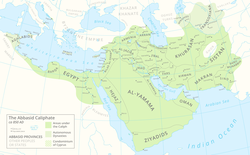
Abbasid Caliphate
DynastyWikipedia
252
MENTIONS
87
EPISODES
70
PODCASTS
Search complete. 252 mentions across 87 episodes found for "Abbasid Caliphate".
Sep 12, 2026

Shehnaz HaqqaniHOST
Han Sian argues that this vision of pious rulership emerged from what he calls homiletic piety, revealing how the moral and emotional world of hortatory preaching shaped ideas about what it meant to rule well.
Shehnaz HaqqaniHOST
By placing Ibn al-Jawzi's writing in their historical and political context, including his relationship with, uh, the Abbasid caliphate and his controversial intervention in debates over the cursing of Yazid, Han Sian challenges simplistic distinctions between political quietism and activism, and reveals a thinker who is deeply invested in influencing those who wielded political power.
Shehnaz HaqqaniHOST
In our conversation, Han Sian explains why he chose Ibn al-Jawzi as the subject of the book and what we can learn about medieval Islamic politics by taking preachers seriously as political thinkers.
Shehnaz HaqqaniHOST
We discuss the concept of homiletic piety and Ibn al-Jawzi's approach to exhorting rulers wh- including the rhetorical strategies that he believed scholars could use to encourage rulers toward greater humility, kindness, and moral responsibility.
Shehnaz HaqqaniHOST
We also explore Ibn al-Jawzi's relationship with the Abbasid Caliph al-Mustadi, who...
Shehnaz HaqqaniHOST
And, and what his writings reveal about the particular concerns of the ruler to whom they were addressed.
Shehnaz HaqqaniHOST
Han Sian discusses the complicated relationship between scholars and political power, including the historical debate over Sharia and Siyasa, or politics, and explains why Ibn al-Jawzi does not fit neatly into the categories of quietis- quietist or activist.
15 MINS LATER
Han Hsien LiewGUEST
Uh, and one thing I noticed with these books is that, um, even though, uh, you know, they use different sources, you know, maybe more sources than Lambton, uh, had a little more nuance, uh, maybe approached the sources, uh, a bit differently, uh, the bare bones of this kind of might is right narrative more or less stayed the same.

Shahnaz HaqqaniHOST
Hansian argues that this vision of pious rulership emerged from what he calls homiletic piety, revealing how the moral and emotional world of hortatory preaching shaped ideas about what it meant to rule well.
Shahnaz HaqqaniHOST
By placing Ibn al-Jawzi's writing in their historical and political context, including his relationship with the Abbasid caliphate and his controversial intervention in debates over the cursing of Yazid, Hansian challenges simplistic distinctions between political quietism and activism and reveals a thinker who is deeply invested in influencing those who wielded political power.
Shahnaz HaqqaniHOST
In our conversation, Hansian explains why he chose Ibn al-Jawzi as the subject of the book and what we can learn about medieval Islamic politics by taking preachers seriously as political thinkers.
Shahnaz HaqqaniHOST
We discuss the concept of homiletic piety and Ibn al-Jawzi's approach to exhorting rulers, including the rhetorical strategies that he believed scholars could use to encourage rulers toward greater humility, kindness, and moral responsibility.
Shahnaz HaqqaniHOST
We also explore Ibn al-Jawzi's relationship with the Abbasid caliph al-Mustadi and what his writings reveal about the particular concerns of the ruler to whom they were addressed.
Shahnaz HaqqaniHOST
Hansian discusses the complicated relationship between scholars and political power, including the historical debate over sharia and siyasa or politics, and explains why Ibn al-Jawzi does not fit neatly into the categories of quietist or activist.
Shahnaz HaqqaniHOST
We also talk about the significant role of emotions, including fear, remorse, humility, compassion, in Ibn al-Jawzi's understanding of political authority and to consider whether he actually believed that rulers could be transformed through preaching.
15 MINS LATER
Han Hsien LiewGUEST
And one thing I noticed with these books is that even though they use different sources, maybe more sources than Lampton, had a lot more nuance, maybe approached the sources a bit differently, the bare bones of this kind of might-is-right narrative more or less stayed the same.

Mirza Yawar BaigHOST
And that is why some of the people who really, uh, who Allah Subhanahu Wa Ta'ala blessed and who understood the truth, they even did not make the effort of going to the human being.
Mirza Yawar BaigHOST
They said, "Why should I ask him?" There's a famous story about three young men in the time of, I think it was the time of Imam Ahmad bin Hanbal, early Abbasid period.
Mirza Yawar BaigHOST
These three people went to Baghdad to study deen.
Mirza Yawar BaigHOST
So they're students, they didn't have much money and so on in any case.

Shahnaz HaqqaniHOST
Hansian argues that this vision of pious rulership emerged from what he calls homiletic piety, revealing how the moral and emotional world of hortatory preaching shaped ideas about what it meant to rule well.
Shahnaz HaqqaniHOST
By placing Ibn al-Jawzi's writing in their historical and political context, including his relationship with the Abbasid caliphate and his controversial intervention in debates over the cursing of Yazid, Hansian challenges simplistic distinctions between political quietism and and activism and reveals a thinker who is deeply invested in influencing those who wielded political power.
Shahnaz HaqqaniHOST
In our conversation, Hansian explains why he chose Ibn al-Jawzi as the subject of the book and what we can learn about medieval Islamic politics by taking preachers seriously as political thinkers.
Shahnaz HaqqaniHOST
We discuss the concept of homiletic piety and Ibn al-Jawzi's approach to exhorting rulers, including the rhetorical strategies that he believes scholars could use to encourage rulers toward greater humility, kindness, and moral responsibility.
Shahnaz HaqqaniHOST
We also explore Ibn al-Jawzi's relationship with the Abbasid caliph al-Mustadi and what his writings reveal about the particular concerns of the ruler to whom they were addressed.
Shahnaz HaqqaniHOST
Hansian discusses the complicated relationship between scholars and political power, including the historical debate over sharia and siyasa or politics, and explains why Ibn al-Jawzi does not fit neatly into the categories of quietist or activist.
Shahnaz HaqqaniHOST
We also talk about the significant role of emotions, including fear, remorse, humility, compassion, in Ibn al-Jawzi's understanding of political authority and to consider whether he actually believed that rulers could be transformed through preaching.
15 MINS LATER
Han Hsien LiewGUEST
And one thing I noticed with these books is that even though they use different sources, maybe more sources than Lampton, had a lot more nuance, maybe approached the sources a bit differently, the bare bones of this kind of might-is-right narrative more or less stayed the same.

Shahnaz HaqqaniHOST
Hansian argues that this vision of pious rulership emerged from what he calls homiletic piety, revealing how the moral and emotional world of hortatory preaching shaped ideas about what it meant to rule well.
Shahnaz HaqqaniHOST
By placing Ibn al-Jawzi's writing in their historical and political context, including his relationship with the Abbasid caliphate and his controversial intervention in debates over the cursing of Yazid, Hansian challenges simplistic distinctions between political quietism and activism and reveals a thinker who is deeply invested in influencing those who wielded political power.
Shahnaz HaqqaniHOST
In our conversation, Hansian explains why he chose Ibn al-Jawzi as the subject of the book and what we can learn about medieval Islamic politics by taking preachers seriously as political thinkers.
Shahnaz HaqqaniHOST
We discuss the concept of homiletic piety and Ibn al-Jawzi's approach to exhorting rulers, including the rhetorical strategies that he believes scholars could use to encourage rulers toward greater humility, kindness, and moral responsibility.
Shahnaz HaqqaniHOST
We also explore Ibn al-Jawzi's relationship with the Abbasid caliph al-Mustadi and what his writings reveal about the particular concerns of the ruler to whom they were addressed.
Shahnaz HaqqaniHOST
Hansian discusses the complicated relationship between scholars and political power, including the historical debate over sharia and siyasa or politics, and explains why Ibn al-Jawzi does not fit neatly into the categories of quietist or activist.
Shahnaz HaqqaniHOST
We also talk about the significant role of emotions, including fear, remorse, humility, compassion, in Ibn al-Jawzi's understanding of political authority and to consider whether he actually believed that rulers could be transformed through preaching.
15 MINS LATER
Han Hsien LiuGUEST
And one thing I noticed with these books is that even though they use different sources, maybe more sources than Lampton, had a lot more nuance, maybe approached the sources a bit differently, the bare bones of this kind of might-is-right narrative more or less stayed the same.

Kurt JeffersonGUEST
with the prophet Muhammad.
Kurt JeffersonGUEST
But you start to see Islamic empires come, the Umayyads, the Abbasid Caliphate.
Kurt JeffersonGUEST
And then about the 12th, 13th century, you get the Mongols coming through and and challenging Twelver Shiism.
Kurt JeffersonGUEST
And what's interesting about that is that's where we get the term assassins, because the Mongols were the first group that could subdue the assassins coming out of the Shia environment.

Doug MetzgerHOST
The salik, or wanderer poem, chronicles the thoughts of the outlaw or castaway, again wending through arid landscapes in a state of emotive and philosophical contemplation.
Doug MetzgerHOST
In the great cities of the Abbasid Caliphate, Baghdadi and Damascene and Alexandrian literati of Arabian extraction read these poems and felt romantic connections to their roots.
Doug MetzgerHOST
That was what Bedouin life was like, some well-heeled Abbasids probably thought, riding huge camels through moonlit sandscapes and flexing your imagination and sometimes your biceps to come up with bottomlessly profound verses about what it was to be a person.
Doug MetzgerHOST
And of course, during the real 500s CE, there were tens of thousands of miles of rocky trails and as many hardy and vigorous Arabs riding along them and thinking private, weighty thoughts.
Doug MetzgerHOST
The literature and theology that we read toward this season's close was the product of a world in transition.
Doug MetzgerHOST
Ibn al-Muqaffa's Kalila and Dimna was originally a collection of beast fables from India.
Doug MetzgerHOST
Later, it was translated into Middle Persian, and in the hands of Ibn al-Muqaffa, the wonderful stories of lions and oxen and crows were rendered into Arabic at the dawn of the Abbasid Caliphate.
Doug MetzgerHOST
This caliphate had manifold leaders and wars, but at its heart were the cities of the Sawad, namely Baghdad and Basra, Sawad meaning the black, arable lands of the lower Fertile Crescent.

speaker_0NARRATOR
Born in Central Asia around 780 AD, Al-Khwarizmi rose to prominence as a leader of Islamic science.
speaker_0NARRATOR
He was a key scholar at the Bait al-Hikmah, House of Wisdom, in Baghdad, then the largest institution of intellectual inquiry in the Muslim world, with a vast knowledge of mathematics, astronomy, and geography that was relevant to the practical problems of governance and administration faced by the Abbasid Empire.
speaker_0NARRATOR
He described his treatise on algebra, the Kitab al-Muqtasar fi Hisab al-Jabr wal-Muqabala, the concise book of calculation by restoration and balancing, as a practical handbook, a work on algebra, confining it to the fine and important parts of its calculations.
speaker_0NARRATOR
such as people constantly require in cases of inheritance, legacies, partition, lawsuits and trade, and in all their dealings with one another where surveying, the digging of canals, geometrical computation, and other objects of various sorts and kinds are concerned.

Doug MetzgerHOST
The Salik poem chronicles the thoughts of the outlaw or castaway, again wending through arid landscapes in a state of emotive and philosophical contemplation.
Doug MetzgerHOST
In the great cities of the Abbasid Caliphate, Baghdadi and Damascene and Alexandrian literati of Arabian extraction read these poems and felt romantic connections to their roots.
Doug MetzgerHOST
That was what Bedouin life was like, some well-heeled Abbasids probably thought, riding huge camels through moonlit sandscapes and flexing your imagination and sometimes your biceps to come up with bottomlessly profound verses about what it was to be a person.
Doug MetzgerHOST
And of course, during the real 500s CE, there were tens of thousands of miles of rocky trails and as many hardy and vigorous Arabs riding along them and thinking private, weighty thoughts.
Doug MetzgerHOST
It's just that other pre-Islamic poetry points to other dimensions of what was happening on the peninsula just before Muhammad was born.
Doug MetzgerHOST
The literature and theology that we read toward this season's close was the product of a world in transition.
Doug MetzgerHOST
Ibn al-Muqaffa's Qalila and Dimna was originally a collection of beast fables from India.
Doug MetzgerHOST
Later, it was translated into Middle Persian, and in the hands of Ibn al-Muqaffa, the wonderful stories of lions and oxen and crows were rendered into Arabic at the dawn of the Abbasid Caliphate.

DuneHOST
They're still considered-- There's not a split at this point.
DuneHOST
But anyway, this Abbasid Revolution comes over, and it basically completely overturns the Umayyads, and then the Abbasids end up in control.
DuneHOST
What does it mean that the Abbasids are in control? It means that the Persians are in control now.
DuneHOST
So now no longer, you no longer have the Umayyad tribe.
DuneHOST
You have a Persian tribe that is somewhat connected to the family of Ali, maybe.
77 more episodes mention Abbasid Caliphate.
Create an account to see the whole feed, search across every transcript, and follow the entities you care about.