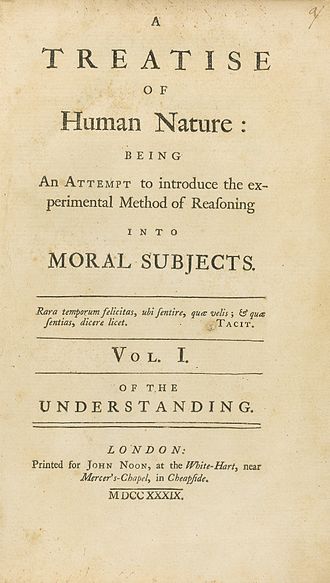
A Treatise of Human Nature
Book by David HumeWikipedia
15
MENTIONS
5
EPISODES
5
PODCASTS
Search complete. 15 mentions across 5 episodes found for "A Treatise of Human Nature".
Oct 28, 2026

A.R.HOST
Hume was interested in how we know anything at all, and he argued that all our knowledge ultimately comes from experience.
A.R.HOST
He was skeptical that pure reason could settle moral or political disagreements, and in his work A Treatise of Human Nature, he wrote the famous line that reason is, and ought only to be, the slave of the passions.
A.R.HOST
Hume wasn't throwing reason away.
A.R.HOST
He was setting firm limits on what it could do.

speaker_1NARRATOR
But his deepest impressions were probably those which he derived from France.
speaker_1NARRATOR
It was there that he composed his Treatise of Human Nature, and during his whole life his relations with France and with French authors were very intimate.
speaker_1NARRATOR
The easy, pleasure-loving temper of that light-hearted people appears always to have possessed a singular fascination for his mind.
speaker_1NARRATOR
He eulogizes them repeatedly as models of what, quote, sensible, polite, and knowing, end quote, people ought to be.
6 MINS LATER
speaker_1NARRATOR
Many suggestions of Smith's peculiar moral theories are scattered up and down the works of Hume.
speaker_1NARRATOR
With regard to Reid, it is only necessary to refer to his own express acknowledgement that it was Hume's sceptical conclusions which first of all startled him into independent inquiry.
speaker_1NARRATOR
I acknowledge, he says, that I never thought of calling in question the principles commonly received with regard to the human understanding until the Treatise of Human Nature was published in the year 1739.
speaker_1NARRATOR
The ingenious author of that treatise upon the principles of Locke, who was no sceptic, hath built a system of scepticism which leaves no ground to believe any one thing rather than its contrary.

Zach LeeHOST
But I understand that You're busy, you know, but these are important.
Zach LeeHOST
So what's considered kind of his magnum opus is his A Treatise of Human Nature.
Zach LeeHOST
By the way.
Zach LeeHOST
Yeah.
Zach LeeHOST
So A Treatise of Human Nature, which is it's a thick book.
Zach LeeHOST
It's dense and difficult at places.
Zach LeeHOST
It's probably my favorite thing that he wrote, though.

speaker_0NARRATOR
David Hume, the cool-eyed Scottish anatomist of human nature, gave the most famous answer on one side.
speaker_0NARRATOR
Reason is, and ought only to be the slave of the passions, he wrote in A Treatise of Human Nature, 1739.
speaker_0NARRATOR
It can never pretend to any other office than to serve and obey them.
speaker_0NARRATOR
Reason does not command.

speaker_0NARRATOR
David Hume, the cool-eyed Scottish anatomist of human nature, gave the most famous answer on one side.
speaker_0NARRATOR
"Reason is and ought only to be the slave of the passions," he wrote in A Treatise of Human Nature seventeen thirty-nine.
speaker_0NARRATOR
"It can never pretend to any other office than to serve and obey them." Reason does not command.
speaker_0NARRATOR
It defers.