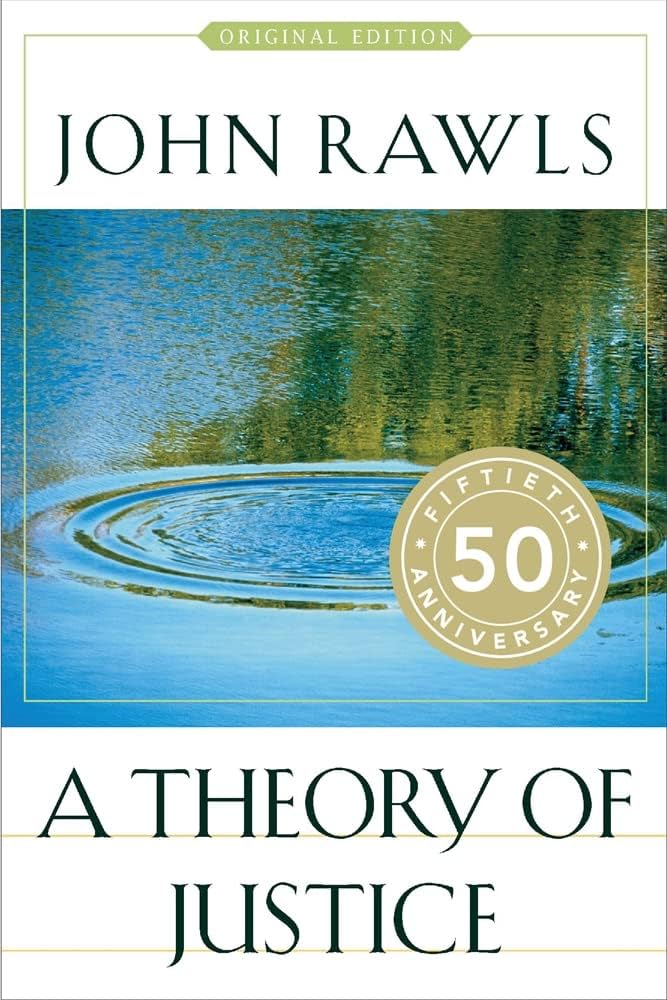
A Theory of Justice
Book by John RawlsWikipedia
12
MENTIONS
10
EPISODES
10
PODCASTS
Search complete. 12 mentions across 10 episodes found for "A Theory of Justice".
Sep 3, 2026

Blaine NeufeldtHOST
So the first claim is that justice is the first virtue of social institutions.
Blaine NeufeldtHOST
This is a famous statement from the philosopher John Rawls at the very beginning of A Theory of Justice.
Blaine NeufeldtHOST
And what this means roughly is that when evaluating or reforming social institutions, we should regard justice as having a kind of priority over other considerations.
Blaine NeufeldtHOST
Say, it's more important that institutions be just than they be efficient or promote overall happiness or some other good thing.

Blaine NeufeldtHOST
So the first claim is that justice is the first virtue of social institutions.
Blaine NeufeldtHOST
This is a famous statement from the philosopher John Rawls at the very beginning of A Theory of Justice.
Blaine NeufeldtHOST
And what this means roughly is that when evaluating or reforming social institutions, we should regard justice as having a kind of priority over other considerations.
Blaine NeufeldtHOST
Say, it's more important that institutions be just than they be efficient or promote overall happiness or some other good thing.

Blaine NeufeldtHOST
So the first claim is that justice is the first virtue of social institutions.
Blaine NeufeldtHOST
This is a famous statement from the philosopher John Rawls at the very beginning of A Theory of Justice.
Blaine NeufeldtHOST
And what this means roughly is that when evaluating or reforming social institutions, we should regard justice as having a kind of priority over other considerations.
Blaine NeufeldtHOST
Say, it's more important that institutions be just than they be efficient or promote overall happiness or some other good thing.

Blaine NeufeldtHOST
So the first claim is that justice is the first virtue of social institutions.
Blaine NeufeldtHOST
This is a famous statement from the philosopher John Rawls at the very beginning of A Theory of Justice.
Blaine NeufeldtHOST
And what this means roughly is that when evaluating or reforming social institutions, we should regard justice as having a kind of priority over other considerations.
Blaine NeufeldtHOST
Say, it's more important that institutions be just than they be efficient or promote overall happiness or some other good thing.

Blaine NeufeldtHOST
So the first claim is that justice is the first virtue of social institutions.
Blaine NeufeldtHOST
This is a famous statement from the philosopher John Rawls at the very beginning of A Theory of Justice.
Blaine NeufeldtHOST
And what this means roughly is that when evaluating or reforming social institutions, we should regard justice as having a kind of priority over other considerations.
Blaine NeufeldtHOST
Say, it's more important that institutions be just than they be efficient or promote overall happiness or some other good thing.

Patrick LucianiSOUNDBITE_SPEAKER
It's an admirable ambition and not much help.
Patrick LucianiSOUNDBITE_SPEAKER
Where Hardin ultimately lands is, in substance, John Rawls's A Theory of Justice.
Patrick LucianiSOUNDBITE_SPEAKER
Rawls argued that the distribution of natural talents, intelligence, temperament, even the capacity for self-control, is morally arbitrary.
Patrick LucianiSOUNDBITE_SPEAKER
A natural lottery, no one earns any more than they earn their parents' bank balance.

Kofi AchinaGUEST
book.
Kofi AchinaGUEST
It was one that I used as inspiration, The Theory of Justice by John Rawls.
Kofi AchinaGUEST
It's a book that he kind of, I mean, I assume but he talks about how this thing called the veil of ignorance.
Kofi AchinaGUEST
And so the most fair way to create a just society is to create a hypothetical situation in which you have no idea what position you will take within that society.

Scott HerndonGUEST
Yeah, so the reason why Project Justice's prospectus has this elimination of standpoint and perspective and this idea that human emotions and experiences are noise comes almost directly from one of the towering figures of philosophy of law, John Rawls.
Scott HerndonGUEST
So in 1971, he writes this book called A Theory of Justice.
Scott HerndonGUEST
which is this just massive and incredible book of philosophy.
Scott HerndonGUEST
A tome.
Sean O'ConnorHOST
A tome, if you will.
Scott HerndonGUEST
Yeah, and it's impossible to overstate just how influential this philosopher was.
Scott HerndonGUEST
In A Theory of Justice, Rawls posits this feature called the veil of ignorance.
Scott HerndonGUEST
And so his basic question is, how can we guarantee fair and just outcomes to every member of society? If we had to have people decide on what those principles of justice were, he thinks those people should be forced to rationalize away everything about their standpoints.

Jesse GillHOST
In the essay, Berlin distinguishes between two concepts, negative liberty and positive liberty.
Jesse GillHOST
Now, if you remember our episode on freedom back in episode 58, I talked about Eric Fromm and his book, Escape from Freedom, where he distinguishes between freedom from and freedom to.
Jesse GillHOST
Berlin's concept sounds very similar, but he's doing something a little bit different here.
Jesse GillHOST
Instead of primarily exploring what happens to individuals when they gain freedom and then struggle with it, Berlin is exploring the different ways we can understand freedom itself, particularly in political life.
19 MINS LATER
Jesse GillHOST
and then keep questioning yourself after.
Jesse GillHOST
Keep learning, keep listening, and every once in a while, keep an eye out for those damn horseshoes.
Jesse GillHOST
And if you want a possible fun thought experiment to help yourself determine closer to what you personally really think on a political level, ask yourself the question made famous by American philosopher John Rawls in his 1971 book, A Theory of Justice.
Jesse GillHOST
Using a thought experiment called the veil of ignorance, imagine you're designing society, but you don't know whether you'll be, you know, rich or poor, healthy or with some disability, born male or female, talented or untalented, born into a powerful family or an impoverished one, religious or non-religious.

Julie MericaHOST
How are we supposed to know the difference? Closed Stacks then goes on to talk about how he's reading a very complicated book.
Julie MericaHOST
It's John R.'s Theory of Justice.
Julie MericaHOST
And as he's been going through it for several months, he can safely say it's the hardest book he's ever read.
Julie MericaHOST
There are pages he's gone through several times, and he still has no idea what he's talking about.