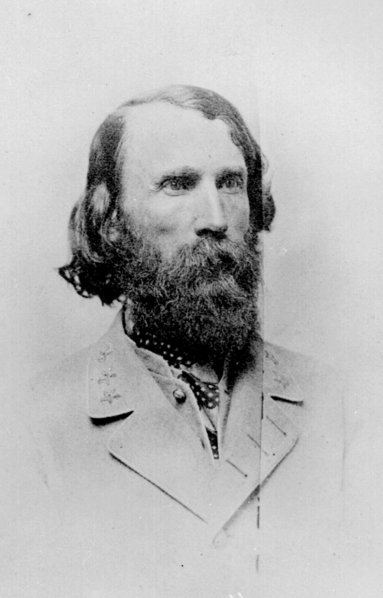
A. P. Hill
Confederate generalWikipedia
52
MENTIONS
9
EPISODES
9
PODCASTS
Search complete. 52 mentions across 9 episodes found for "A. P. Hill".
Sep 20, 2026

Will TannerHOST
By 3 p.m., Jackson had still not reached his designated attack position on Porter's rear.
Will TannerHOST
Across the Chickahominy, Major General Ambrose Powell Hill, or A.P. Hill, impetuous, aggressive, pacing the banks of Meadow Bridge in his distinctive red flannel battle shirt, could contain his impatience no longer.
Will TannerHOST
Fearing that the entire day would be lost and the plan betrayed, Hill took the initiative into his own hands without orders.
Will TannerHOST
At 3 p.m., Hill hurled his light division across the river, seized the town of Mechanicsville, and launched a furious frontal assault against Porter's entrenched positions behind Beaverdam Creek.
Will TannerHOST
His 30,000 infantrymen were arrayed in three concentric, tiered lines of breastworks rising up a steep, wooded slope, flanked by 60 heavy field guns and protected at the base by the deep, sluggish waters of Boatswain's Creek.
Will TannerHOST
Throughout the sweltering, smoke-choked afternoon, Lee hurled division after division against the Union stronghold.
Will TannerHOST
A.P. Hill's exhausted light division attacked with legendary valor, only to be repeatedly shattered and driven back with horrific slaughter.
Will TannerHOST
Longstreet's veterans moved forward on the right, pinned down under a merciless plunging fire.

Mark SmithNARRATOR
I can only say that I was, to a considerable extent, an actor in the scenes I describe, and knew the principal leaders on both sides, in consequence of my association with them at West Point, and subsequently in the regular army.
Mark SmithNARRATOR
Indeed, several of them, including Stonewall Jackson and A. P. Hill, were, prior to the war, officers in the regiment to which I belonged.
Mark SmithNARRATOR
As commander of the defenses of Washington in the spring of 1862, I was, owing to the nature of my duties, brought into intimate relations with the statesmen who controlled the government at the time, and became well acquainted with President Lincoln.
Mark SmithNARRATOR
I was present, too, after the Battle of Gettysburg, at a very interesting cabinet council, in which the pursuit of Lee was fully discussed.
1 HR 31 MINS LATER
Mark SmithNARRATOR
He was removed to the Wilderness Tavern, and as General Lee was in some fear that Averell's cavalry, then at Ellie's Ford, would make a dash and capture him, he was sent on to Guinea's Station, on the Fredericksburg and Richmond Railroad, where he died on the tenth of May.
Mark SmithNARRATOR
Whether the rebels killed him, or whether some of his wounds came from our own troops, the First Massachusetts or Seventy-Third New York, who were firing heavily in that direction, is a matter of some doubt.
Mark SmithNARRATOR
While leaning over him and expressing his sympathy, A. P. Hill was also wounded by the fire from a section of Dimmock's battery, posted in advance in the Plank Road, and the command of his corps was assigned at his request to the cavalry general, J. E.
Mark SmithNARRATOR
B. Stuart.

Mark SmithNARRATOR
I can only say that I was, to a considerable extent, an actor in the scenes I describe, and knew the principal leaders on both sides, in consequence of my association with them at West Point, and subsequently in the regular army.
Mark SmithNARRATOR
Indeed, several of them, including Stonewall Jackson and A. P. Hill, were, prior to the war, officers in the regiment to which I belonged.
Mark SmithNARRATOR
As commander of the defenses of Washington in the spring of 1862, I was, owing to the nature of my duties, brought into intimate relations with the statesmen who controlled the government at the time, and became well acquainted with President Lincoln.
Mark SmithNARRATOR
I was present, too, after the battle of Gettysburg, at a very interesting cabinet council, in which the pursuit of Lee was fully discussed, so that, in one way and another, I have had better opportunities to judge of men and measures than usually fall to the lot of others who have written on the same subject.
1 HR 17 MINS LATER
Mark SmithNARRATOR
He was removed to the Wilderness Tavern, and as General Lee was in some fear that Averell's cavalry, then at Ellie's Ford, would make a dash and capture him, he was sent on to Guinea's Station, on the Fredericksburg and Richmond Railroad, where he died on the 10th of May.
Mark SmithNARRATOR
Whether the rebels killed him, or whether some of his wounds came from our own troops, the 1st Massachusetts or 73rd New York, who were firing heavily in that direction, is a matter of some doubt.
Mark SmithNARRATOR
While leaning over him and expressing his sympathy, A. P. Hill was also wounded by the fire from a section of Dimmock's battery, posted in advance in the Plank Road, and the command of his corps was assigned at his request to the cavalry general, J. E.
Mark SmithNARRATOR
B. Stewart.

speaker_4NARRATOR
Disaster seemed at hand for Leeds' decimated force.
speaker_4NARRATOR
A.P. Hill turns the tide.
speaker_4NARRATOR
but now came a great moment in confederate military annals a p hill's notable light division having hurriedly crossed the potomac three miles away was driving hard toward the jubilant federals charging on sharpsburg some of hill's artillery had already arrived from harper's ferry with the cheering news that hill's brigade of infantry were close by at lee's urgent order hill had left harper's ferry early sensing the critical role they would play urged on at sword point by their grim commander hill's veterans had covered the seventeen miles from harper's ferry to the potomac in seven hours hundreds of men had fallen out unable to keep the pace now across the river the stalwart survivors pounded on toward the sound of the guns suddenly the head of hill's column appeared on the road to the south hill rode up to lee's headquarters at the oak grove then quickly to d r jones whose exhausted troops formed the last defense line in front of sharpsburg Hill's five brigades now rushed toward the Federal flank.
speaker_4NARRATOR
Confusion gripped Burnside's men as this unexpected onslaught plowed into their lines.
25 MINS LATER
speaker_4NARRATOR
At 1 p.m., the Federals finally crossed the bridge, now known as the Burnside Bridge, and after a two-hour delay to reform their lines, advanced up the slope beyond.
speaker_4NARRATOR
By late afternoon, they had driven the Georgians back almost to Sharpsburg, threatening to cut off the line of retreat for Lee's decimated Confederates.
speaker_4NARRATOR
Then, about 4 p.m., General A.P. Hill's division left behind by jackson at harper's ferry to salvage the captured federal property arrived on the field and immediately entered the fight burnside's troops were driven back to the heights near the bridge they had taken earlier the battle of antietam was over the next day lee began withdrawing his army across the potomac river more men were killed or wounded at antietam on september seventeenth eighteen sixty two than on any other single day of the civil war federal losses were twelve thousand four hundred and ten confederate losses ten thousand seven hundred although neither side gained a decisive victory lee's failure to carry the war effort effectively into the north caused great britain to postpone recognition of the confederate government the battle also gave president abraham lincoln the opportunity to issue the emancipation proclamation which on january one eighteen sixty three declared free all slaves in states still in rebellion against the united states now the war had a dual purpose to preserve the union and end slavery end of supplementary text end of a part four end of antietam national battlefield maryland by frederick
Lady LuckADVERTISER
Hey, everybody.

Andrew LangerGUEST
I'm a traditionalist.
Andrew LangerGUEST
So, you know, sending Fort Liberty back to being Fort Bragg, all in favor of AP Hill in Virginia, a couple of other forts in Virginia, that would be that would be great.
Andrew LangerGUEST
I have no problem with that.
Andrew LangerGUEST
And I had no problem with changing the Gulf of Mexico to the Gulf of America.

David WalesNARRATOR
Lee had suffered an irreparable loss at Chancellorsville when Stonewall Jackson was mortally wounded.
David WalesNARRATOR
Now reorganized into three infantry corps under Longstreet, A.P. Hill, and R.S. Ewell, and a cavalry division under J.E.B. Stuart, a changed Army of Northern Virginia faced the great test that lay ahead.
David WalesNARRATOR
Stonewall Jackson, the right hand of Lee, and in the words of the latter, the finest executive officer the sun ever shone on, was no longer present to lead his corps in battle.
David WalesNARRATOR
The long lines of gray started moving on June 3 from Fredericksburg, Virginia, first northwestward across the Blue Ridge and then northward in the Shenandoah Valley.
David WalesNARRATOR
Neither Lee nor Meade yet foresaw Gettysburg as a field of battle.
David WalesNARRATOR
Each expected to take a strong defensive position and force his adversary to attack.
David WalesNARRATOR
A.P. Hill, in the absence of Lee, who was still beyond the mountains, now took the initiative.
David WalesNARRATOR
At daybreak of July 1, he ordered the brigade of Archer and Davis of Heath's division to advance along the Chambersburg Road to Gettysburg for the purpose of testing the strength of the Union forces.

David WalesNARRATOR
On September 9, he issued Special Order 191.
David WalesNARRATOR
Briefly, it directed Major General James Longstreet and Major General D.H. Hill to proceed across South Mountain toward Boonsboro and Hagerstown.
David WalesNARRATOR
Three columns cooperating under Major General Thomas J. Stonewall Jackson were ordered to converge on Harper's Ferry from the northwest, northeast, and east.
David WalesNARRATOR
En route, the column under Jackson's immediate command was to swing westward and catch any federals remaining at Martinsburg.
David WalesNARRATOR
Major General J.E.B. Stuart's cavalry was to screen these movements from McClellan by remaining east of South Mountain.
David WalesNARRATOR
At this point, a fateful event occurred, one which was destined to change the subsequent course of the campaign.
David WalesNARRATOR
D.H. Hill, Jackson's brother-in-law, had until this time been under Jackson's command.
David WalesNARRATOR
Unaware that a copy of Lee's order had already been sent to Hill, Jackson now prepared an extra copy for that officer.

David WalesNARRATOR
After that, he added, "I can turn my attention to Philadelphia, Baltimore, or Washington, as may seem best for our interest." Lee had suffered an irreparable loss at Chancellorsville when Stonewall Jackson was mortally wounded.
David WalesNARRATOR
Now reorganized into three infantry corps under Longstreet, A. P. Hill, and R. S. Ewell, and a cavalry division under J. E.
David WalesNARRATOR
B. Stuart, a changed army of Northern Virginia faced the great test that lay ahead.
David WalesNARRATOR
Stonewall Jackson, the right hand of Lee, and in the words of the latter, the finest executive officer the sun ever shone on, was no longer present to lead his corps in battle.
5 MINS LATER
David WalesNARRATOR
Neither Lee nor Meade yet foresaw Gettysburg as a field of battle.
David WalesNARRATOR
Each expected to take a strong defensive position and force his adversary to attack.
David WalesNARRATOR
A. P. Hill, in the absence of Lee, who was still beyond the mountains, now took the initiative.
David WalesNARRATOR
At daybreak of July 1, he ordered the brigade of Archer and Davis of Heath's division to advance along the Chambersburg Road to Gettysburg for the purpose of testing the strength of the Union forces.

David WalesNARRATOR
Disaster seemed at hand for Leeds' decimated force.
David WalesNARRATOR
A.P. Hill turns the tide.
David WalesNARRATOR
but now came a great moment in confederate military annals a p hill's notable light division having hurriedly crossed the potomac three miles away was driving hard toward the jubilant federals charging on sharpsburg some of hill's artillery had already arrived from harper's ferry with the cheering news that hill's brigade of infantry were close by at lee's urgent order hill had left harper's ferry early sensing the critical role they would play urged on at sword point by their grim commander hill's veterans had covered the seventeen miles from harper's ferry to the potomac in seven hours hundreds of men had fallen out unable to keep the pace now across the river the stalwart survivors pounded on toward the sound of the guns suddenly the head of hill's column appeared on the road to the south hill rode up to lee's headquarters at the oak grove then quickly to D.R. Jones, whose exhausted troops formed the last defense line in front of Sharpsburg.
David WalesNARRATOR
Hill's five brigades now rushed toward the Federal flank.