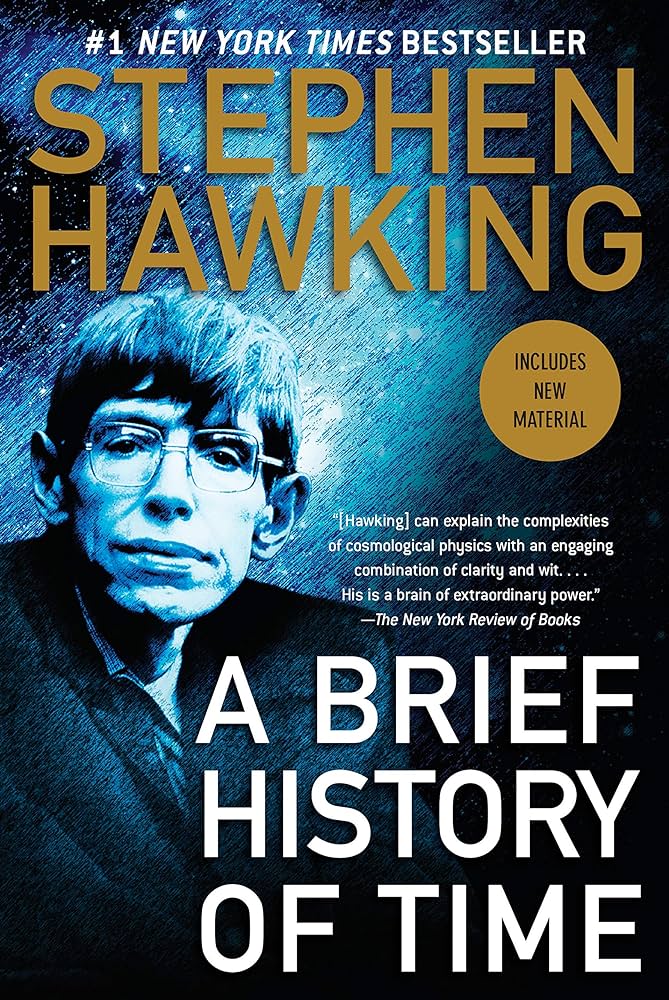
A Brief History of Time
Book by Stephen HawkingWikipedia
36
MENTIONS
12
EPISODES
11
PODCASTS
Search complete. 36 mentions across 12 episodes found for "A Brief History of Time".
Oct 28, 2026

Steve LovelaceHOST
And I'm worried now that, you know, I go have surgery and now I'm one handed.
Steve LovelaceHOST
I can, I can get around with my forearm crutches with one, but I'm not as fast, um, nor am I as stable, but yeah, just those small little things that make you appreciate what, uh, like Seeing a Stephen Hawking, for instance, in his chair that, you know, had to basically, he couldn't talk, he couldn't communicate, but the guy wrote a book, The History of Time, I think it was, back in the 90s or the 80s.
Steve LovelaceHOST
And just because your body doesn't work does not mean your mind won't.
Steve LovelaceHOST
And you can kind of progress beyond that level and get to a point where You know what, you just accommodate what you can do and then you excel at that just by putting an effort into it.

Brian KeatingHOST
Because he'd always change his mind, and so he'd be right as often as he'd be right.
Brian KeatingHOST
But yeah, speaking of Hawking, as he mentioned in A Brief History of Time, which you'd think would address this question, he introduces several things like M-theory and string theory as if they're proven.
Brian KeatingHOST
And he does motivate the no boundary hypothesis as if it's sort of accepted.
Brian KeatingHOST
And even inflation, you know, at that time in 1989, something wasn't accepted.

Graham FarmeloGUEST
But when he moved into the public sphere, and I think...
Graham FarmeloGUEST
I think a reasonable date to give for that is 1988, because that was when A Brief History of Time was published.
Graham FarmeloGUEST
Now, he had done stuff before then.
Graham FarmeloGUEST
You know, he'd been a very good guest at a British Association annual meeting at Liverpool, for example.
Graham FarmeloGUEST
And also, when he was a bit older, that he might be a politician.
Graham FarmeloGUEST
She really thought this because he was actually interested in those things.
Graham FarmeloGUEST
But but when he when he really became a global celebrity pretty quickly after the publication of A Brief History of Time, then you see someone who is more than happy to give interviews.
Graham FarmeloGUEST
And he really enjoyed the limelight, you know, and apart from press intrusion into his private life, which he detested, he was a very obliging interviewee.

Mark KayeHOST
You know what? I almost got a little.
Mark KayeHOST
It was very close to who's the guy that wrote Brief History of Time? Stephen Hawking.
Mark KayeHOST
My RFK Jr. almost was like my Stephen Hawking.
Mark KayeHOST
That's my Stephen Hawking.
speaker_1ADVERTISER
A Brief History of Time.
Mark KayeHOST
But I got really close to that with RFK.
Mark KayeHOST
RFK Jr. is more like this.

Michael GuillénGUEST
It's just something even to this day I enjoy.
Michael GuillénGUEST
Whether I'm writing a book or making a movie or, as I say, doing a TV or a podcast, I'm just teaching.
Michael GuillénGUEST
I share what I've learned with people.
Michael GuillénGUEST
I don't lecture.
Michael GuillénGUEST
okay those are all cool stuff and we i mean how much time do we have we have enough we have enough it does that would be like a whole
JakeHOST
semester at harvard what are some of the things that you've seen from his work that have like made you go like that have affected you well we were going to get into that today okay
Michael GuillénGUEST
yeah yeah oh that's great i'm looking i'm looking forward to it i mean this book
Taylor WelchHOST
yeah i've read most of this book but i read it without it was a couple years ago when i read it um believing a scene this is five years old

EmHOST
He reasoned that exposure to warped space-time at scales beyond normal human perception would psychologically shatter people.
EmHOST
His other influences included the works of H.P. Lovecraft, Robert Wise's The Haunting from 1963, Kubrick's 2001 A Space Odyssey, Ridley Scott's Alien, the tabletop game Warhammer 40,000 and Stephen Hawking's book A Brief History of Time.
EmHOST
Eisner first pitched the concept verbally to producers Lawrence Gordon and Lloyd Levin of Largo Entertainment, describing it as a haunted house story in space.
EmHOST
Gordon responded favourably and encouraged him to develop a full screenplay.

Arvin AshHOST
In fact, they emit faint radiation consisting of photons and potentially neutrinos and other particles.
Arvin AshHOST
But what if I told you that even Hawking's own book didn't accurately describe what's really going on? There's one crucial aspect of this theory that has become a bit too simplified in popular descriptions, specifically the idea that Hawking radiation comes from the spontaneous creation of virtual particle-antiparticle pairs near the event horizon of a black hole.
Arvin AshHOST
While this explanation is catchy and relatively easy to visualize, it turns out to be wrong.
Arvin AshHOST
or at least an egregious oversimplification of the actual quantum processes.
Arvin AshHOST
Near the event horizon of a black hole, this quantum fluctuation is no different.
Arvin AshHOST
It happens there too.
Arvin AshHOST
And this is what Hawking used to explain Hawking radiation in his popular 1988 book, A Brief History of Time.
Arvin AshHOST
He explained it like this, when a pair of virtual particles forms at the very edge of the event horizon of a black hole, before they can annihilate each other, one of them falls into the black hole while the other escapes.

Paul DaviesGUEST
Uh, but, uh, I think there's a, an appetite among the general public, uh, for, uh, books which are, uh, quick and easy to read.
Paul DaviesGUEST
And the trend was set by my old friend Stephen Hawking with his Brief History of Time.
Paul DaviesGUEST
People thought, "Well, this stuff, uh, I read about it in the papers.
Paul DaviesGUEST
I'm not sure I understand it, but here is a, a brief description of it." And of course it was a tremendous success.

Stefan MolyneuxHOST
And, uh, women who say silly things, I mean, they're just looking for you to, you know, reasonably and, and in a sort of friendly and humorous fashion just call them out and so on.
Stefan MolyneuxHOST
Like I remem- [laughs] I remember when I was dating a woman in my 20s, the big book at the time was, it was called "The Brief History of Time" by Stephen Hawking, and I saw it in her bookshelf.
Stefan MolyneuxHOST
I'm like, "Wow." And she's like, "Yeah, I love that book." And I pulled it out, and the spine was completely flat.
Stefan MolyneuxHOST
And I said, "You really, you love this book? Have you been able to read it without opening it? 'Cause this spine has never been cracked." [chuckles] And I was just...

Andrew C. ScottHOST
A- and tell me a little bit about how that came about and-
David WilkinsonGUEST
Well, Professor Hawking, of course, uh, with A Brief History of Time, sold 10 million copies worldwide.
David WilkinsonGUEST
It was a phenomenon at the time.
David WilkinsonGUEST
And I remember being at a, a research scientist Christian fellowship, um, and talking with Sir Robert Boyd about this, who I mentioned earlier.
2 more episodes mention A Brief History of Time.
Create an account to see the whole feed, search across every transcript, and follow the entities you care about.