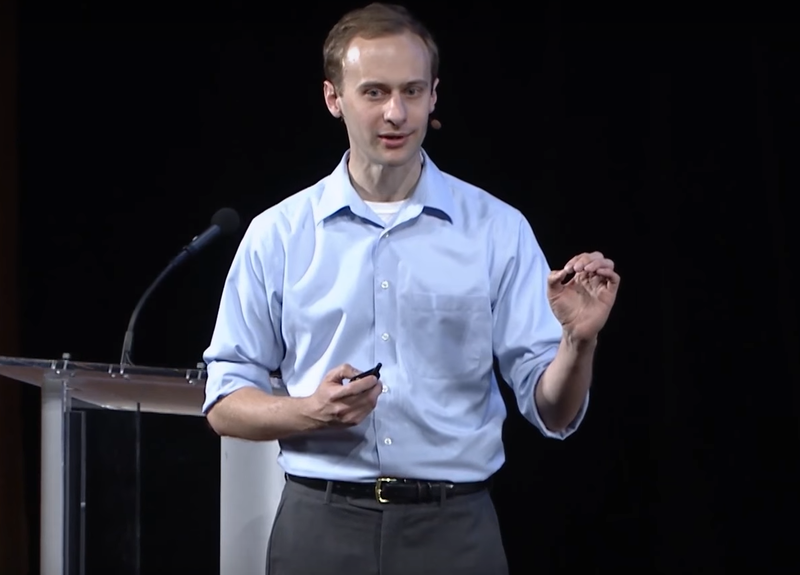
Kevin M. Esvelt
American biologist
5
APPEARANCES
5
PODCASTS
Sep 25, 2026


Scott CarneyHOST
Now what, what can you tell me about this particular experiment, and more importantly, what are the implications of this experiment for the, you know, biosecurity world?

Kevin EsveltGUEST
So first, huge kudos to the scientists who did it because it was a big accomplishment.
Scott CarneyHOST
Um, and, and it doesn't seem that we're so far away from someone being like, "You know, let's just go wipe us all out again." Walk me through exactly what you told Congress, and h- then in the year or two years that they've had, how, how have they totally fixed this problem?

ShaneHOST
Are we just lucky or are these things really difficult to engineer?
Kevin EsveltGUEST
My answer is of publicly known agents today, Setting aside like traditional bioweapons, the anthrax and so forth, which requires a lot of technical knowledge to produce, to purify and to deliver.
Kevin EsveltGUEST
What you're, I think, really talking about is why haven't we seen a deliberate pandemic today? And I think the answer to that one is when it comes to credible will cause a pandemic agents available out there that we know that is just broadly understood, this will cause a pandemic.
1 HR 50 MINS LATER
ShaneHOST
Nope, not a skin cancer


Kevin EsveltGUEST
... 'cause they trained it on 15,000 viruses that normally infect this kind of bacteria.
Kevin EsveltGUEST
So it's more like imagining if you had trained it on all of the COVID variants, then the AI would spit out new COVID variants, and some of those would spread.
Kevin EsveltGUEST
And thankfully, right now, due to new government policy, you cannot get funding to run that experiment to actually make the predicted human viruses in the lab.


Kevin EsveltGUEST
I think a key job for us is looking ahead at where technology as a whole is taking us, and I don't just mean AI.
Kevin EsveltGUEST
It's the meta technology that can accelerate all of the others, especially cross-domain advances.
Kevin EsveltGUEST
And it may well be that AI can be the equivalent of a... child safety seat and eventually seat belts.
Kevin EsveltGUEST
And I don't know about you, but even when I get in a Waymo, I still wear a seat belt.
12 MINS LATER

Kevin EsveltGUEST
Which means it's hard for these communities to say, "Actually, thanks, but no thanks." And most people in malaria-afflicted communities, I mean, you can imagine more than half a million children dead every single year, and you can just keep going back and back and back, and that just kept happening.
Kevin EsveltGUEST
The question is, do they trust this as a thing that can stop it, and do they trust the people proposing to do this to actually keep their word and tell them the truth?
11 MINS LATER
Kevin EsveltGUEST
I envision a world that is kinder and more elegant, one where instead of spraying our fields with insecticides to kill the insects so they don't eat our crops, we instead engineer them to not like the taste, and otherwise go about their normal ecological role.
Kevin EsveltGUEST
Where we can create new diversity, new forms of life, to solve problems that we're experiencing or that other organisms are experiencing.